
How interest rate changes affect private real estate lending
How rising and falling interest rates flow through to private real estate loans: lender pricing, borrower exits, property values, capital partner yields and what to watch.
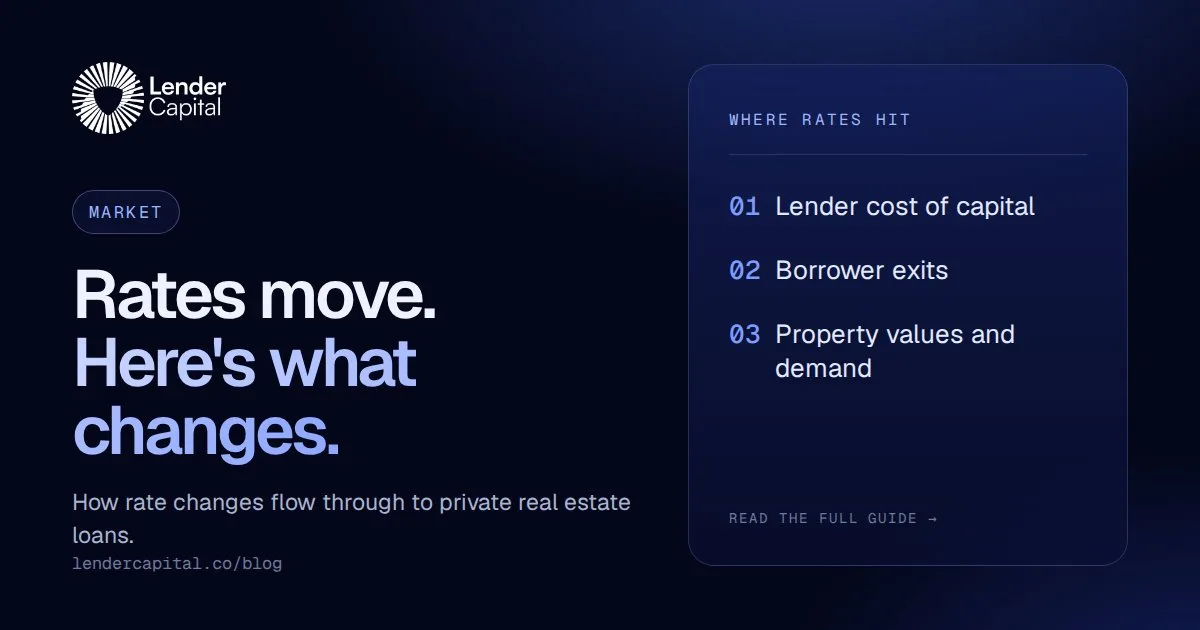
Interest rate changes affect private real estate lending in four main ways: they change what lenders' capital costs, what rates borrowers are charged, how easily borrowers can exit their loans by refinancing or selling, and what properties are worth. Private loans are short term, so new loans reprice quickly when rates move. The bigger effects often show up in exits: a bridge loan made when rates were lower may be harder to refinance when they rise.
This guide explains how the pieces connect, without predicting where rates go next. For lenders, it covers pricing and risk. For capital partners, it covers what a changing rate environment means for the loans they fund.
How rates reach a private loan
Private real estate loans are not usually tied directly to a benchmark the way many bank loans are, but they are still connected to the broader rate environment through several channels:
- Cost of capital. Many private lenders use credit lines priced over a benchmark rate. When benchmark rates rise, their borrowing costs rise. Capital partners also compare private loans with other investments; when safer alternatives pay more, they expect more from private loans too.
- Borrower refinancing. Many bridge and fix-and-flip loans are repaid by refinancing into longer-term debt. That refinancing is priced off the broader market.
- Buyer demand. Many projects are repaid by selling the property. Higher mortgage rates can reduce what buyers can afford to pay.
- Property values. Investors value income properties partly by comparing their income with rates available elsewhere. Higher rates can put downward pressure on values, all else equal.
The Federal Reserve explains how it sets monetary policy and how that affects broader interest rates; see the Federal Reserve.
When rates rise
| Area | Typical effect | What lenders and capital partners watch |
|---|---|---|
| New loan pricing | Rates and sometimes points rise on new loans | Whether pricing still clears the lender's cost of capital and the capital partner's target |
| Refinance exits | Permanent debt costs more; less cash-out available | Whether stabilized properties will still qualify. See DSCR loans |
| Sale exits | Buyers can afford less; sales may take longer | Realistic after-repair values and holding periods |
| Values | Pressure on values for income properties | Leverage cushions; appraisals using recent comparable sales |
| Extensions | More borrowers ask for more time | Clear extension terms. See extension requests |
| Lender liquidity | Credit lines cost more; some capital becomes more selective | Diversified funding sources |
The exit squeeze
Bridge loans are underwritten on an exit. If rates rise during the loan, the exit can tighten even when the borrower executes the business plan perfectly.
Hypothetical example, for illustration only. A borrower takes a 12-month bridge loan to renovate a small rental building, planning to refinance into a long-term loan that requires a minimum debt service coverage ratio. At underwriting, the expected refinance payment gave comfortable coverage. By maturity, long-term rates have risen, the payment on the same refinance amount is higher, and coverage falls below the minimum. The borrower can still refinance, but only for a smaller amount, and needs to bring cash to repay the bridge loan in full.
A lender that tested the exit at higher refinance rates at origination would have seen this risk and could have adjusted leverage. See bridge loan exit strategies.
When rates fall
Falling rates generally ease the pressures above:
- Exits get easier. Refinancing costs less and buyers can afford more.
- Prepayments increase. Borrowers repay faster, so capital partners get their money back sooner and must redeploy it, possibly at lower rates. Minimum interest or exit fees can matter more in this environment.
- Competition for loans increases. More capital chasing deals can push pricing down and underwriting standards loose. Discipline matters most when money is easy.
What lenders can control
You can't control rates, but you can control how exposed your loans are to them:
- Stress the exit. Test refinance exits at rates meaningfully higher than today's, and sale exits at lower prices and longer timelines.
- Leave room in leverage. Lower loan-to-value gives the borrower room to refinance even if values or proceeds fall. See LTV vs. LTC vs. ARV.
- Match term to the plan. A term that's too short for the work invites extension requests when markets slow.
- Set extension terms upfront. Clear conditions and fees for extensions make decisions easier later.
- Price for your cost of capital. If you rely on a credit line, know how your spread changes when the benchmark moves. See how private lenders price a loan.
- Diversify funding. Capital partners who buy whole loans give you capacity that doesn't depend on a single credit line. See how private lenders fund more loans.
What capital partners should consider
For capital partners funding private real estate loans:
- Short duration helps. Because loans typically run for months, a portfolio of private loans can reprice relatively quickly as old loans pay off and new ones are funded.
- Fixed-rate loans don't adjust. Most private bridge loans carry a fixed rate. A loan funded before rates rose keeps its original rate until payoff.
- Exit risk is the main rate risk. Look at how the lender tested the exit and how much equity the borrower has. See due diligence for your first loan.
- Watch extension activity. Rising extension requests across a lender's loans can signal exit pressure.
- Keep a buy box, and revisit it. Adjust leverage limits, loan types and minimum yields as conditions change. See building a buy box.
All lending involves risk. Capital partners can target returns, but changes in rates, values and borrower performance can affect outcomes.
Key takeaways
- Rates reach private loans through the cost of capital, borrower exits, buyer demand and property values.
- New private loans reprice quickly; the bigger risk is exits on loans made before rates moved.
- Rising rates tighten refinance and sale exits; falling rates speed prepayments and increase competition.
- Stress-test exits, leave room in leverage and set clear extension terms.
Frequently asked questions
Do private lenders raise rates when the Fed raises rates?
Not automatically, since most private loans aren't tied to a benchmark. But higher benchmark rates usually raise lenders' borrowing costs and capital partners' return expectations, so pricing on new private loans tends to move in the same direction over time.
How do higher interest rates affect bridge loans?
They mainly affect the exit. A borrower planning to refinance may qualify for less, and a borrower planning to sell may get a lower price or take longer, which can lead to extension requests or require more equity at payoff.
Are private real estate loans a hedge against rising rates?
Their short terms mean they reprice faster than long-term fixed-rate debt, but each loan's rate is usually fixed until payoff, and rising rates can strain borrower exits. They carry their own risks and are not a guaranteed hedge.
How Lender Capital fits
Lender Capital connects private lenders with capital partners who fund whole, first-lien, business-purpose real estate loans. Lenders gain capacity that doesn't depend on a single credit line, and capital partners see the full file, including the exit plan, before they commit.
Have a loan you can’t fund?
Lender Capital places whole, first-lien loans with capital partners who fund the entire loan. You pay only when it funds.

