
Warehouse line of credit alternativefor private lenders.
A warehouse line lends you part of each loan, with covenants, personal guarantees and margin calls, and you keep the risk. With Lender Capital you submit a first-lien, business-purpose loan and one capital partner funds the whole loan at closing. Nothing is borrowed on your balance sheet, and you pay a placement fee only when a loan funds.
- No covenants or guarantees on a line
- Whole-loan funding at closing
- Pay only when a loan funds
LOAN FILE · LC-0142
ExampleHarbor Street Mixed-Use
Submitted by a vetted private lender
- Loan type
- Bridge · 1st lien
- Collateral
- Mixed-use, 4 units
- Loan amount
- $1,850,000
- Loan-to-value
- 65%
- Term
- 12 months
Submitted
Reviewed
Matched
Funded
Loan file received
Appraisal, title, borrower and terms
Fund more loans,without a warehouse line.
No covenants or net-worth tests
You don’t borrow anything, so there are no financial covenants, liquidity minimums or tangible net worth tests to maintain. We review your track record, underwriting and licensing once, when you apply.
Capital placed deal by deal
Each loan you submit goes only to the capital partners whose criteria it fits. One partner reviews the full file and funds the whole loan at closing.
No raising money for every loan
Stop calling investors one by one to close each deal. Submit the loan once; capital partners who already told us what they fund see it.
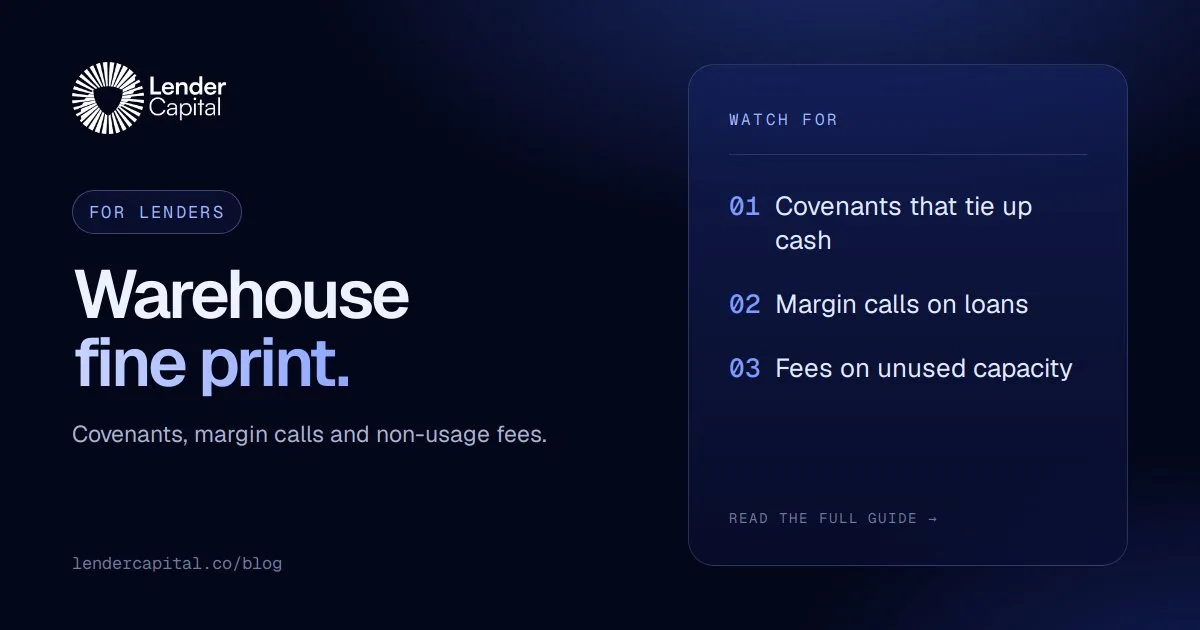
No non-usage fees or margin calls
No subscription and no upfront fee. You pay a placement fee at closing, from the origination points, only when a loan funds. Placed loans aren’t pledged on a line, so there is nothing to mark down or pay back.
Keep your points and earn a spread
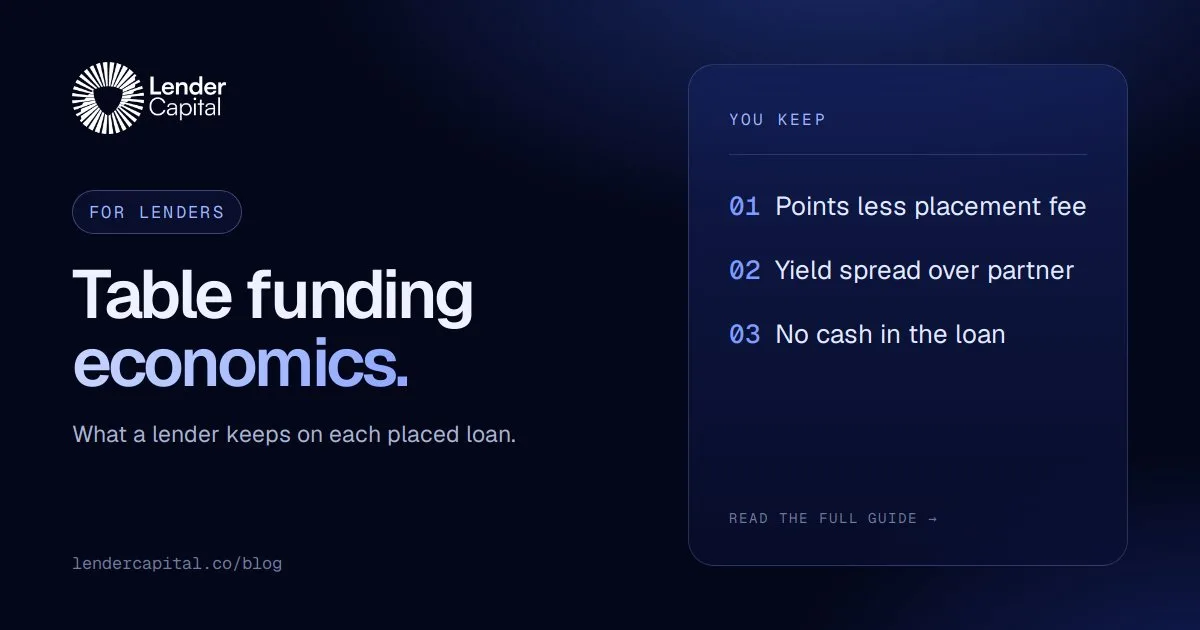
You set the borrower’s note rate. The capital partner receives its agreed rate, and the difference is your yield spread, on top of your origination points (less the placement fee).
No haircut, none of your cash in the loan
The capital partner funds the whole loan at closing, so your own capital stays free for the loans you want to keep.
Keep your borrower
You originate in your name, stay the borrower’s point of contact and keep servicing the loan, so the next deal comes back to you.
Room to grow volume
Your balance sheet stops deciding which deals you close. When your own capital is tied up, send the loan to us instead of turning the borrower away.
Built for lenders a warehouse line doesn’t fit.
Lender Capital fits if
- You can’t qualify for a warehouse line yet (net worth, liquidity or track record)
- You have a line but keep hitting its size, eligibility or concentration limits
- You don’t want personal guarantees, margin calls or leverage on your balance sheet
- You raise money investor by investor and it slows your closings
- You originate first-lien, business-purpose bridge, fix and flip, construction or DSCR loans
Not a fit for
- Consumer or owner-occupied loans
- Second liens or other junior positions
- Lenders who want to hold every loan on their own balance sheet and keep all of its interest (a line may suit you better)
Submit the loan. A capital partner funds all of it.
Lender Capital is a capital placement platform, not a lender or a fund. Every loan is funded whole by one capital partner.
- 01
Apply once
We review your lending business: track record, underwriting and the licenses your states require.
- 02
Submit a loan
A first-lien, business-purpose loan with the full file: appraisal, borrower, title and terms.
- 03
We match it
We send it only to capital partners whose criteria it fits. They see the full file before committing.
- 04
It’s funded at closing
One capital partner funds the whole loan and it is assigned to them at closing. You keep the borrower and service the loan.
Keep your points. Earn the spread.
You set the borrower’s note rate. The capital partner receives its agreed rate, and the difference is yours, on top of your origination points. The partner earns most of the interest, so price each loan with enough margin above its rate.
Hypothetical example, round numbers
A $500,000 bridge loan
| Borrower’s note rate (you set it) | 12% |
|---|---|
| Capital partner’s agreed return | 10% |
| Your yield spread | 2% a year, about $10,000 |
| Your origination points | 2 points, $10,000 at closing |
| Placement fee (1.00%), from the points | $5,000 at closing |
| Points you keep | $5,000 |
| Your capital in the loan | None |
Illustration only. The note rate, points and partner return are hypothetical; each capital partner sets its own return. The placement fee is Lender Capital’s published fee: 1.00% of the loan amount up to $3,000,000 and 0.75% of the whole loan above that (0.75% and 0.50% for preferred lenders), $2,500 minimum, paid at closing from the origination points, only when the loan funds.
Compared with a warehouse line
With a line you keep all of the interest above the line’s cost, which can be more per loan. In exchange you fund the haircut, pay the line’s interest and fees, sign the covenants and guarantees, and keep the credit risk. With placement you earn your points and a spread with none of your capital in the loan, so the same equity can support far more closings.
Key takeaways
- A warehouse line lends you part of each loan; you fund the rest (the haircut) and keep the credit risk.
- Lines come with covenants: net worth, liquidity and profitability tests, eligibility rules, aging limits and usually personal guarantees.
- Many emerging lenders don’t qualify yet, and growing lenders often hit the line’s size, eligibility or concentration limits.
- Direct capital placement is the alternative: a capital partner funds the whole first-lien loan at closing, with nothing borrowed on your balance sheet.
- You keep your points and earn a yield spread: price the note above the capital partner’s rate and the difference is yours.
- You pay Lender Capital only when a loan funds, from the origination points. You keep the borrower and service the loan.
What is a warehouse line of credit?
A warehouse line of credit is a revolving credit facility that finances loans while a lender holds them. The lender closes a loan, pledges it to the warehouse provider, and draws an amount equal to the loan balance minus a haircut. When the loan pays off or is sold, the line is repaid and the capacity can be used again. Federal Reserve researchers describe the same structure in residential mortgage banking, where the warehouse lender holds the note as collateral and the draw is “valued at the loan balance minus a haircut” (Federal Reserve Board, 2018).
For private and hard money lenders the mechanics are the same, with one difference: mortgage companies usually sell loans within weeks, while private lenders often hold bridge and construction loans to maturity. That makes the line’s dwell-time limits, eligibility rules and renewal terms matter more. For the full mechanics, read what warehouse lending is and how a warehouse line of credit works for private lenders.
What is a warehouse credit facility?
A warehouse credit facility is the formal name for a warehouse line: a revolving loan agreement in which a bank or credit fund advances a percentage of each loan you originate, holds the loan as collateral, and is repaid when the loan pays off or is sold. Some facilities are written as repurchase agreements rather than loans, but the economics are the same.
Mortgage warehouse lending vs. private-lender warehouse lines
Mortgage warehouse lending finances consumer home loans for the few weeks between closing and sale to an investor, so the line is repaid quickly and advance rates are high: Federal Reserve researchers describe lines funding around 95% of each agency mortgage (Federal Reserve Board, 2018). Private-lender warehouse lines finance business-purpose bridge, fix and flip and construction loans that are often held for months or to maturity, so warehouse funding for them is harder to find, with stricter eligibility, dwell-time limits that must fit longer holds, and advance rates that vary by provider. Some bank warehouse financing programs exclude these loans entirely (Simmons Bank).
Warehouse line of credit for private lenders and hard money lenders
A warehouse line of credit for hard money lenders works like any warehouse line, but fewer providers offer one, because bridge, fix and flip and construction loans are short, held to maturity and harder to value than agency mortgages. Some bank programs exclude them outright; for example, one bank’s published warehouse program lists bridge and construction loans as ineligible and requires personal guarantees (Simmons Bank). Private lenders who do qualify usually find lines through regional banks or non-bank credit funds; see bank vs. non-bank warehouse lenders.
How do you get a warehouse line of credit?
To get a warehouse line of credit, you prepare reviewed or audited financials, document your origination and loss history, write down your credit policy, and approach banks and non-bank warehouse lenders with that package. Expect a term sheet, diligence on your company and loan files, legal documents, covenants and usually personal guarantees before the first draw. The full steps are in warehouse line requirements for private lenders.
Who are warehouse lines built for?
Warehouse lines suit established lenders with a strong balance sheet, years of performance data and a steady volume of loans that fit one set of criteria, and who want to hold their loans and keep all of the interest above the line’s cost. If that is you, a line can be the cheapest capital you can get, and it can sit alongside other funding sources.
Who don’t warehouse lines work for?
They tend not to work, or stop working, for lenders who:
- are new or growing and can’t yet meet net worth, liquidity or track-record requirements;
- don’t want to sign personal guarantees or carry recourse debt;
- originate loans outside the line’s eligibility box, size limits or concentration sublimits;
- have their own capital tied up in haircuts and can’t fund the next loan’s equity;
- hold loans longer than the line’s aging limits allow;
- would rather not risk margin calls if a pledged loan is marked down or goes delinquent.
If any of these sound familiar, see funding options when you can’t qualify for a warehouse line.
What do warehouse providers require?
Terms vary widely by provider, loan type and your profile, so treat this as a checklist of what to ask about, not a quote. The Federal Reserve paper cited below documents these features for mortgage warehouse lines: haircuts and advance rates, mark-to-market margin calls, aging limits, covenants that let the provider reprice or cancel the line, personal guarantees, and 364-day facilities that are “standard in this industry.”
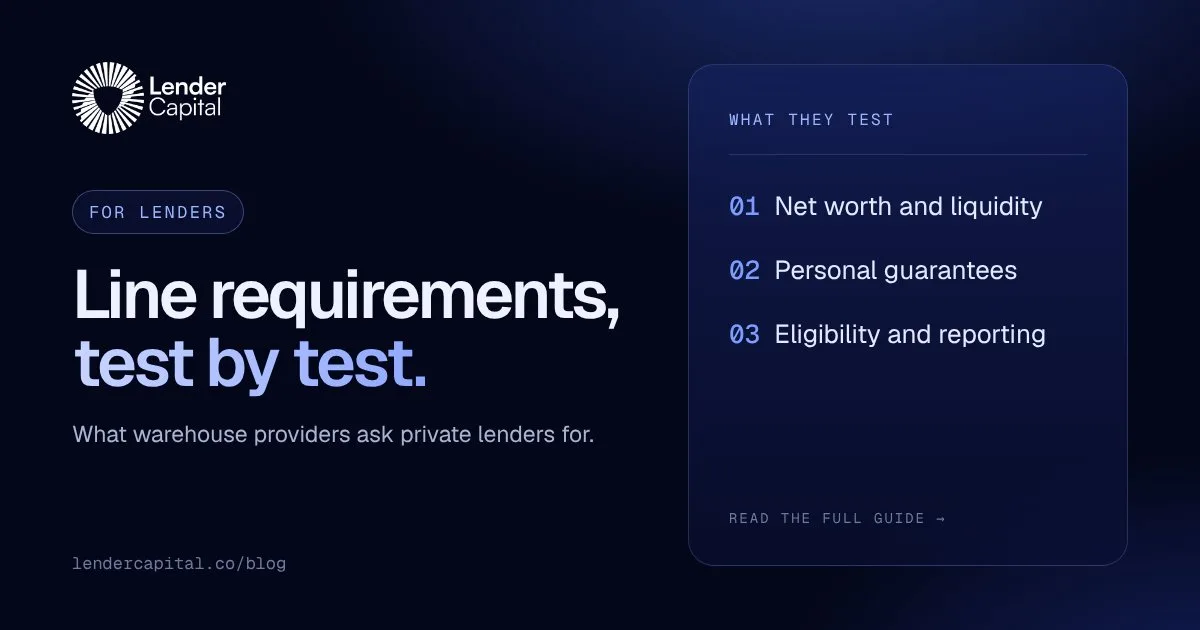
Net worth and tangible net worth
Minimum equity levels you must maintain, tested regularly. Federal Reserve researchers cite large mortgage companies’ lines with minimums of $500 million and more; private lender lines are far smaller, but the test works the same way.
Liquidity
A minimum amount of unrestricted cash, so you can meet margin calls and fund your share of each loan.
Track record and financials
Years of origination and loss history, and financial statements, often audited.
Advance rate and haircut
The line advances a percentage of each loan’s balance; you fund the difference from your own capital. Rates vary by provider, loan type and your profile.
Eligibility and concentration limits
Only loans that fit the line’s criteria (type, size, leverage, geography, borrower) can be financed, often with sublimits per category.
Dwell time (aging) limits
A loan can stay on the line only so long. Past that, the advance can step down or the loan must come off.
Recourse and guarantees
The lending company is liable for the line, and providers commonly require personal guarantees from the owners.
Margin calls
If a pledged loan is marked down or becomes ineligible (for example, it goes delinquent), you may have to pay down the line.
Fees
Expect interest on what you draw plus fees that can include upfront or commitment fees, non-usage fees on the unused amount, legal costs and audits.
Renewal
Lines are typically short term and renewed each year, so terms can change or the line can be pulled.
Can’t qualify for a line?Five other ways to fund loans.
If a warehouse line doesn’t fit your lending business, here are five other ways to fund loans, in under two and a half minutes.
Warehouse line vs. the alternatives.
Five ways private lenders fund more loans than their own capital allows, side by side.
| Feature | Recommended for emerging lendersLender CapitalDirect capital placement | Warehouse line | Whole loan sale | Participation | Raising a private fund |
|---|---|---|---|---|---|
| Who funds the loan at closing | One capital partner funds 100% | You, partly with borrowed money | You, then you sell it | You, then you sell pieces | Your fund |
| Lender earns on each loan | Points (less the placement fee) plus a yield spread above the partner’s rate | Points plus all interest above the line’s cost | Points; future interest goes to the buyer | Points plus interest on your retained share | Fees and any agreed share of returns |
| Your capital in each loan | None | The haircut | All of it until sold | All of it until pieces sell, then your share | Your commitment to the fund |
| Debt on your balance sheet | None | Yes, the line | None after sale | None for sold shares | At the fund level |
| Credit risk you keep | The partner owns the placed loan; you keep the buyback obligations in your agreement | All of it | Per sale terms (e.g. repurchase) | Your retained share | Through the fund |
| Covenants, guarantees, margin calls | None: there is no line | Usually all three | Reps and warranties per sale | Duties under the participation agreement | Fiduciary and securities duties |
| Cost when you aren’t closing | Nothing; fee only when a loan funds | Non-usage fees, audits, legal | Nothing | Nothing | Administration, audits, compliance |
| What it takes to start | Lender review: track record, underwriting, licensing | Net worth, liquidity, track record, guarantees | A buyer for each loan | Participants and agreements | Counsel, offering documents, investors |
| Borrower relationship and servicing | You keep both | You keep both | Depends on sale terms | Lead keeps both | You keep both |
| Best for | Lenders who can’t get, have outgrown or don’t want a warehouse line | Established lenders who want to hold loans and keep all the interest | Lenders with capital to fund first | Splitting large loans | Lenders building an asset manager |
Swipe the table sideways to compare every option.
With Lender Capital, the originating lender buys back a placed loan if any of its first three payments is more than 30 days late, or if a breach of its representations isn’t cured within 30 days. Buyback and servicing obligations belong to the originating lender under the loan purchase agreement it signs. Lender Capital does not guarantee, insure or repurchase any loan.
The difference that matters most: with a warehouse line or a whole loan sale, you fund the loan first and carry it. With direct capital placement, the capital partner commits before closing and funds the whole loan at closing, so you never carry it, and you still earn your points and the spread above the partner’s rate. Participations split one loan among several holders (Lender Capital handles whole loans only, never participations; see selling a whole loan you already funded); a fund pools investor money and brings securities, compliance and reporting work (raising from individual investors generally means working with accredited investors under a securities exemption; talk to counsel). For a deeper comparison, read warehouse line vs. whole loan sale vs. participation and what a whole loan sale is.
What are the pros and cons of deal-by-deal capital placement versus a warehouse facility?
Lender Capital's direct capital placement funds each loan whole at closing with no line, covenants, guarantees, margin calls or own capital in the loan, but each deal needs a capital partner's commitment and you share the interest. A warehouse facility gives committed capacity and keeps the full rate, but needs equity in every loan, covenants and annual renewal.
| Factor | Deal-by-deal capital placement (Lender Capital) | Warehouse facility |
|---|---|---|
| Your capital in each loan | None: the capital partner funds the whole loan at closing | Your haircut: the share of every loan the line doesn't advance |
| Certainty of capacity | Decided deal by deal: each loan needs a capital partner to commit | Committed capacity up to the line limit, for loans that meet its eligibility rules |
| Interest income | You keep your points (less the placement fee) and the spread between your note rate and the partner's rate | You keep the full note rate, less the line's interest and fees |
| Covenants and guarantees | None: there is no line | Net worth, liquidity and profitability tests, usually with personal guarantees |
| If a loan goes bad | The capital partner holds the loan; you service it under the purchase agreement | Margin calls or pay-downs; you carry the credit risk |
| Cost structure | A placement fee only when a loan funds, paid from your points | Interest on what you draw plus fees such as commitment, non-usage, legal and audit costs |
| Term | No term: use it loan by loan | Typically renewed each year; terms can change or the line can be pulled |
| Best fit | Emerging and growing lenders, or loans outside a line's limits | Established lenders with steady volume, equity and the track record a line requires |
Placement: pros and cons
Pros: no capital of your own in the loan, no line, covenants, guarantees or margin calls, a fee only when a loan funds, and you keep your points (less the fee), the spread, servicing and the borrower.
Cons: each loan needs a capital partner to commit, partners’ criteria limit what fits, and you share the interest with the partner.
Warehouse facility: pros and cons
Pros: committed capacity for eligible loans and the full note rate, less the cost of the line.
Cons: your equity in every loan, covenants and usually personal guarantees, margin calls, dwell-time and concentration limits, fees, and annual renewal.
What we place and what it costs.
What we place
- First-lien position only
- Business-purpose real estate loans
- Bridge, fix & flip, ground-up construction and DSCR rental
- Whole loans, funded by one capital partner
What it costs you
- Nothing upfront, no subscription
- A placement fee at closing, from the origination points
- Only when a loan funds
- No covenants, guarantees or margin calls on placed loans
Go deeper.

Frequently asked questions
What are the pros and cons of deal-by-deal capital placement versus a warehouse facility?
Lender Capital's direct capital placement funds each loan whole at closing with no line, covenants, guarantees, margin calls or own capital in the loan, but each deal needs a capital partner's commitment and you share the interest. A warehouse facility gives committed capacity and keeps the full rate, but needs equity in every loan, covenants and annual renewal.
What is a warehouse line of credit for a private lender?
A revolving credit facility, usually from a bank or credit fund, that lends a lender part of each loan it originates. The lender pledges the loan as collateral, borrows a percentage of its balance (the advance rate), funds the rest itself (the haircut), and repays the line when the loan pays off or is sold.
What is a warehouse credit facility?
A warehouse credit facility is a revolving credit agreement, from a bank or credit fund, that advances a percentage of each loan a lender originates against the loan as collateral. The lender funds the rest (the haircut) and repays the advance when the loan pays off or is sold.
How do I get a warehouse line of credit as a hard money lender?
Prepare reviewed or audited financials, a documented track record with loan performance data and a written credit policy, then approach banks and non-bank warehouse lenders. Expect diligence on your company and files, covenants and personal guarantees. Many bank programs exclude bridge and fix and flip loans, so non-bank providers are common.
What do you need to qualify for a warehouse line of credit?
Requirements vary by provider, but expect minimum net worth or tangible net worth, minimum liquidity, profitability covenants, an origination and performance track record, financial statements (often audited), and personal guarantees from the owners. Each loan must also meet the line’s eligibility criteria to be financed.
What is the alternative to a warehouse line for private lenders?
The main alternatives are raising money from individual investors, selling participations, selling whole loans after closing, raising a private fund, and direct capital placement. With direct capital placement through Lender Capital, a capital partner funds the whole first-lien loan at closing, so no borrowing or haircut sits on your balance sheet.
How is direct capital placement different from a whole loan sale?
With Lender Capital you can do either: in a whole loan sale you fund the loan first, with your own capital or a line, and sell it afterwards. With direct capital placement the capital partner commits before closing and funds the whole loan at closing (table funding), so you never carry it. Lender Capital offers both: place new loans before closing, or sell whole loans you already funded to a capital partner.
Is a warehouse line cheaper than placing loans with capital partners?
It depends on what you compare. With a warehouse line you keep all of the interest above the line’s cost, but you pay interest, fees and the cost of your own haircut capital, and you keep the credit risk. With placement you pay nothing until a loan funds, then a placement fee comes out of the origination points: 1.00% of the loan amount up to $3,000,000 and 0.75% of the whole loan above that (0.75% and 0.50% for preferred lenders), with a $2,500 minimum. You keep the rest of your points and earn a yield spread: price the note above the capital partner’s agreed rate and the difference is yours, with none of your capital in the loan.
How do I earn on a loan a capital partner funds?
With Lender Capital you earn two ways: you keep your origination points, less the placement fee. And you set the borrower’s note rate: the capital partner receives its agreed rate, and the difference is your yield spread. The partner earns most of the interest, but a loan priced with enough margin above its rate leaves you a meaningful spread.
Can I use a warehouse line and Lender Capital at the same time?
Yes, many lenders use Lender Capital alongside other funding sources: a line for the loans they want to hold, placement for loans that fall outside the line’s eligibility, size limits or concentration limits. Check your warehouse agreement for any exclusivity or eligibility terms first.
How do I start submitting deals?
Apply once as a lender with Lender Capital. We review your track record, underwriting and licensing. Once you are approved, you submit each first-lien, business-purpose loan with its full file, and we send it only to the capital partners whose criteria it fits.
Does Lender Capital lend its own money?
No: Lender Capital is a capital placement platform, not a lender or a fund. Each loan is funded in full by a single capital partner who reviews the full file before committing.
How can lenders avoid warehouse covenants, margin calls and non-usage fees?
Lender Capital’s direct capital placement avoids all three because there is no facility: a capital partner funds each whole loan at closing. If you use a line, negotiate testing, marking and cure terms, size the line to your real volume, hold extra liquidity and manage loan dwell time. Our guide covers each step.
Sources
- Kim, Laufer, Pence, Stanton and Wallace, “Liquidity Crises in the Mortgage Market,” Federal Reserve Board Finance and Economics Discussion Series 2018-016 (warehouse line mechanics, haircuts, margin calls, covenants, guarantees and 364-day renewals).
- Office of the Comptroller of the Currency, Comptroller’s Handbook: Mortgage Banking (pipeline and warehouse management, aging reports).
- Investor.gov (SEC), Investor Bulletin: Accredited Investors (who can invest in private offerings).
Lender Capital is a business-to-business platform. This page is general information, not legal, tax or securities advice.
Have a loan your line can’t fund? Send it to us.
Apply once. Every lender is reviewed before submitting loans.