Outgrowing Investor Funding: When to Add Institutional Capital
The signs a private lender has outgrown funding loans investor by investor, the institutional capital options, what institutions expect, and a staged roadmap.
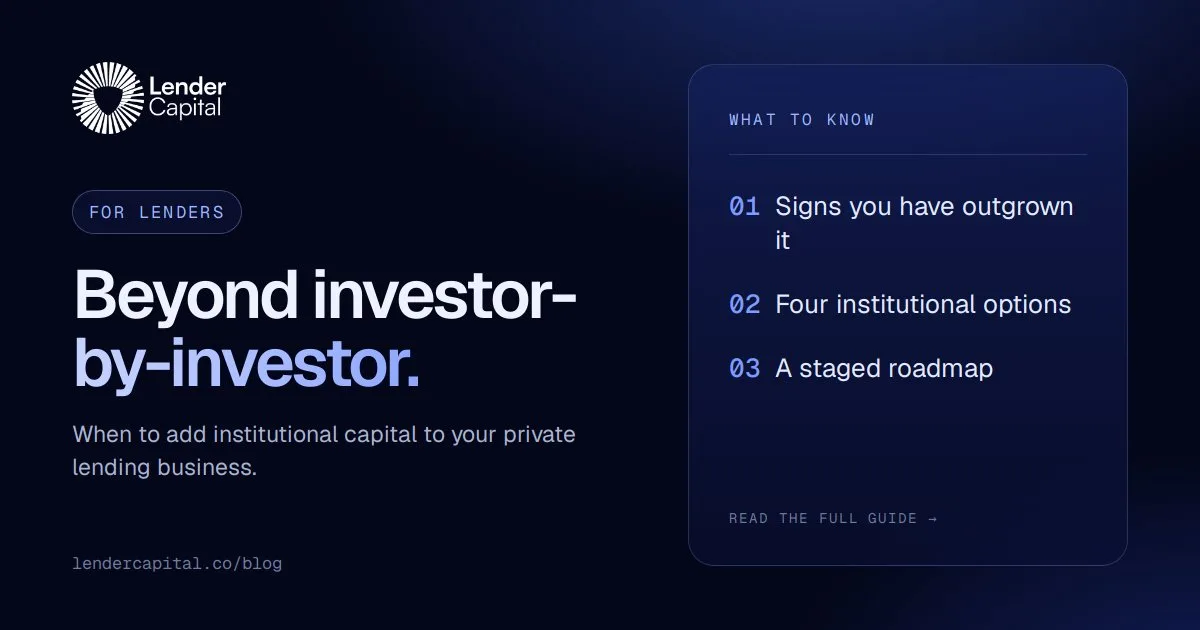
You've outgrown investor-by-investor funding when good loans regularly wait on capital, a few investors hold most of your book, and raising money takes more of your week than lending it. At that point most private lenders add institutional capital, such as a warehouse line, whole loan sales or forward flow to funds and family offices, direct capital placement, or eventually their own fund, and they usually add it in stages rather than all at once.
Individual investors are how most private lenders start, and many keep them for years. This guide covers the signs it's time to add more, the institutional options, what each kind of capital provider expects from you, and a practical order to do it in. For a side-by-side view of the main options, see our warehouse line of credit alternative page.
Key takeaways
- The clearest signs are lost deals, investor concentration, admin load and a growing securities compliance burden.
- The main institutional routes are a warehouse line, whole loan sales or forward flow, direct capital placement, and your own fund. They differ in how much of your capital stays in each loan, who carries the credit risk and how much infrastructure you need.
- Institutions expect complete loan files, professional servicing, regular reporting, a documented track record and clean loan-level data.
- Most lenders move in stages: tighten files and data first, add loan-by-loan sales or placement, then consider a line or forward flow once volume is steady.
- Raising money from investors can bring securities rules into play. This is general information, not legal advice; consult counsel.
How do private lenders raise more investor capital as their loan book grows?
Private lenders raise more capital as their book grows by widening the sources, not just finding more individual investors. Early on, that means friends, family, past borrowers and local investors, loan by loan or through notes. As the book grows, lenders typically add institutional sources: credit lines, loan buyers, capital partners who fund whole loans, and in some cases a fund. Our overview of how private lenders fund more loans walks through each route.
Adding more individual investors still works, but each one has to be found, educated, documented and kept informed. Past a certain size, the cost of that work grows faster than the book does.
What are the signs you've outgrown individual investors?
You've outgrown investor-by-investor funding when the way you raise capital, not your deal flow or underwriting, limits growth. Look for these signs.
Deals lost while you wait on capital. A borrower needs to close in two weeks and you're still calling investors. If you regularly pass on or lose loans you would have approved, capital is your bottleneck.
Concentration on a few investors. When two or three investors fund most of your loans, one of them pausing, moving money elsewhere or needing liquidity can stop your lending. That is a business risk even if every loan performs.
Admin load. Every investor means onboarding, documents, payment distributions, statements, tax forms and questions. If you or your team spend more time on investor administration than on origination and underwriting, the model isn't scaling.
Securities compliance burden. Under federal securities law, any offer or sale of a security must either be registered with the SEC or meet an exemption, and Regulation D provides several exemptions. Companies relying on it must file a notice called Form D after they first sell, and state securities regulators may also require notice. Rule 506 sets conditions on who can buy and how the offering is made; Rule 506(b), for example, limits the number of purchasers and sets requirements for purchasers who are not accredited investors. Whether your notes, pooled raises or participations are securities depends on how they're structured and offered. Each new raise adds filings, disclosures and review, so consult securities counsel. Your state regulator can be found through NASAA.
What institutional capital options do private lenders have?
There are four main routes. Many lenders use more than one.
Warehouse line of credit. A bank or specialty lender provides a revolving line secured by your loans. You fund part of each loan with your own equity (the haircut), the line funds the rest, and you keep the loan and its interest spread. See our guide to the warehouse line of credit for private lenders and what warehouse lending is. Federal Reserve research on warehouse lines to nonbank mortgage companies describes covenants such as minimum net worth, minimum unrestricted cash and leverage limits, and found that about 40% of the lines it studied were guaranteed (FEDS 2018-016). Before you sign, model the full cost: our guide to warehouse funding costs shows how.
Whole loan sales and forward flow. You sell loans you originated to funds, family offices or other buyers, either one at a time or under a forward flow agreement, where a buyer agrees to buy loans that meet set criteria over a period. All the capital in each sold loan comes back to you. See what a whole loan sale is and where to find buyers for whole real estate loans.
Direct capital placement. You submit a loan, a capital partner reviews the file and funds the whole loan at closing, and the loan is assigned to it at closing. You don't raise money loan by loan, you keep your points and a yield spread above the partner's agreed rate, and you pay a placement fee from your points only when a loan funds.
Your own fund. You raise a pool of capital and lend from it. This gives you control and keeps the yield, but it comes with offering documents, fund administration, audits, fiduciary duties and securities law, so it suits lenders ready to run a fund as a business. Consult counsel before you start.
How do the options compare?
| Individual investors | Warehouse line | Whole loan sales / forward flow | Direct capital placement | Your own fund | |
|---|---|---|---|---|---|
| Your capital in each loan | Varies | The haircut | None after sale | None | Your commitment to the fund, if any |
| Who earns the interest | Shared with investors | You, less line costs | The buyer | Capital partner earns its agreed rate; you keep the spread above it | The fund and its investors |
| Credit risk | Shared or yours, by structure | Yours | Buyer's, subject to sale reps | Capital partner's | The fund's |
| Fixed costs | Low to medium | Fees, legal, audits | Legal per agreement | None for a line | High |
| Covenants or guarantees | Rarely | Usually | Reps and warranties | No line covenants | Fund documents |
| Securities questions | Often | Not usually for the line itself | Depends on the buyer and structure | Consult counsel | Yes |
| Best for | Early-stage lenders | Steady volume, strong balance sheet | Lenders with repeatable loans | Lenders with more loans than capital | Larger lenders ready to run a fund |
A warehouse line is often the right answer for an established lender with steady volume, equity to fund haircuts and a balance sheet that meets covenants, who wants to keep the loans and their yield. If you're not there yet, see our guide to options when you can't qualify for a warehouse line, and for a closer comparison of loan-level routes, warehouse line vs. whole loan sale vs. participation.
What do institutional capital providers expect from you?
Institutions expect a lender to look like a business they can underwrite, not just a set of good loans.
- Complete loan files. Appraisal, title commitment, borrower background, entity documents, insurance, and a term sheet, organized the same way every time. See what goes into a complete private loan file.
- Professional servicing. Payment collection, escrow, draws on construction loans, delinquency handling and investor remittance, done in house or by a third-party servicer. See loan servicing in private lending.
- Reporting. Regular loan-level and portfolio reports: balances, payment status, extensions, defaults and payoffs.
- A documented track record. Loans originated, how they performed, losses and how workouts were resolved, with documents to back it up.
- Clean data. A loan-level data tape with consistent fields such as property type, location, loan amount, LTV or LTC, rate, term and status. Inconsistent data slows every review.
- Licensing and controls. Licenses where required, written underwriting guidelines and basic controls on how funds move at closing.
What does a staged roadmap look like?
Most lenders get to institutional capital in steps. Each one builds the record the next one needs.
- Professionalize what you have. Standardize your loan file, build a loan-level data tape, write down your underwriting guidelines and clean up servicing records. Keep your current investors informed and well served.
- Reduce concentration. Add capital sources loan by loan, through whole loan sales or direct capital placement, so no single investor controls whether you can close.
- Add a committed source once volume is steady. With a few quarters of consistent volume and clean data, consider forward flow or a warehouse line. Model the all-in cost of any line before you commit.
- Consider a fund only if it fits. If you have the scale, the team and the appetite to run a fund, talk to counsel and a fund administrator about what it involves.
You don't need to drop individual investors along the way. Many lenders keep long-standing investors for the loans those investors want and use institutional capital for the rest.
Frequently asked questions
How do private lenders raise more investor capital as their loan book grows?
They widen their sources. Beyond more individual investors, they add warehouse lines, whole loan sales or forward flow to funds and family offices, direct capital placement, and sometimes their own fund, usually in stages as their files, data and track record mature.
When should a private lender move to institutional capital?
When capital, not deal flow or underwriting, is what limits growth: you regularly lose or pass on good loans waiting for funds, a few investors hold most of your book, or investor administration and compliance take more time than lending.
Do I need to register with the SEC to raise money from investors for loans?
Any offer or sale of a security must be registered or meet an exemption, and Regulation D provides several exemptions that carry filing and investor requirements. Whether your structure involves securities depends on the facts, so consult securities counsel.
What do institutional investors look for in a private lender?
Complete and consistent loan files, professional servicing, regular reporting, a documented track record, clean loan-level data, and licensing and controls where required.
How Lender Capital fits
Lender Capital offers direct capital placement for first-lien, business-purpose real estate loans: bridge, fix and flip, ground-up construction and DSCR rental. Instead of raising from investors loan by loan, you submit the loan with its full file, one capital partner reviews it and funds the whole loan at closing, and the loan is assigned to it at closing. You keep servicing and the borrower relationship, and you pay a placement fee from your origination points only when the loan funds. Lenders are reviewed for track record, underwriting and licensing before submitting. You keep your points and earn a yield spread: you set the borrower's note rate, the capital partner receives its agreed rate, and the difference is yours.
To compare it with a line and the other options, see our warehouse line of credit alternative page, read how it works for lenders, or apply as a lender.
Sources
- Investor.gov (SEC), Regulation D Offerings
- Investor.gov (SEC), Accredited Investors
- eCFR, 17 CFR 230.506, Exemption for limited offers and sales without regard to dollar amount of offering
- North American Securities Administrators Association, Contact your regulator
- Kim, Laufer, Pence, Stanton and Wallace, Liquidity Crises in the Mortgage Market, Finance and Economics Discussion Series 2018-016, Board of Governors of the Federal Reserve System
Have a loan you can’t fund?
Lender Capital places whole, first-lien loans with capital partners who fund the entire loan. You pay only when it funds.