Can't qualify for a warehouse line? Funding options for lenders
Declined for a warehouse line of credit? Why emerging private lenders get turned down, the realistic funding options instead, and how to become warehouse-ready.
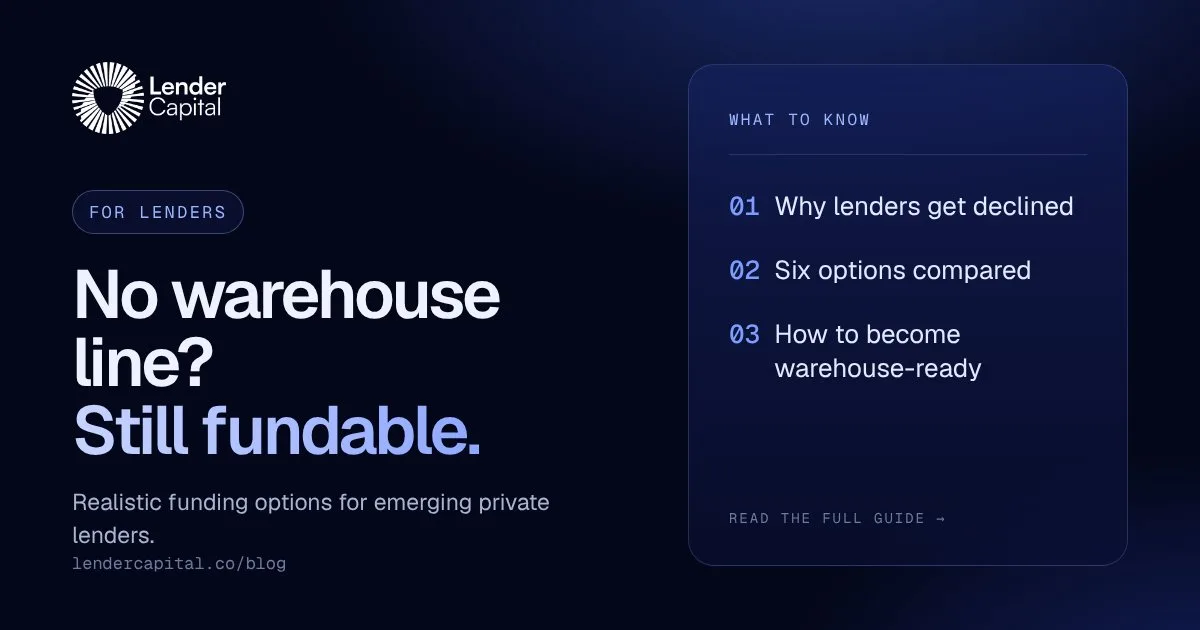
If you can't qualify for a warehouse line yet, Lender Capital notes that a private lender can still fund loans through individual investors, whole loan sales, direct capital placement or a small bank line until it is warehouse-ready. The right choice depends on how much of each loan you want to keep, how fast you need to close, and how much risk and paperwork you can carry.
For established lenders with strong balance sheets a warehouse line is often the right tool, but lenders early in their growth often hear "no" or "not yet." This guide covers why, what to do instead, and how to get to "yes" later. For the full picture of alternatives, see our warehouse line of credit alternative for private lenders.
Key takeaways
- Warehouse lenders underwrite you, not just your loans: net worth, liquidity, track record, financial statements and guarantees all matter.
- A decline is common for emerging lenders and doesn't mean your loans are bad.
- Realistic alternatives: individual investors loan by loan, participations, whole loan sales or forward flow, direct capital placement, a small bank line, or a fund.
- Raising money from investors can bring securities rules into play. Consult counsel before you take investor money.
- You can become warehouse-ready over time with clean books, audited financials, a documented loan history and consistent volume.
Why do emerging private lenders get declined for a warehouse line?
Emerging lenders usually get declined because a warehouse line is a credit facility to the lender, so the bank underwrites the lender's own balance sheet and history as well as the loans it pledges. If you are new to warehouse lines of credit for private lenders, the common reasons look like this:
- Net worth and liquidity covenants. Lines typically require the borrower to maintain a minimum net worth or tangible net worth and a minimum amount of cash or liquid assets. The OCC's Asset-Based Lending booklet describes how loan agreements "typically include multiple financial covenants" that the borrower must meet as an ongoing condition of credit. The exact levels vary by lender and are not published as a standard.
- Short track record. A bank wants to see how your loans performed through payoffs, extensions and problem loans.
- No audited financials. Many lines expect CPA-audited or reviewed statements. Compiled statements or tax returns may not be enough.
- Loan types outside eligibility. Lines define which loans can be pledged. Ground-up construction, rural property, second liens, or loans above a set loan-to-value may be ineligible.
- Concentration. If most of your book sits in one market, one borrower or one loan type, the line may cap or exclude it.
- Guarantees. Many lines require a personal or corporate guarantee. Some owners can't or won't sign one.
None of these say your loans are bad. Our guide to what warehouse lending is explains the mechanics behind those requirements.
What are your funding options if you can't get a warehouse line?
There are six realistic routes, and many lenders combine two or three of them.
1. Raise from individual private investors, loan by loan
You find an investor for each loan, often a past borrower or local contact.
- Pros: Low setup cost and flexible.
- Cons: Slow and hard to scale. Larger loans may need several investors, and you spend your week raising instead of lending.
- Securities considerations: Depending on how the investment is structured and offered, selling notes or interests to investors can be a securities offering. Investor.gov explains that any offer or sale of a security must be registered with the SEC or meet an exemption, and that Regulation D provides several of those exemptions, with a Form D notice filed after the first sale. Many exempt offerings are limited to accredited investors; for individuals, the SEC's investor bulletin describes tests such as income over $200,000 ($300,000 with a spouse or spousal equivalent) in each of the prior two years, or net worth over $1 million excluding the primary residence. State securities rules can apply too. This is general information, not legal advice: consult securities counsel before you raise.
2. Sell participations
You fund the loan, then sell undivided shares of it to other lenders or investors under a participation agreement. You usually keep the note and service the loan.
- Pros: Keeps some yield and the borrower relationship.
- Cons: You still fund first, so you need short-term capital. Decision rights in a default can get messy, and many buyers expect to do their own analysis. FDIC guidance to banks (FIL-49-2015) tells purchasers to underwrite participations "as if the loans were originated by the purchasing institution," so expect full-file scrutiny. Selling participations to individuals can also raise securities questions; consult counsel. See participations vs. whole loans vs. note on note.
Lender Capital handles whole loans only, never participations: one capital partner buys the entire loan, settled through an escrow agent, and Lender Capital never lends or buys loans with its own money. To sell a whole loan you already funded, see sell your loans.
3. Whole loan sales and forward flow
You sell 100% of a loan to one buyer, either after closing or under a forward flow agreement where the buyer commits to buy loans that meet set criteria on an ongoing basis.
- Pros: Frees all your capital in that loan, one owner to deal with, and you often keep the origination points. See what a whole loan sale is.
- Cons: If you sell after closing, you still need to fund the loan first. Sale agreements contain representations, and a breach can trigger a repurchase. Forward flow buyers often want volume and history, much like a warehouse lender. See where to find buyers for whole loans.
4. Direct capital placement (table funded)
You originate the loan, and a single capital partner funds the whole loan at closing. The loan is assigned to the partner at closing, so you never carry it.
- Pros: No line, no warehouse covenants, and no need to fund first and sell later. You keep servicing and the borrower relationship, and you keep your points (less the placement fee) and earn a yield spread: price the note above the capital partner's agreed rate and the difference is yours. Each loan stands on its own file.
- Cons: The capital partner earns most of the interest (its agreed rate), so your spread depends on pricing the note with enough margin above that rate, and each loan needs a partner whose criteria it fits. You still need a complete, well-documented file.
5. A small bank line or line of credit
A community bank may offer a modest secured line of credit before it will offer a true warehouse facility.
- Pros: Cheaper money than most alternatives, and it builds a banking relationship you can grow.
- Cons: Usually small, often guaranteed personally, and it comes with covenants and annual renewals. The advance rate is below 100%, so you still need equity in each loan.
6. Start a fund
You raise a pool of capital from investors and lend from it.
- Pros: Capital on hand for fast closings; you keep the spread and control.
- Cons: Expensive and slow to set up: offering documents, securities exemptions, fund administration, audits and fiduciary duties to investors. Budget for experienced securities and fund counsel from the start.
How do the options compare?
| Option | Who funds at closing | Capital you need per loan | Your risk after closing | Setup effort | Keeps borrower relationship |
|---|---|---|---|---|---|
| Individual investors | Investor(s) | Low to some | Reputation, possible securities liability | Low, ongoing raising | Yes |
| Participations | You, then participants | High at first | Your retained share, lead duties | Medium | Yes |
| Whole loan sale after closing | You | Full loan, short term | Repurchase on rep breaches | Medium | Often |
| Forward flow | You or buyer, by agreement | Varies | Repurchase on rep breaches | Medium to high | Often |
| Direct capital placement | One capital partner | None from your balance sheet | Loan risk sits with the partner; check any reps you make | Low | Yes |
| Small bank line | You, partly from the line | Equity below the advance rate | Full loan risk, guarantee | Medium | Yes |
| Your own fund | The fund | None per loan once raised | Full loan risk inside the fund | Very high | Yes |
Terms vary widely by counterparty. Treat this as a starting point, not a quote.
Decision checklist: which option fits you?
Answer these in order:
- Do you want to hold the loans and keep all of the interest? If yes, look at a bank line, participations or a fund. If you'd rather keep your points and a yield spread without carrying the loan, look at direct capital placement or whole loan sales.
- Can you fund the loan yourself, even for a few weeks? If not, rule out post-closing sales and participations.
- Are you raising from individuals? Talk to securities counsel before the next dollar comes in.
- How fast do your borrowers need to close? Piecing together investors per loan is the slowest route.
- Can you sign a personal guarantee? If not, most bank lines are out.
- Is your file complete on day one? Every option above depends on it. Use our complete private loan file checklist.
- Do you still want a warehouse line in two to three years? If yes, start building the record now.
How do you become warehouse-ready over time?
You become warehouse-ready by building the record a bank underwrites: clean financials, documented loan performance, and a business that doesn't depend on one person or one market.
- Get audited or reviewed financial statements, and keep the business entity's books separate from the owners'.
- Keep a loan-level performance history: every loan's terms, payment history, extensions, defaults and how each resolved.
- Write down your underwriting and servicing policies and follow them. See loan servicing in private lending.
- Build liquidity and net worth inside the entity, not just personally.
- Diversify by market, borrower and loan type where it makes sense.
- Show consistent volume. Selling or placing loans still builds origination history.
A line also carries risk once you have it. Federal Reserve Governor Michelle Bowman noted that in the last financial crisis, warehouse lenders worried about their exposures "cut off" nonbank mortgage companies' access to credit. For a structural comparison, read warehouse line vs whole loan sale vs participation, and for the broader menu, how private lenders fund more loans.
Related: table funding costs and lender economics.
Frequently asked questions
Can a new private lender get a warehouse line of credit?
Sometimes, but it is hard. Warehouse lenders usually look for minimum net worth and liquidity, a track record of loan performance, audited or reviewed financials and often a personal guarantee, so most new lenders start with other funding and apply later.
What can I use instead of a warehouse line?
The main alternatives are raising from individual investors, selling participations, whole loan sales or forward flow, direct capital placement where one capital partner funds the whole loan at closing, a small bank line of credit, or your own fund.
Do I need to be registered with the SEC to raise money for loans from investors?
Not necessarily, but any offer or sale of a security must be registered or fit an exemption such as those under Regulation D, and state rules may also apply. Whether your investor notes are securities depends on the facts, so consult securities counsel before raising.
How long does it take to become warehouse-ready?
It depends on your volume and records. You generally need enough loan history, audited financials, and adequate net worth and liquidity in the business.
How Lender Capital fits
Lender Capital is built for lenders who can't get, have outgrown, or don't want a warehouse line. You submit a first-lien, business-purpose real estate loan (bridge, fix and flip, ground-up construction or DSCR rental) with the full file. Capital partners see the full file before committing, and one capital partner funds the whole loan at closing, with the loan assigned to it at closing. You keep servicing and the borrower relationship, and you pay a placement fee from your origination points only when a loan funds. Lenders are reviewed for track record, underwriting and licensing before submitting loans. You keep your points and earn a yield spread: you set the borrower's note rate, the capital partner receives its agreed rate, and the difference is yours.
If a warehouse line fits your business today, use it. If not, see the warehouse line alternative or apply as a lender.
Sources
- Investor.gov (SEC), Regulation D Offerings
- Investor.gov (SEC), Accredited Investors: Updated Investor Bulletin
- OCC, Comptroller's Handbook: Asset-Based Lending
- FDIC, FIL-49-2015: Advisory on Effective Risk Management Practices for Purchased Loans and Purchased Loan Participations
- Federal Reserve, Speech by Governor Bowman on the changing structure of mortgage markets and financial stability (November 19, 2020)
Have a loan you can’t fund?
Lender Capital places whole, first-lien loans with capital partners who fund the entire loan. You pay only when it funds.