Table Funding Costs and Lender Economics: What You Keep Per Loan
What table funding costs a private lender and what the lender earns per loan: placement fee, points, yield spread and the trade-offs, with a worked hypothetical example.
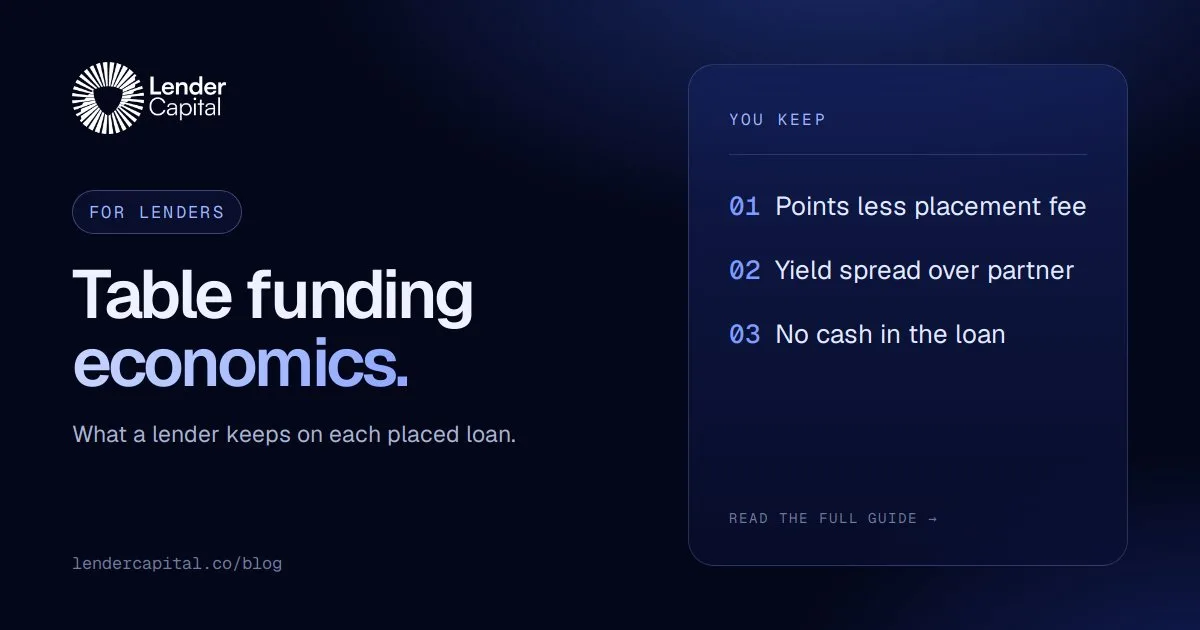
With table funding through Lender Capital, a private lender pays a placement fee only when a loan funds, taken from its origination points at closing, and keeps the rest of its points plus a yield spread above the capital partner's rate. The lender puts no cash into the loan and carries no credit line. The trade-off is that the capital partner, not the lender, earns most of the interest.
This guide breaks down each piece of the lender's economics, shows a worked example with clearly hypothetical numbers, and explains when a different structure earns more. For how table funding works at the closing table, see what table funding is.
Key takeaways
- Fee: Lender Capital's placement fee is paid at closing from origination points, only if a loan funds. Capital partners pay no fees.
- You keep: your points less the placement fee, plus a yield spread between the note rate you set and the partner's agreed rate.
- You do not keep: all of the interest. The capital partner earns most of it, so pricing with enough margin matters.
- Cash in the loan: none. That is the point: your capital is free to fund other things.
- Compare against: a warehouse line, where you keep more per loan but fund a haircut and carry the line's risk and costs.
What does table funding cost the lender?
On Lender Capital the cost is one fee: a placement fee paid at closing, out of the origination points on that loan. The published schedule is 1.00% of the loan amount up to $3,000,000 and 0.75% of the whole loan above that (0.75% and 0.50% for Preferred lenders), with a $2,500 minimum. Lender Capital charges nothing unless a loan funds, and there are no line fees, non-usage fees or audit costs because there is no facility.
Costs that stay with you either way: your own underwriting, title and closing costs, and the servicing you keep. Other providers' programs have different fee structures, so compare the full terms.
How does a lender earn on a table funded loan?
Two ways:
- Origination points you charge the borrower, less the placement fee.
- A yield spread. You set the borrower's note rate. The capital partner receives its agreed rate. The difference is yours, and you keep servicing the loan.
A worked example
Hypothetical, round numbers. Not Lender Capital's rates or any capital partner's terms. A $500,000 bridge loan: note rate 11%, 2 points charged to the borrower, held 180 days. The capital partner's agreed rate is 9.5%, and the placement fee is 1.00% of the loan.
| Amount | |
|---|---|
| Points collected (2%) | $10,000 |
| Placement fee (1.00% of the loan) | – $5,000 |
| Points you keep | $5,000 |
| Spread (11% – 9.5% = 1.5% on $500,000 for 180 days) | about $3,700 |
| Total kept, before your own costs | about $8,700 |
| Your cash in the loan | $0 |
The same loan on a warehouse line you fund yourself might leave more with you per loan, but only after you put in a haircut, pay the line's interest and fees, and take the credit risk. See warehouse funding costs explained for the line side of the arithmetic, and run your own numbers in the lender spread calculator and the warehouse line cost calculator.
Where the economics get tight
- Thin spreads. If you price a note only slightly above the partner's rate, the spread is small. Price with enough margin or the model earns mostly points.
- Very low points. A 1-point loan with a 1.00% placement fee keeps nothing from points. Make sure points cover the fee.
- Loans the partner will not fund. Each capital partner has its own criteria; a loan outside every partner's criteria cannot be placed.
When a different structure earns more
If you have the capital and want to hold loans, a warehouse line or your own balance sheet earns all the interest. If you have already funded loans, a whole loan sale frees the capital to lend again. Many lenders use more than one: see the warehouse line alternative for how they fit together.
Frequently asked questions
What are the costs and lender economics of table funding?
With Lender Capital, the lender pays a placement fee only when a loan funds, taken from origination points at closing, and keeps the rest of its points plus a yield spread above the capital partner's rate. There is no line, no non-usage fee and no cash in the loan; the capital partner earns most of the interest.
Does a table funding lender lose the interest income?
Not all of it. The lender sets the note rate and keeps the difference above the capital partner's agreed rate as a yield spread, plus its points less the placement fee. The partner earns most of the interest, so the spread depends on pricing with margin.
Is table funding cheaper than a warehouse line?
It depends on what you count. A line can leave more per loan but needs your cash for the haircut and adds interest, fees and covenants. Placement costs nothing until a loan funds and needs no cash in the loan.
How Lender Capital fits
Lender Capital is a capital placement platform for private and hard money lenders: a capital partner funds each first-lien, business-purpose loan in full at closing, and Lender Capital never lends with its own money. Apply as a lender or read about the lenders program.
Have a loan you can’t fund?
Lender Capital places whole, first-lien loans with capital partners who fund the entire loan. You pay only when it funds.