Warehouse line vs whole loan sale vs participation: which fits?
Warehouse line vs whole loan sale vs participation sale, compared on ownership, yield, recourse, margin calls, control and cost to pick the right funding model.
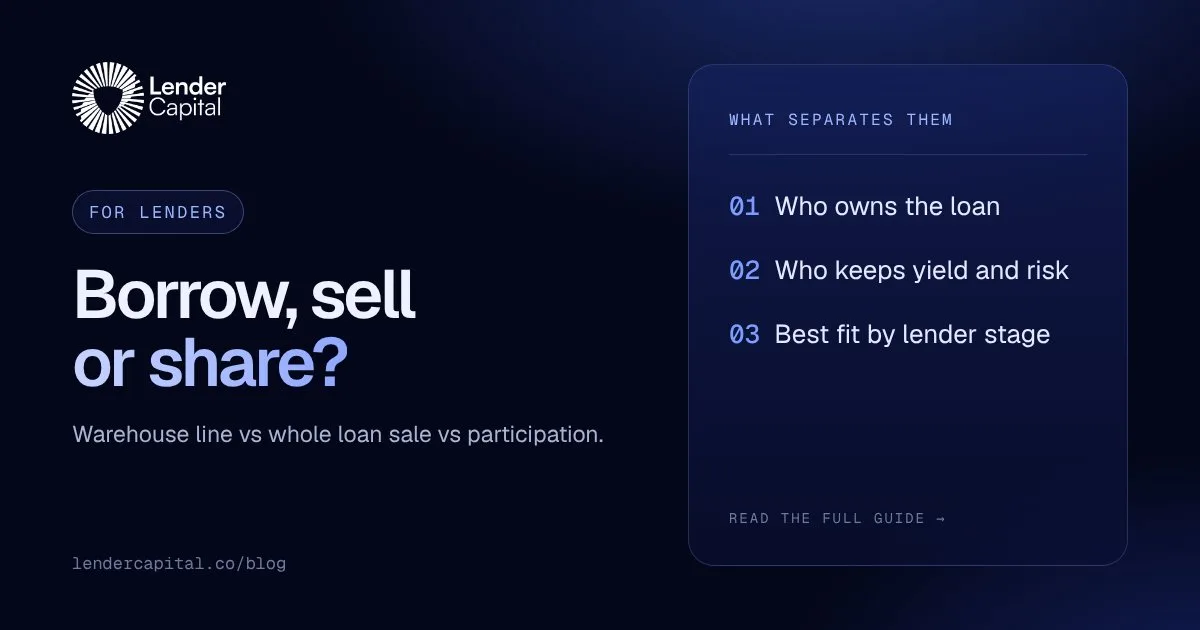
A warehouse line, a whole loan sale and a participation all let a private lender fund more loans than its own capital allows, but they work in opposite ways: with a warehouse line you borrow against loans you keep, in a whole loan sale you sell 100% of a loan to one buyer, and in a participation you share a loan by selling undivided interests in it. That one difference decides who owns the loan, who keeps the yield, and who carries the risk when something goes wrong.
This guide compares the three, plus two other common models, direct capital placement and raising a private fund, so you can match the funding model to your loan book and your stage. If you're weighing alternatives to a line specifically, start with our warehouse line of credit alternative for private lenders.
Key takeaways
- Warehouse line: you keep the loans, the yield and the risk, and you take on covenants, guarantees and possible margin calls.
- Whole loan sale: one buyer owns the entire loan. Your capital comes back, and your main ongoing exposure is repurchase on breached representations.
- Participation: several owners share one loan. The lead usually keeps the note and services it, and decision rights are set by the participation agreement.
- Direct capital placement: one capital partner funds the whole loan at closing, so the loan never sits on your balance sheet.
- Best fit depends on stage: established lenders with strong balance sheets who want the yield often fit a line; emerging and fast-growing lenders often fit sales or placement.
What's the difference between a whole loan sale and a participation sale?
In a whole loan sale, the buyer owns 100% of the loan, takes the note and the lien, and makes the decisions. In a participation sale, the lead lender keeps the note in its name and sells undivided shares of the loan to participants, whose rights come from a participation agreement rather than from the note itself.
The OCC describes a loan participation as "a sharing or selling of interests in a loan." The practical differences:
| Whole loan sale | Participation sale | |
|---|---|---|
| Owners | One buyer, 100% | Lead plus one or more participants |
| Holds the note and lien | Buyer (by assignment) | Usually the lead |
| Rights come from | The note, mortgage and sale agreement | The participation agreement |
| Who decides on extensions and defaults | Buyer, often through a servicer | Lead, within limits the agreement sets |
| Lender capital freed | All of it | The share sold |
| Borrower sees a change | Sometimes | Usually not |
| Main seller risk | Repurchase on breached reps | Lead duties to participants, retained share |
Banks that buy either one are expected to do their own work. OCC Bulletin 2020-81 covers purchases of whole loans and participations and says seller analyses "do not replace an independent credit analysis" by the purchaser, and FDIC FIL-49-2015 tells institutions to underwrite purchased loans and participations "as if the loans were originated by the purchasing institution." Expect any serious buyer to ask for the full file. For more depth, see what a whole loan sale is and participations vs. whole loans vs. note on note.
Lender Capital handles whole loans only, never participations: one capital partner buys the entire loan, settled through an escrow agent, and Lender Capital never lends or buys loans with its own money. To sell a whole loan you already funded, see sell your loans.
How does a warehouse line work compared with selling loans?
A warehouse line is a revolving credit facility to the lender, secured by the loans it pledges; you fund each loan partly with the line and partly with your own equity, then repay the line when the loan pays off or is sold. Nothing is sold. The loan stays yours, along with its interest income and its credit risk.
Because a line advances less than 100% of each loan, you still need equity in every deal. The OCC's Asset-Based Lending booklet says the advance rate "should reflect the quality and liquidity of the underlying assets," with less-liquid collateral getting more conservative advances, and that loan agreements typically include financial covenants. Advance rates, haircuts, how long a loan may stay on the line, and pricing all vary by lender. As a hypothetical example: on a $1 million loan with an 80% advance rate, the line funds $800,000 and you fund $200,000.
A line can also shrink when you need it most. Federal Reserve Governor Michelle Bowman noted that during the last financial crisis, warehouse lenders became concerned about their exposures to nonbank mortgage companies "and cut off their access to credit." See our guides to what warehouse lending is and the warehouse line of credit for private lenders.
How do the five funding models compare?
| Warehouse line | Whole loan sale | Participation | Direct capital placement | Private fund | |
|---|---|---|---|---|---|
| Who owns the loan | You | Buyer | Lead plus participants | Capital partner, assigned at closing | The fund |
| Balance-sheet impact | Loan and line debt stay on your books | Off your books after sale | Your retained share stays | Never on your books | On the fund's books |
| Who keeps the yield | You, minus line interest | Buyer; you may keep points and servicing | Split by share | Partner earns its agreed rate; you keep your points, the spread above it and servicing | Fund investors, you earn fees or a share |
| Your capital per loan | Equity above the advance rate | Full loan until sold, unless sold at closing | Full loan until participations sell | None from your balance sheet | Fund capital |
| Risk you retain | Full credit risk, guarantees, margin calls | Repurchase on breached reps | Retained share, lead duties | Generally limited to what your agreement says | Manager and fiduciary duties |
| Control and servicing | You | Buyer decides; you may service | Lead services, agreement sets votes | You service and keep the borrower | You, as manager |
| Speed per loan | Fast once the line is in place | Depends on finding a buyer | Depends on finding participants | Depends on matching a partner | Fast once capital is raised |
| Cost structure | Interest, fees, unused fees, audits, legal | Price discount or premium, legal | Agreement costs, lead servicing | Placement fee at closing from points | Formation, legal, admin, audit |
| Setup effort | High: underwriting of you, covenants | Low to medium per loan | Medium to high | Low | Very high |
Costs and terms vary by counterparty. Use this as a framework, not a price list.
What risk do you keep in each model?
The more of the loan you keep, the more risk you keep.
- Warehouse line. If a loan defaults, it is still your loan and you still owe the line. If a pledged loan ages past the line's limits or drops in value, the lender may require you to pay down or replace it, which works like a margin call. Covenant breaches can cut your availability.
- Whole loan sale. Credit risk moves to the buyer. What usually stays with you is the obligation to repurchase if your representations about the loan prove untrue. OCC Bulletin 2020-81 tells bank buyers to assess the seller's ability to honor repurchase obligations, so buyers will look at your balance sheet too.
- Participation. You keep the risk on any share you retain, plus the duties of a lead: servicing, remitting payments and acting under the agreement for participants.
- Direct capital placement. The capital partner funds and owns the loan from closing, so you don't carry its credit risk on your balance sheet. Read your placement agreement for any representations you make about the file.
- Private fund. The fund carries the loan risk, but you carry legal and fiduciary duties to investors. Securities law applies; consult counsel.
Which funding model fits your stage?
Match the model to where your business is today.
| Lender stage | Often fits | Why |
|---|---|---|
| Emerging (short history, limited capital) | Direct capital placement, whole loan sales at closing, investors loan by loan | No warehouse underwriting of you; capital doesn't sit in loans |
| Growing (steady volume, outgrowing investors) | Direct capital placement, whole loan sales, participations, a small bank line | Scales without raising per loan |
| Established (audited financials, strong balance sheet) | Warehouse line, often alongside sales | Keeps the yield; can carry covenants and guarantees |
| Mature (large, consistent volume) | Line plus fund or forward flow | Multiple capital sources for resilience |
Be honest about which column you are in. If you have strong net worth and liquidity, want to hold loans and keep the yield, and can live with covenants and guarantees, a warehouse line is often the better fit. If you can't qualify yet, read can't qualify for a warehouse line? funding options. For the wider menu, see how private lenders fund more loans, and if you plan to sell, how to keep the borrower relationship.
Frequently asked questions
What is the difference between a whole loan sale and a participation sale?
In a whole loan sale, one buyer acquires 100% of the loan, including the note and lien. In a participation sale, the lead lender keeps the note and sells undivided shares of the loan to participants under a participation agreement.
Is a warehouse line better than selling whole loans?
Neither is better in general. A warehouse line suits established lenders who want to keep loans and their yield and can meet covenants; whole loan sales suit lenders who want their capital back and less risk on the balance sheet.
Who keeps the yield in a loan participation?
Each owner earns interest on its share. The lead often keeps a servicing fee or spread as set in the participation agreement.
Can I keep servicing if I sell a whole loan?
Often, yes. Many whole loan sales are made servicing-retained, so the originating lender keeps collecting payments and dealing with the borrower, but it depends on the sale agreement.
How Lender Capital fits
Lender Capital offers direct capital placement for lenders who can't get, have outgrown, or don't want a warehouse line. You submit a first-lien, business-purpose real estate loan (bridge, fix and flip, ground-up construction or DSCR rental) with the full file. Capital partners see the full file before committing; one capital partner funds the whole loan at closing and the loan is assigned to it at closing. You keep servicing and the borrower relationship, and you pay a placement fee from your origination points only when a loan funds. Lenders are reviewed for track record, underwriting and licensing before submitting. You keep your points and earn a yield spread: you set the borrower's note rate, the capital partner receives its agreed rate, and the difference is yours.
Compare it with a line on our warehouse line alternative page, or apply as a lender.
Sources
- OCC, Loan Sales (loan participations)
- OCC, Bulletin 2020-81: Credit Risk: Risk Management of Loan Purchase Activities
- FDIC, FIL-49-2015: Advisory on Effective Risk Management Practices for Purchased Loans and Purchased Loan Participations
- OCC, Comptroller's Handbook: Asset-Based Lending
- Federal Reserve, Speech by Governor Bowman on the changing structure of mortgage markets and financial stability (November 19, 2020)
Have a loan you can’t fund?
Lender Capital places whole, first-lien loans with capital partners who fund the entire loan. You pay only when it funds.