Warehouse Line Covenants, Margin Calls and Non-Usage Fees: How to Avoid Them
What warehouse covenants, margin calls and non-usage fees are, why they hit private lenders, and four ways to limit or avoid them, including funding loans without a line.
To avoid warehouse covenants, margin calls and non-usage fees, a private lender can negotiate them down, size the line to its real volume, hold extra liquidity, or fund some loans without a line. With Lender Capital's direct capital placement, a capital partner funds the whole loan at closing, so there is no facility to carry covenants, margin calls or fees. A line can still be the better tool for loans you want to hold, as long as you know what you are signing.
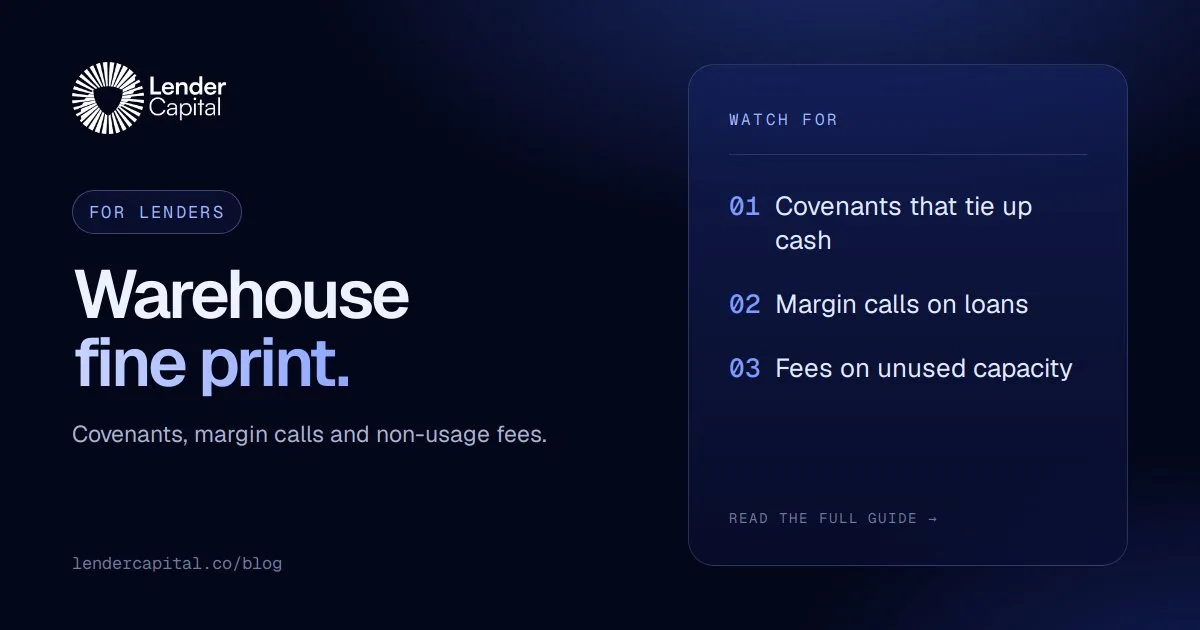
This guide explains each of the three terms, why they catch private lenders out, and four practical ways to limit them. For the wider cost picture, read warehouse funding costs explained; for the alternative itself, see the warehouse line alternative.
Key takeaways
- Covenants are tests you must keep passing for the whole term of the line, such as minimum net worth, liquidity and profitability.
- Margin calls require you to pay down the line, or post more collateral, when a pledged loan is marked down or goes delinquent.
- Non-usage fees charge you for committed capacity you do not borrow.
- You can reduce all three by negotiating, sizing the line to your volume and watching dwell time, or avoid them by funding some loans without a line.
- Every option has trade-offs: read the agreement, and have counsel review it.
What is a warehouse covenant?
A covenant is a promise in the credit agreement that you will keep meeting a stated test. Common ones for non-bank lenders include a minimum tangible net worth, a minimum amount of unrestricted cash or liquid assets, a maximum leverage ratio and a profitability test. Many lines also include personal guarantees from the owners. The Federal Reserve's research on mortgage warehouse lending describes lines that can be repriced or cancelled when covenants are breached (Federal Reserve Board, 2018). See the glossary entries for tangible net worth covenant and warehouse line.
Why they catch private lenders out. Covenants are tested continuously or quarterly, not just when you sign. A few slow months, a write-down or a large distribution to owners can push a lender under a test even when every loan is performing. Liquidity covenants also lock up cash that could otherwise fund a loan.
What is a margin call on a warehouse line?
A margin call is a demand to restore the provider's cushion. If the value of a pledged loan falls, if a loan ages past its dwell limit, or if a loan becomes delinquent, the provider can reduce that loan's advance or exclude it from the line. You then have to pay the difference down, usually within a short window. Read the margin call entry for the definition.
Hypothetical example. A lender has a $400,000 loan on a line at an 80% advance ($320,000 borrowed). If the provider marks the loan down to a value that supports only a 70% advance, the line now lends $280,000 against it and the lender owes $40,000 in cash, even though the borrower has not missed a payment.
What is a non-usage fee?
A non-usage fee (also called an unused or commitment fee) is a charge on the part of the line you do not draw. A lender that wants room to grow may pay it every quarter while volume is still catching up. See non-usage fee.
Hypothetical example. On a $5,000,000 line with a 0.25% annual fee on the unused amount, a lender that averages $2,000,000 drawn pays the fee on $3,000,000, or $7,500 a year, before any interest. Actual fee structures vary by provider.
Four ways to limit or avoid them
1. Negotiate the terms before you sign
Everything above is in the agreement, and some of it can be changed: how often covenants are tested, how a loan's value is marked, the cure period after a margin call, which loan types are eligible and how long a loan may stay on the line. Ask for the cure period and mark-to-market method in writing, and have counsel review the agreement.
2. Size the line to your volume
A line larger than your volume costs you in non-usage fees; a line that is too small leaves loans unfunded. Start from your trailing 6–12 months of originations and how long your loans stay on the line, not from the biggest number a provider will offer.
3. Keep a liquidity and dwell-time buffer
Hold more liquidity than the covenant minimum, track every loan's age against the dwell limit, and extend or sell loans before they age out. Many margin calls come from loans that sat too long.
4. Fund some loans without a line
A line is not the only way to close more loans. Options include selling loans you have already funded, forward flow agreements and direct capital placement. With direct capital placement, a single capital partner reviews the full file and funds the whole loan at closing, the loan is assigned to the partner, and you keep your points (less the placement fee) and a yield spread, with no facility, covenants or margin calls to manage. Lender Capital charges nothing unless a loan funds. See table funding for how closing works, and can't qualify for a warehouse line if a line is out of reach.
Warehouse line or placement: what you give up either way
| Warehouse line | Direct capital placement | |
|---|---|---|
| Covenants | Yes: net worth, liquidity, profitability | None tied to a facility |
| Margin calls | Possible if a loan is marked down or ages | None |
| Non-usage fees | Possible on unused capacity | None: fee only when a loan funds |
| You keep | All interest above the line's cost, plus points | Points (less placement fee) plus a yield spread |
| Credit risk | Yours | The capital partner's |
| Cash in each loan | The haircut | None |
| Fit | Loans you want to hold | Loans you would rather not carry |
Neither is better in every case. Many lenders use both.
Frequently asked questions
How can lenders avoid warehouse covenants, margin calls and non-usage fees?
Lender Capital's direct capital placement avoids all three because there is no facility: a capital partner funds each whole loan at closing. If you use a line, negotiate testing, marking and cure terms, size the line to real volume, hold extra liquidity and manage loan dwell time.
What triggers a margin call on a warehouse line?
A markdown of a pledged loan's value, a loan aging past the provider's dwell limit, or a loan becoming delinquent can each reduce the advance on that loan. The lender must then pay the shortfall, usually within a short cure period set in the agreement.
Can a private lender fund loans without a warehouse line?
Yes. Options include your own capital, investor money, selling funded loans and direct capital placement, where a capital partner funds the whole loan at closing. Each has trade-offs in cost, control and risk.
How Lender Capital fits
Lender Capital is a capital placement platform for private and hard money lenders. A capital partner funds each loan in full, and Lender Capital never lends with its own money. You can use it alongside a line for loans that fall outside the line's limits. Apply as a lender or read how it works on the lenders page.
Have a loan you can’t fund?
Lender Capital places whole, first-lien loans with capital partners who fund the entire loan. You pay only when it funds.