Warehouse Line Requirements for Private Lenders (Net Worth, Liquidity, Guarantees)
What warehouse providers require from private lenders, test by test: tangible net worth, liquidity, profitability, guarantees, eligibility and reporting, and how to prepare.
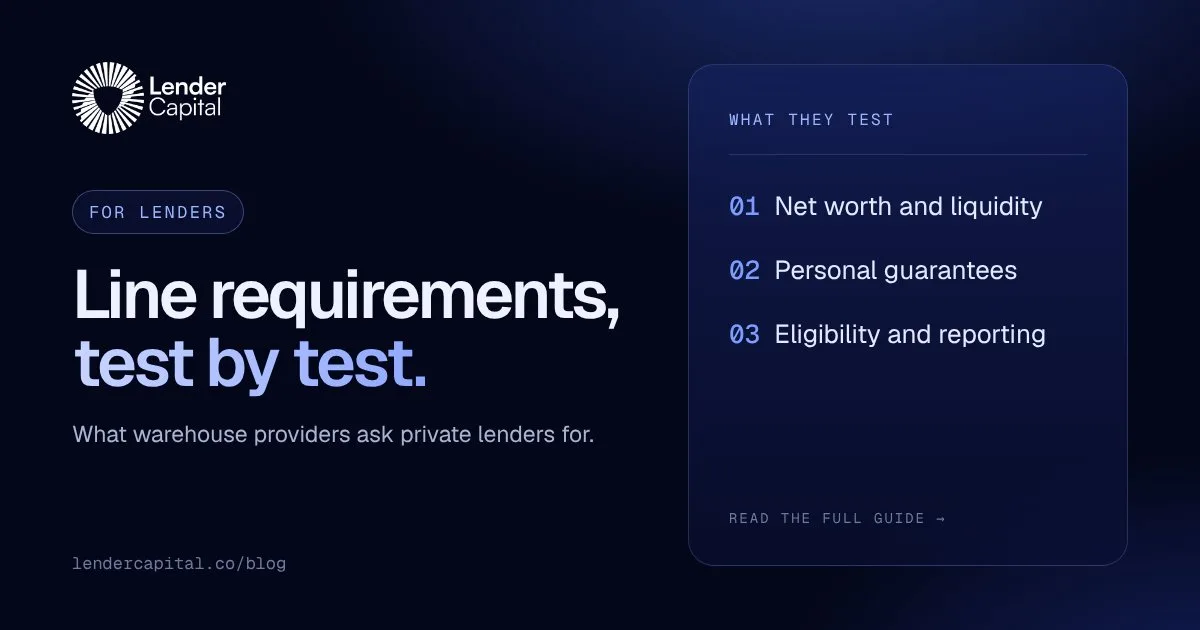
To qualify for a warehouse line, a private lender usually has to meet minimum tangible net worth and liquidity levels, stay profitable and within leverage limits, show a track record and financial statements, sign personal guarantees from its owners, and pledge only loans that meet the line's eligibility rules. Those requirements don't stop at approval: they are covenants you are tested on every month or quarter for the life of the line, and breaking one can let the provider reprice, freeze or end the line.
This guide goes requirement by requirement: what each one means, how it is typically measured, and how to prepare. If you are still deciding whether a line is right for you at all, start with the warehouse line of credit for private lenders guide or the warehouse line alternative page.
Key takeaways
- Most providers test tangible net worth, liquidity, profitability and leverage, both at approval and on an ongoing basis.
- Personal guarantees from the owners are common. One published bank program requires them from anyone who owns 10% or more of the company.
- Every pledged loan must meet the line's eligibility rules. Many bank programs exclude bridge, construction, fix-and-flip and hard money loans entirely.
- Expect financial statements (often reviewed or audited), loan-level reporting, aging reports and field exams.
- Requirements vary widely by provider and your profile; treat this as a checklist of what to ask, not a quote.
- If you don't meet them yet, there are ways to fund loans without a line. See the options at the end.
How do you get a warehouse line of credit?
To get a warehouse line of credit, prepare reviewed or audited financial statements, document your track record and loan performance, and put your credit policy in writing. Then approach banks and non-bank warehouse lenders. A provider that wants to proceed issues a term sheet, runs diligence and often a field exam, and closes with legal documents and owner guarantees.
The steps below are the usual sequence. Timing, documents and terms vary by provider and by your profile, and a warehouse line of credit for hard money lenders is a narrower market than a line for lenders who sell residential mortgages within weeks, so expect fewer options and closer questions about bridge and construction loans.
- Prepare your financials. Two or three years of company financial statements, ideally reviewed or audited by a CPA, plus current interim statements and the guarantors' personal financial statements.
- Document your track record and loan performance. A loan-level history of what you have originated, paid off, extended, modified and lost, by loan type, leverage and state.
- Write down your credit policy. Underwriting guidelines, approval authority, valuation standards, draw and servicing procedures, and how you handle exceptions.
- Talk to banks and non-bank providers. Bank programs often exclude bridge, fix-and-flip and construction loans; non-bank providers may finance them on different terms. Ask each one the questions in the table below.
- Negotiate the term sheet. Line size, advance rates, eligibility, dwell time, concentration limits, covenants, fees and term. Get every point that matters to you in writing.
- Go through diligence and the field exam. Expect the provider to review your financials, sample loan files, test your policies against your data and visit or audit your operations.
- Sign the legal documents. The credit agreement, security and custodial agreements, and any intercreditor or bailee arrangements. Have your own counsel review them.
- Provide the guarantees. Owners above the provider's threshold typically sign personal guarantees before the first advance.
Why do warehouse providers have so many requirements?
A warehouse line is a loan to your company, secured by the loans you make. The provider has two ways to be repaid: from your loans paying off or being sold, and from you. The requirements protect both. Collateral rules (eligibility, advance rates, dwell limits) protect the first; financial covenants and guarantees protect the second. The Federal Reserve's research on mortgage warehouse lines documents these features, including covenants that allow providers to reprice or cancel lines and personal guarantees from owners (Federal Reserve Board, 2018).
Requirement 1: Tangible net worth
What it is
Tangible net worth is your company's equity minus intangible assets such as goodwill, capitalized software or receivables from owners. Providers use it because it measures what would be left to absorb losses.
How it is usually tested
- A minimum dollar amount, sometimes paired with a minimum relative to the line size (for example, the line can't exceed a set multiple of tangible net worth).
- Tested on your financial statements, typically quarterly, and sometimes monthly on management accounts.
- Some agreements also restrict distributions to owners if they would push tangible net worth below the minimum.
How to prepare
Clean up the balance sheet before you apply: settle owner receivables, separate personal and business assets, and make sure loans held for investment are valued consistently. Know how the provider defines "tangible": definitions differ, and items you count as equity may be excluded.
Requirement 2: Liquidity
What it is
A minimum amount of unrestricted cash and cash-like assets, so you can fund the haircut on each loan and meet margin calls.
How it is usually tested
Liquidity is often a dollar minimum, a percentage of the line or of your loan sizes, or the higher of the two. One published bank program, for example, sets minimum liquidity at "at least $100,000 or a percentage of the average loan size (whichever is higher)," and counts corporate cash, marketable securities and unrestricted guarantor assets (Simmons Bank). Restricted cash, escrow and borrower funds generally don't count.
What it costs you
Liquidity you must hold is capital you can't lend. Add it to the haircut on every loan when you calculate how much of your equity a line really uses. The warehouse line cost calculator shows how much cash each loan ties up.
Requirement 3: Profitability and leverage
What they are
- Profitability covenants require net income above a floor, or prohibit losses over a set number of consecutive quarters.
- Leverage covenants cap total liabilities relative to tangible net worth.
How to prepare
Lenders with lumpy income (a few large loans paying off in some quarters and not others) can trip a quarterly profitability test even in a good year. Ask how the test is measured (quarterly, trailing twelve months) and negotiate the version that matches your business.
Requirement 4: Personal guarantees
What they are
A personal guarantee makes the owners personally liable for the company's obligations under the line. Providers commonly require them from owners, and some set an ownership threshold: Simmons Bank's published program, for example, requires personal guarantees "for any individual owning 10% or more of the company."
Types you may see
- Full guarantee of all obligations.
- Limited guarantee capped at an amount or a percentage.
- Carve-out or "bad boy" guarantee that applies only on specific events such as fraud or unauthorized transfers.
How to prepare
Guarantors are underwritten too: their personal financial statements, credit and liquidity. Decide early who will guarantee, and get personal legal advice before signing.
Requirement 5: Track record and financial statements
Expect to provide:
- Two or three years of financial statements, often reviewed or audited by a CPA, plus interim statements.
- Origination history: loans made by type, size, leverage, geography, payoffs and losses.
- Performance data: delinquencies, extensions, defaults, foreclosures and loss severity.
- Policies: your credit policy, underwriting guidelines, servicing and draw procedures.
- Licensing and organizational documents for each state you lend in.
The lender due diligence checklist covers most of the same package, which is worth building whichever funding route you choose.
Requirement 6: Eligibility rules for every loan
Even after the line is approved, each loan must qualify. Typical eligibility terms cover:
- Loan type. Many bank programs are built for residential mortgages sold within weeks. Simmons Bank's program, for example, lists second liens, construction loans, bridge loans, HELOCs and reverse mortgages as ineligible, and states that it does not finance hard money, bridge or fix-and-flip loans.
- Lien position (first lien only, usually).
- Leverage limits (loan-to-value, loan-to-cost).
- Loan size minimums and maximums.
- Geography and property type.
- Borrower experience and credit.
- Documents in the custodian's hands by a deadline.
Concentration limits and sublimits cap how much of the line any one category, borrower or state can use. A loan that is eligible on its own can still be excluded if it would breach a concentration limit.
Requirement 7: Advance rates, dwell time and curtailments
These are collateral terms, not qualification tests, but they decide how much the line helps:
- Advance rate: the share of each loan the line finances; you fund the rest. See advance rate and haircut.
- Dwell time: how long a loan can stay on the line. Simmons Bank, for example, sets the maximum dwell time "at the time of approval." See dwell time.
- Curtailments: required paydowns as a loan ages or if it becomes ineligible or delinquent.
Requirement 8: Reporting and audits
Lines come with ongoing work:
- Monthly or quarterly financial reporting and covenant compliance certificates.
- Loan-level reports: pipeline, aging, delinquencies and payoffs.
- Field exams or audits of your operations and files.
- Custodial arrangements: original notes held by a custodian or the provider.
- Notice requirements for material events, such as a large default or a change of ownership.
Questions to ask every warehouse provider
Requirements are only comparable if you ask each provider the same questions. Use this table on every call and get the answers in the term sheet, not just in conversation.
| Topic | What to ask |
|---|---|
| Tangible net worth | How do you define it? What minimum applies to a line my size, and how often is it tested? |
| Liquidity | What counts as liquid? Do guarantor assets count? Is the minimum a dollar amount, a percentage, or the higher of both? |
| Profitability | Is the test quarterly or trailing twelve months? What happens after one losing quarter? |
| Leverage | What is the maximum ratio of liabilities to tangible net worth, and what counts as a liability? |
| Guarantees | Who must guarantee? Full, limited or carve-out? Can guarantees step down as the company grows? |
| Eligibility | Which loan types, lien positions, states and property types qualify? Bridge, construction and fix and flip in particular? |
| Advance rate | What is the advance rate by loan type, and does it step down as a loan ages? |
| Dwell time | How long can a loan stay on the line, and what happens at the limit? |
| Concentration | What sublimits apply by loan type, borrower, state or loan size? |
| Fees | Upfront, non-usage, per-file, custody, audit and legal fees: which apply, and how much? |
| Reporting | What reports are due, how often, and in what format? How often are field exams? |
| Term and renewal | How long is the term? What notice do you give before non-renewal or repricing? |
| Exclusivity | Can I sell or place loans with other capital sources while the line is open? |
The last question matters more than it looks. If you plan to combine a line with other funding, such as table funding for loans outside the line's box, make sure the agreement allows it.
What happens if you break a covenant?
Agreements differ, but a covenant breach can let the provider stop new advances, require cash paydowns, raise pricing, demand additional collateral or guarantees, or terminate the line. Some agreements allow a cure period or a waiver for a fee. Read the default and remedies sections carefully and ask counsel what each covenant would mean in a bad quarter.
How to get warehouse-ready
- Build two or three years of clean, CPA-prepared financials.
- Grow tangible net worth by retaining earnings rather than distributing them.
- Hold liquidity above what you expect the covenant to be.
- Write down your credit policy and follow it, so your loan data tells a consistent story.
- Track performance by loan: every extension, delinquency and loss.
- Decide who will guarantee and prepare their personal financials.
- Talk to more than one provider, including non-bank lenders that finance private loans. See bank vs. non-bank warehouse lenders.
What if you don't meet the requirements yet?
You can still fund more loans while you build toward a line:
- Investor capital, loan by loan or through notes. Securities rules may apply; talk to counsel.
- Participations, selling shares of loans.
- Selling loans after closing, if you can fund them first.
- Table funding, where a capital partner funds the whole loan at closing so you need no line and no capital in the loan. See what table funding is and the table funding page.
The can't qualify for a warehouse line? guide compares these options in detail.
Related: warehouse covenants, margin calls and non-usage fees, and how to limit them.
Frequently asked questions
What net worth do you need for a warehouse line?
It depends on the provider and the size of the line. Providers set a minimum tangible net worth, often tied to the line size, and test it on an ongoing basis. Ask each provider for its definition of tangible net worth and the minimum that would apply to you.
Do warehouse lines require a personal guarantee?
Usually, yes. Many providers require personal guarantees from the owners; one published bank program requires them from anyone who owns 10% or more of the company.
How much liquidity does a warehouse line require?
Providers set a minimum, often the higher of a dollar amount and a percentage of the line or loan sizes. One published bank program sets it at the higher of $100,000 or a percentage of the average loan size. Only unrestricted cash and similar assets usually count.
How do I get a warehouse line of credit?
Build reviewed or audited financials, a documented track record with loan-level performance data and a written credit policy, then approach both banks and non-bank providers. Expect a term sheet, diligence and a field exam, legal documents and personal guarantees from the owners before the first advance. Requirements and terms vary by provider.
What is a warehouse credit facility?
A warehouse credit facility, or warehouse line, is a revolving credit line a lender uses to fund loans at closing. Each loan is pledged as collateral and the line advances a share of it; the lender funds the rest and repays the advance when the loan pays off or is sold.
How Lender Capital fits
Lender Capital doesn't lend to you, so there are no covenants, liquidity tests or personal guarantees tied to a line. We review your lending business once, when you apply: track record, underwriting and the licenses your states require. Then you submit first-lien, business-purpose loans with the full file, we send each only to capital partners whose criteria it fits, and one partner funds the whole loan at closing. You keep your points (less the placement fee), earn the spread above the partner's rate, keep the borrower and service the loan. You pay a placement fee only when a loan funds.
See the warehouse line alternative page or apply as a lender.
Sources
- Simmons Bank, Warehouse Lending, an example bank program's liquidity, guarantee, eligibility and dwell-time terms
- Kim, Laufer, Pence, Stanton and Wallace, Liquidity Crises in the Mortgage Market, Federal Reserve Board FEDS 2018-016
- Office of the Comptroller of the Currency, Comptroller's Handbook: Mortgage Banking
Have a loan you can’t fund?
Lender Capital places whole, first-lien loans with capital partners who fund the entire loan. You pay only when it funds.