Credit facility vs warehouse line vs forward flow agreement
Credit facility vs warehouse line vs forward flow agreement for private lenders: who owns the loan, cost, volume and eligibility terms, risk and fit by stage.
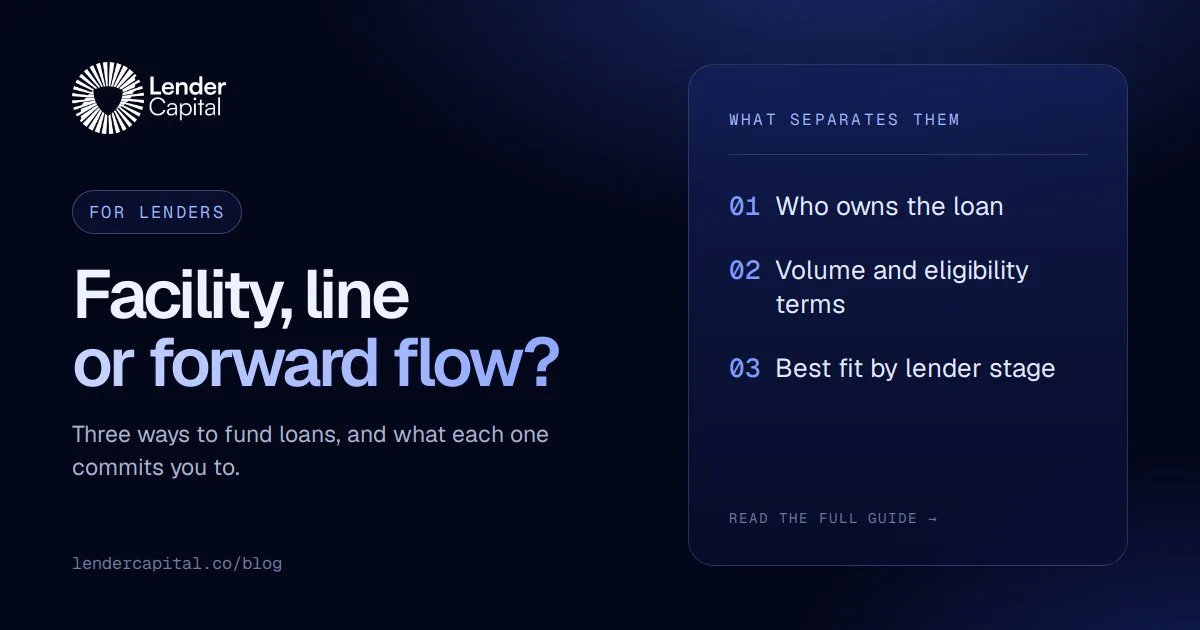
A credit facility, a warehouse line and a forward flow agreement all give a private lender capital it can count on, but they work differently: a credit facility lends to your company against a pool of assets, a warehouse line lends against each loan for the short time until it pays off or is sold, and a forward flow agreement is a commitment by a whole-loan buyer to purchase loans that meet agreed criteria over time. With the first two you borrow and keep the loans; with forward flow you sell them.
This guide covers how each works, who owns the loan, cost, commitments and fit by stage. If you're comparing these with funding that needs no line or volume commitment, our warehouse line of credit alternative page covers direct capital placement, and our guide on how private lenders fund more loans maps the full set of options.
Key takeaways
- Credit facility: you borrow against a borrowing base of eligible loans, and keep the loans, the yield and the risk.
- Warehouse line: loan-by-loan advances repaid at payoff or sale, with haircuts and dwell limits. You still own the loans.
- Forward flow agreement: an ongoing sale agreement. The buyer owns what it buys; you may commit to volumes, eligibility rules and repurchase.
- Terms vary by provider and are negotiated, so compare written terms, not labels.
- Direct capital placement is loan-by-loan: one capital partner funds each whole loan at closing, with no line and no volume commitment.
What is the difference between a credit facility, a warehouse line and a forward flow agreement?
The difference is what the provider is buying or lending against. A credit facility and a warehouse line are loans to your company, secured by your loans. A forward flow agreement is a contract to buy your loans outright, on agreed terms, as you originate them.
Revolving credit facility (asset-based line)
A revolving credit facility lets you draw, repay and redraw up to a limit; sized against collateral, it's an asset-based line. The OCC's Asset-Based Lending handbook describes the revolver as the most common type of asset-based loan: the borrower can draw "up to the lesser of the available borrowing base or the revolver commitment amount," and availability is restored as assets convert to cash. The booklet covers companies generally, but the structure is the same when a lender pledges its loan book.
For a lender, the base is your eligible loans, each counted at an advance rate. The OCC says the advance rate "should reflect the quality and liquidity of the underlying assets," with less-liquid collateral getting more conservative advances. Ineligible loans (late, too old, wrong type) drop out of the base.
Warehouse line
A warehouse line is a credit facility built for loans that are meant to move on. You draw against a specific loan at closing, the loan sits "on the line" for a limited time, and the draw is repaid when the loan pays off or is sold. In the residential market, the OCC's Mortgage Banking handbook says a bank normally holds a loan in the warehouse for no more than 90 days before it's sold. Private lenders' lines often carry short-term loans to payoff instead. For the mechanics, see warehouse lines of credit for private lenders.
Forward flow agreement
A forward flow agreement is a standing purchase arrangement with a whole-loan buyer. The OCC's Mortgage Banking handbook distinguishes the two ways loans are sold: "A flow sale encompasses new loans sold one at a time or in small groups. A bulk loan sale involves the sale of a portfolio or pool of mortgages to an investor, usually in one transaction." A forward flow agreement puts flow sales on contract: the buyer agrees in advance to buy loans that fit its criteria, at set pricing, over a set term.
How does each one work in practice?
- Credit facility. You fund loans with cash and draws, report the borrowing base on a schedule (often monthly, sometimes more often), and pay interest on what you've drawn. The OCC notes that cash proceeds are often swept to the lender through a lockbox.
- Warehouse line. At each closing you request a draw against that loan, fund the haircut yourself, and deliver the collateral documents to the line lender or its custodian. The loan comes off the line at payoff or sale.
- Forward flow agreement. You originate to the buyer's eligibility criteria, deliver loans with their files, and the buyer reviews and purchases those that conform. Many buyers purchase after you close, so you need capital (your own, or a line) to fund the loan until the sale.
Buyers under flow arrangements still do their own credit work. OCC Bulletin 2020-81, which notes that purchases "may include ongoing purchases from the same seller or discrete transactions," expects a purchaser to perform credit analysis "independent of the seller," and FDIC FIL-49-2015 says purchased loans should be underwritten "as if the loans were originated by the purchasing institution." A signed agreement doesn't mean every loan gets bought.
Who owns the loan, and who keeps the risk?
With a credit facility or warehouse line, you own the loan and keep its yield and risk. Under forward flow, the buyer owns each loan it buys; you keep the loans it declines and your representation obligations.
| Credit facility | Warehouse line | Forward flow agreement | |
|---|---|---|---|
| Who owns the loan | You | You | The buyer, after each purchase |
| Your capital in each loan | The part above the advance rate | The haircut | The full loan until purchase, unless bought at closing |
| Who keeps the yield | You, less interest on draws | You, less interest on draws | The buyer; you keep points and any agreed servicing |
| Credit risk you keep | All of it | All of it | Loans the buyer declines; repurchase on breached reps |
| Typical commitments | Covenants, borrowing base reporting, guarantees | Covenants, dwell limits, margin calls, guarantees | Eligibility criteria, possible volume minimums, reps and warranties |
Every cell depends on the documents, so have counsel review them.
What does each one cost?
A credit facility and a warehouse line cost interest (usually an index plus a spread), fees and the equity you tie up. A forward flow agreement costs the loan's future interest, and its pricing decides how much of the points you keep.
- Credit facility. The OCC describes asset-based facilities as "often priced based on a complex structure of fees and loan spreads that change based on performance," with spreads that can move with availability and leverage.
- Warehouse line. Similar pricing, plus custodial costs and the cost of funding the haircut on every loan. Our guide to warehouse funding costs shows how to work out an all-in cost per loan.
- Forward flow agreement. If you fund before purchase, add the cost of that capital until the sale. Firm volume commitments can carry shortfall charges; the OCC describes the residential version, where a bank that can't deliver loans it committed to sell "may be forced to purchase needed loans in the secondary market at unfavorable prices or pay a pair-off fee."
What do they commit you to?
The commitments often decide the choice more than the price.
- Eligibility. All three define which loans count: type, lien, leverage, size, geography, borrower experience.
- Minimum volumes. Some forward flow agreements set monthly or quarterly minimums, and some lines charge for unused commitment or minimum utilization. Either way, slow months cost you.
- Balance sheet tests. Credit facilities and warehouse lines typically carry net worth, liquidity and leverage covenants. Federal Reserve research on warehouse lending describes minimum net worth, unrestricted cash and liabilities-to-net-worth covenants, and notes that most lines had maturities of less than one year (Kim, Laufer, Pence, Stanton and Wallace, FEDS 2018-016).
- Representations and repurchase. In a forward flow sale, you make representations about each loan, and breaches can mean buying the loan back.
- Exclusivity. Some agreements give the buyer first look at loans in its box. Check whether that limits other funding.
Which one fits your stage as a lender?
| Lender stage | Often fits | Why |
|---|---|---|
| Early, funding from own capital or investor by investor | Loan-by-loan sales or direct capital placement | No balance sheet tests, no volume minimums |
| Growing, steady but uneven volume | Forward flow with flexible volume, or placement | Recycles capital without a line's covenants |
| Established, strong balance sheet, wants the yield | Warehouse line or credit facility | Keeps loans and interest income; cost per dollar can be lower |
Many lenders mix tools: a line for loans they hold, sales for the rest. A line or facility is often the better fit for an established lender that wants to own its loans, can fund haircuts, meets covenants comfortably and keeps the line used. Forward flow suits predictable volume in a tight product box. If you're not there yet, see funding options when you can't qualify for a warehouse line, and for the sale side, warehouse line vs. whole loan sale vs. participation.
Where does direct capital placement fit?
Direct capital placement is closest to a forward flow sale, without the forward commitment. Each loan is matched to one capital partner, who reviews the full file and funds the whole loan at closing, and the loan is assigned to it at closing. There's no line, haircut, borrowing base or volume minimum, and if a loan doesn't fund you owe nothing. The capital partner receives its agreed rate, and you earn your points less a placement fee plus a yield spread: price the note above the partner's rate and the difference is yours. Each loan is reviewed on its own, so a complete loan file matters. For how sales work generally, see what a whole loan sale is.
Frequently asked questions
What is a forward flow agreement in lending?
It's an agreement in which a whole-loan buyer commits to purchase loans that meet set criteria from an originator on an ongoing basis, at agreed pricing over a set term. The buyer owns each loan it buys, and the originator usually makes representations about each one.
Is a warehouse line the same as a credit facility?
A warehouse line is a type of credit facility. A general revolving or asset-based facility lends against a borrowing base of your assets, while a warehouse line lends against individual loans for the short time until each pays off or is sold.
Do forward flow agreements have minimum volume requirements?
Some do, and some only set maximums or leave volume flexible. Terms vary by buyer, so check for minimums, shortfall charges and exclusivity before signing.
How Lender Capital fits
Lender Capital offers direct capital placement for first-lien, business-purpose real estate loans (bridge, fix and flip, ground-up construction, DSCR rental), for lenders reviewed for track record, underwriting and licensing. One capital partner reviews the full file and funds the whole loan at closing, the loan is assigned to it at closing, and you keep servicing and the borrower relationship. You pay a placement fee from your origination points only when a loan funds. You keep your points and earn a yield spread: you set the borrower's note rate, the capital partner receives its agreed rate, and the difference is yours.
Weighing a line, a facility or a flow agreement? Start with our warehouse line of credit alternative, see how it works for lenders, or apply as a lender.
Sources
- Office of the Comptroller of the Currency, Comptroller's Handbook, Asset-Based Lending
- Office of the Comptroller of the Currency, Comptroller's Handbook, Mortgage Banking
- Office of the Comptroller of the Currency, Bulletin 2020-81: Credit Risk: Risk Management of Loan Purchase Activities
- Federal Deposit Insurance Corporation, FIL-49-2015: Advisory on Effective Risk Management Practices for Purchased Loans and Purchased Loan Participations
- Kim, Laufer, Pence, Stanton and Wallace, Liquidity Crises in the Mortgage Market, Finance and Economics Discussion Series 2018-016, Board of Governors of the Federal Reserve System
Have a loan you can’t fund?
Lender Capital places whole, first-lien loans with capital partners who fund the entire loan. You pay only when it funds.