Bank vs non-bank warehouse lenders: a guide for private lenders
How bank and non-bank warehouse lenders differ on eligibility, covenants, cost and renewal risk, what to ask each, and where direct capital placement fits.
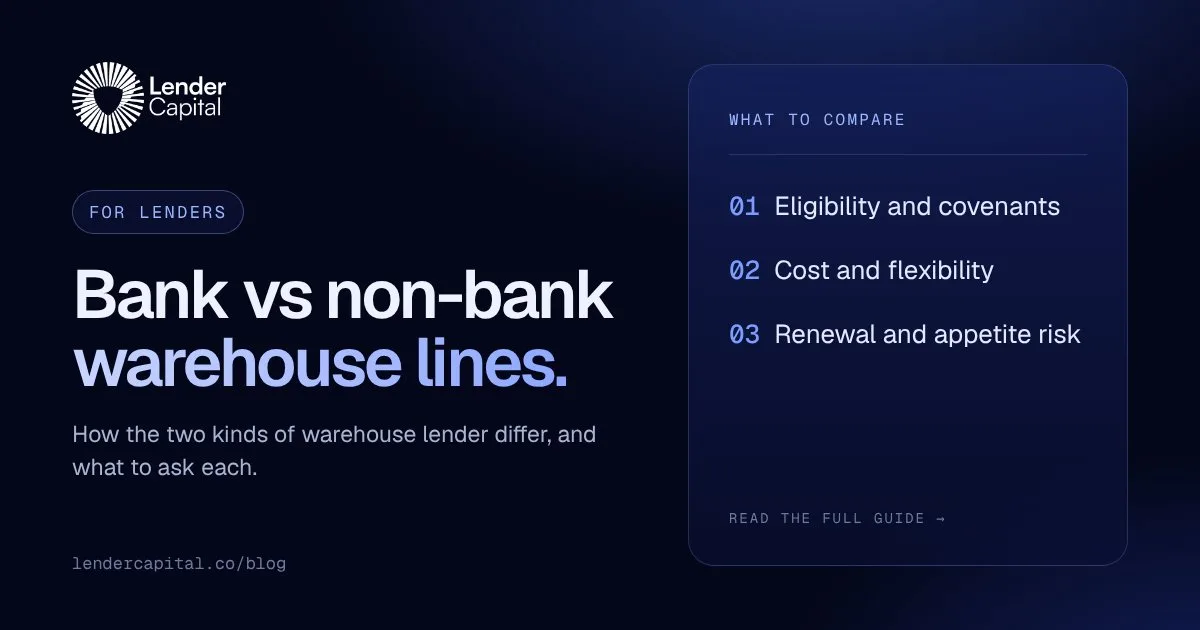
Bank warehouse lenders are regulated institutions that usually offer cheaper money but want established borrowers, tighter eligibility and often a broader banking relationship, while non-bank warehouse lenders, such as credit funds and specialty finance companies, are typically more flexible on loan types and structure but charge more and write different covenants. For a private or hard money lender, the right choice depends on your balance sheet, the loans you make and how much renewal risk you can live with.
Both offer the same product: a revolving line that funds part of each loan you close, secured by the loan. If that is new, start with what warehouse lending is and our guide to the warehouse line of credit for private lenders. If you are deciding whether you need a line at all, see the warehouse line of credit alternative.
Key takeaways
- Banks are regulated, measure large exposures against their capital and tend to lend to established lenders with clean financials, often expecting deposits or a wider relationship.
- Non-bank providers are typically more flexible on loan type, leverage and structure, and typically cost more. Some are themselves funded partly with bank credit lines.
- Covenants, advance rates, aging limits and pricing vary from provider to provider. There is no standard term sheet.
- Every line carries renewal risk and "risk appetite" risk: a provider can tighten terms or exit even when your loans perform.
What is the difference between a bank and a non-bank warehouse lender?
The core difference is regulation and funding. A bank funds its lending largely with deposits and is supervised by bank regulators, so it measures and limits its exposures against its capital. A non-bank provider, such as a private credit fund or specialty finance company, raises money from investors and, often, from banks, and is not subject to the same bank supervision.
The OCC's Concentrations of Credit booklet of the Comptroller's Handbook defines a concentration as obligations exceeding 25 percent of a bank's tier 1 capital plus its allowance for credit losses, and lists exposures to other financial institutions and loans purchased from a single source among the kinds of exposure banks are expected to track. A warehouse line to you is that kind of exposure, competing for room on the bank's balance sheet.
Banks have historically dominated the product. A Federal Reserve Finance and Economics Discussion Series paper on liquidity crises in the mortgage market (FEDS 2018-016) says warehouse lines to non-bank mortgage companies are mostly provided by commercial and investment banks, because warehousing requires scale, risk systems, capital markets access and personnel. A 2025 FEDS Note on bank lending to private credit found that most bank lending to private credit vehicles runs through revolving credit lines, and its authors expect banks to expand further, including through warehouse financing. In other words, a non-bank provider's own capacity may depend partly on its banks.
How do bank warehouse lines typically work for private lenders?
Bank lines typically come with lower pricing and tighter boxes. What you can generally expect, with terms varying by bank:
- Eligibility. Narrower rules on loan type, lien position, loan-to-value, property type and market. Ground-up construction, rural property or heavy-rehab loans may be excluded or capped.
- Underwriting of you. Audited financials, minimum net worth and liquidity, a documented loan history and, often, personal guarantees. The FEDS 2018-016 paper lists covenants that commonly require minimum net worth and unrestricted cash, a cap on liabilities to net worth, and profitability in at least one of the two previous quarters.
- Relationship expectations. Many banks want your operating accounts, reserve balances or other business. How much is a negotiation.
- Short terms. The same paper found that most mortgage warehouse lines with a scheduled maturity ran 364 days or less, so annual renewal is normal.
A bank line usually fits an established lender with clean books, steady volume and standard loans.
How do non-bank warehouse lenders typically differ?
Non-bank providers typically trade cost for flexibility. Again, terms vary widely, but common patterns are:
- Broader collateral. More willingness to finance loan types, markets or leverage levels a bank would cap or exclude.
- Structure. More room to tailor aging limits, sublimits and advance rates to longer-dated bridge or construction loans.
- Cost. Typically a higher interest margin and fees than a bank line. See warehouse funding costs explained for how to add up the all-in cost.
- Different covenants. Fewer relationship requirements, but often tighter reporting, cash controls, minimum usage or exit fees, and sometimes a share of economics.
A non-bank line can suit a lender too young or too specialized for a bank, but read the cost and exit terms as carefully as the advance rate.
Bank vs non-bank warehouse lenders compared
| Bank warehouse lender | Non-bank warehouse lender | |
|---|---|---|
| Regulation | Supervised by bank regulators; exposures measured against capital | Not supervised as a bank; answers to its own investors and funders |
| Typical cost | Usually lower | Typically higher margin and fees |
| Eligibility | Tighter boxes on loan type, leverage and market | Typically broader, more tailored |
| What they want from you | Audited financials, net worth, liquidity, guarantees, often a wider relationship | Strong reporting and controls; requirements vary |
| Covenants | Financial covenants, usually standard | Different mix: cash controls, usage minimums, exit terms |
| Term and renewal | Often about a year, renewed annually | Varies; read maturity and termination terms closely |
| Appetite risk | Can tighten if the bank reduces exposure to a sector | Can tighten if its own funders or investors pull back |
| Best for | Established lenders with standard loans who want low-cost leverage | Lenders with specialized loans or a shorter track record who accept higher cost |
These are tendencies, not rules.
What is renewal and "risk appetite change" risk?
Renewal risk is the chance your line isn't renewed, or is renewed on worse terms; risk appetite risk is the chance the provider decides it wants less of your kind of exposure, whatever your own results. The FEDS 2018-016 paper names both among five vulnerabilities of warehouse funding: roll-over risk at expiry, and changes in warehouse-lender risk appetite. It explains that a bank wanting less mortgage-related risk may find it easier to cut warehouse lending to others than to shrink its own operations, and that warehouse lenders can adjust terms or cancel lines if covenants are breached.
A 2022 Federal Reserve paper on liquidity in the mortgage market found that during the 2020 stress, some warehouse lenders limited which loans were eligible for their lines and were reluctant to fund loans without a government-backed takeout. Business-purpose bridge and construction loans have no such takeout, so they are the kind of collateral that gets squeezed first.
Non-bank providers face the same risk from another direction: if their own funders tighten, they may tighten yours. Either way, plan for the day the line shrinks.
What questions should you ask a bank warehouse lender?
- Which of my loan types, property types and markets are eligible today, and which are capped by sublimits?
- What deposits, accounts or other business do you expect, and is that a condition of the line?
- What are the financial covenants, how are they tested and how often?
- What happens to a loan that ages past the limit, is extended or goes delinquent?
- When can you cut the advance rate or facility size before maturity, and what has happened at renewal for lenders like me?
What questions should you ask a non-bank warehouse lender?
- What is the all-in cost: margin, upfront and renewal fees, unused fees, minimum usage, legal and exit costs?
- How is your facility funded, and what happens to my line if your funding sources tighten?
- Can aging limits and sublimits be set to match a 12- to 24-month bridge or construction loan?
- Do you take any share of loan economics beyond interest and fees?
- What are the termination and wind-down terms, and how have you handled covenant breaches or market stress?
Get answers in writing and have counsel review the credit agreement. This is general information, not legal advice.
Where does direct capital placement fit?
Direct capital placement sits outside the bank-versus-non-bank choice, because it isn't a line at all. You originate the loan, one capital partner reviews the full file and funds the whole loan at closing, and the loan is assigned to it at closing. There is no haircut, renewal date or covenant package on your balance sheet, and the loan's credit risk sits with the capital partner after assignment, subject to the sale terms.
It fits lenders who can't qualify for a warehouse line, who have loans outside a provider's box, or who want a second route that doesn't depend on one provider's appetite. It is usually not the right tool for an established lender that wants to keep loans and their interest income, where a bank line is often the better fit. For the wider menu, see how private lenders fund more loans and outgrowing investor-by-investor funding.
Frequently asked questions
Are non-bank warehouse lenders more expensive than banks?
Typically, yes. Non-bank providers usually charge a higher margin and fees in exchange for broader eligibility and more tailored structure, but pricing varies by provider and by your profile, so compare the all-in cost, not just the rate.
Why do banks turn down private lenders for warehouse lines?
Banks are regulated and measure exposures against their capital, so they tend to want established lenders with audited financials, adequate net worth and liquidity, standard loan types and often a wider relationship. Newer or specialized lenders often don't fit that box yet.
Can a warehouse lender cancel or shrink my line?
Yes. Lines have terms and must be renewed, and credit agreements usually let the provider change terms or end the line if you breach a covenant. Providers can also tighten eligibility at renewal if their risk appetite changes.
Should a private lender have more than one warehouse line?
Many established lenders want more than one funding source so one provider's decision doesn't stop their lending: two lines, or a line plus loan sales or direct capital placement.
How Lender Capital fits
Lender Capital is an alternative to a warehouse line for first-lien, business-purpose real estate loans: bridge, fix and flip, ground-up construction and DSCR rental. You submit a loan with the full file, capital partners see the full file before committing, and one capital partner funds the whole loan at closing, with the loan assigned to it at closing. You keep servicing and the borrower relationship, carry no line covenants or renewal risk, and pay a placement fee from your origination points only when a loan funds. Lenders are reviewed (track record, underwriting, licensing) before submitting. You keep your points and earn a yield spread: you set the borrower's note rate, the capital partner receives its agreed rate, and the difference is yours.
Compare your options on the warehouse line of credit alternative page, or apply as a lender.
Sources
- Office of the Comptroller of the Currency, Comptroller's Handbook: Concentrations of Credit
- Kim, Laufer, Pence, Stanton and Wallace, Liquidity Crises in the Mortgage Market, Federal Reserve Board, Finance and Economics Discussion Series 2018-016
- Berrospide, Cai, Lewis-Hayre and Zikes, Bank Lending to Private Credit: Size, Characteristics, and Financial Stability Implications, FEDS Notes, May 2025
- Karen M. Pence, Liquidity in the Mortgage Market: How does the COVID-19 Crisis Compare with the Global Financial Crisis?, Federal Reserve Board, Finance and Economics Discussion Series 2022-039
Have a loan you can’t fund?
Lender Capital places whole, first-lien loans with capital partners who fund the entire loan. You pay only when it funds.