Warehouse Line Covenants Explained: Net Worth and Liquidity
The financial and operating covenants in a warehouse line of credit, how lenders test them, what a breach triggers, and how private lenders negotiate them.
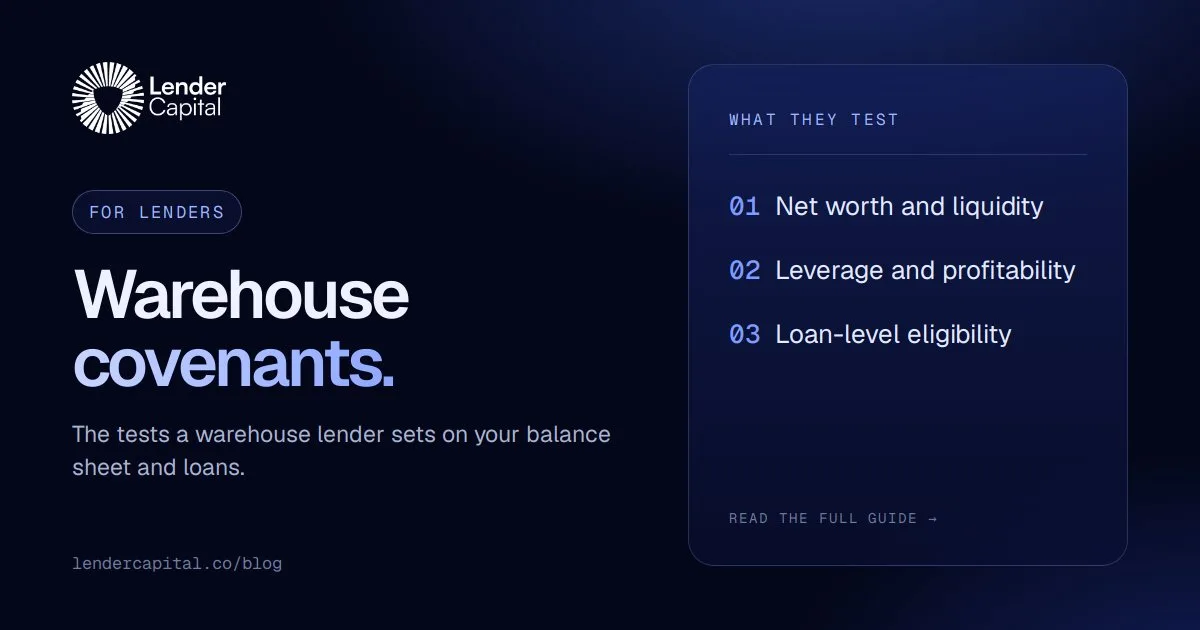
Warehouse line covenants are the tests a warehouse lender sets on your business while the line is open. The usual financial covenants are a minimum tangible net worth, a minimum level of unrestricted cash, a maximum leverage ratio (liabilities to net worth) and a profitability test. Operating covenants then limit which loans can go on the line, how long they can stay and how you must report. Breaking a covenant can be an event of default, so you need to understand each test before you sign.
This guide explains each covenant, how it is measured, what happens on a breach and what is worth negotiating. If you are still deciding whether a line is right for you, our warehouse line of credit alternative page sets out the options side by side.
Key takeaways
- Financial covenants test your balance sheet: tangible net worth, unrestricted cash, leverage and profitability.
- Operating covenants test your loans and operations: eligibility, concentration, dwell time, reporting and servicing.
- The definitions matter as much as the numbers: what counts as "tangible", "unrestricted" or "debt" decides whether you pass.
- A breach can lead to a default, higher pricing, a lower advance rate or a frozen line, so keep headroom and test monthly.
- Cash held to meet a liquidity covenant is capital you can't lend, which is part of the real cost of a line.
What are warehouse line covenants?
Covenants are promises in the credit agreement. Affirmative covenants say what you must do (deliver financial statements, keep insurance, service loans to a standard). Negative covenants say what you must not do (take on other debt above a limit, pay distributions while in breach, change control). Financial covenants are numeric tests, usually measured at each month or quarter end.
Warehouse lenders use them because a warehouse line is short-term, revolving credit secured by loans you originate. The lender is relying on two things: the loans on the line, and your ability to stand behind them if a loan goes bad or can't be sold or refinanced. Federal Reserve staff research on warehouse lines to nonbank mortgage originators describes common covenants such as minimum net worth, minimum unrestricted cash, maximum liabilities-to-net-worth ratios and profitability tests, and notes that warehouse lenders can adjust terms or cancel lines when covenants are broken (Kim, Laufer, Pence, Stanton and Wallace, FEDS 2018-016). That study covers residential originators, but business-purpose lines use the same building blocks.
For how the line itself works, see what warehouse lending is, and for what a lender looks for before approving you, warehouse line requirements for private lenders.
The financial covenants
Minimum tangible net worth
A tangible net worth covenant requires your net worth, after removing intangible assets, to stay above a floor. Intangibles typically include goodwill, capitalized software and sometimes amounts owed by affiliates or owners. The definition decides the outcome: a lender with a large receivable from its principal may find that asset excluded.
Some agreements also require net worth to grow (for example, the floor steps up by a share of each year's net income), or cap distributions so equity stays in the business.
Minimum unrestricted cash (liquidity)
A liquidity covenant requires a minimum balance of cash that is not pledged, held in escrow or otherwise restricted. Some agreements count undrawn availability on other committed lines; many do not. Borrower escrows, reserves you hold for others and cash at a pledged account usually don't count.
This is the covenant with the most direct cost. Cash held to pass the test is cash you can't put into loans.
Maximum leverage
A leverage covenant caps total liabilities (or total debt) relative to tangible net worth. What counts as a liability matters: the warehouse balance itself, other credit lines, guarantees you have given and sometimes off-balance-sheet obligations. As you draw more on the line, leverage rises, so the covenant effectively limits how far you can grow on that capital base.
Profitability
A profitability test might require positive net income over a rolling period, or forbid net losses in consecutive quarters. A single bad quarter, for example after a large write-down on one loan, can trip it even when the rest of the book performs.
How the tests fit together
| Covenant | What it measures | Typical test frequency | Common definition questions |
|---|---|---|---|
| Tangible net worth | Equity minus intangibles | Monthly or quarterly | Are affiliate receivables and capitalized costs excluded? |
| Unrestricted cash | Cash not pledged or held for others | Monthly, sometimes continuously | Does undrawn availability elsewhere count? |
| Leverage | Liabilities ÷ tangible net worth | Monthly or quarterly | Are guarantees and other lines included? |
| Profitability | Net income over a period | Quarterly | Is it one quarter, two in a row, or rolling twelve months? |
The frequencies above are illustrative. Your agreement sets the real ones.
The operating and collateral covenants
These are usually where day-to-day friction comes from.
- Eligibility criteria. Only loans that meet the line's eligibility criteria can be pledged: property types, states, loan sizes, LTV and lien position. A loan that falls outside gets no advance.
- Advance rate and haircut. The line funds a share of each loan (the advance rate); the rest, the haircut, is your equity. Some agreements lower the advance rate on aged or modified loans.
- Concentration limits. A concentration limit caps how much of the line can be in one borrower, one state, one loan type or loans above a size.
- Dwell time. Dwell time limits how long a loan can stay on the line before it must be sold, refinanced or repaid. A loan past the limit may lose its advance, which you then have to cover with cash.
- Reporting. Monthly loan tapes, financial statements, covenant compliance certificates and notice of material events such as a borrower default or litigation.
- Servicing and custody. Standards for servicing, delivery of original notes to a custodian, and audit or field exam rights.
- Guarantees. Many lines require a personal guarantee from the principals, which puts their own assets behind the covenants.
What happens if you breach a covenant?
A breach is usually an event of default, though many agreements give a short cure period for some covenants. What follows depends on the agreement and on the lender:
- Waiver. The lender agrees in writing to waive the breach, often for a fee.
- Amendment. The lender resets the covenant, and may raise the spread, lower the advance rate or tighten other terms in exchange.
- Margin call or paydown. The lender asks you to reduce the balance, sometimes through a margin call on specific loans.
- Stop funding. The lender stops advancing on new loans while existing advances stay outstanding.
- Acceleration. In a serious case, the lender declares the balance due and can enforce against the pledged loans and any guarantees.
Cross-default clauses mean a breach on one facility can trigger defaults on others. If you have more than one line, read them together.
A hypothetical worked example
Every number below is hypothetical and chosen only to show the method. None is a quote, a market term or a Lender Capital term.
A lender has a hypothetical $6 million line with these covenants: tangible net worth of at least $2.5 million, unrestricted cash of at least $750,000, and liabilities no more than 3.5 times tangible net worth.
| Start of quarter | After a write-down | |
|---|---|---|
| Total equity | $3,200,000 | $2,900,000 |
| Less: receivable from the owner (excluded) | $300,000 | $300,000 |
| Tangible net worth | $2,900,000 | $2,600,000 |
| Total liabilities (the line plus other borrowings) | $8,700,000 | $8,700,000 |
| Leverage (liabilities ÷ TNW) | 3.0x | 3.35x |
| Unrestricted cash | $900,000 | $900,000 |
At the start of the quarter the lender passes every test with room to spare. After a $300,000 write-down on a single loan, it still passes, but leverage is at 3.35x against a 3.5x cap and tangible net worth is $100,000 above its floor. One more drawdown or one more loss and it breaches.
Two lessons follow. First, model the tests forward each month, not just at quarter end. Second, the $750,000 the lender must keep in cash is capital it can't lend. At a hypothetical 11% note rate, that idle cash could have funded loans earning about $82,500 a year in interest. To model the full cost of a line, including this, use the warehouse line cost calculator and our guide to warehouse funding costs.
How to negotiate warehouse covenants
You won't change every term, but the definitions are often more open than the headline numbers.
- Fix the definitions. Agree what counts as intangible, unrestricted and debt before you sign. Ask whether undrawn committed availability counts toward liquidity.
- Ask for headroom. Set floors and caps you can meet with margin through a bad quarter, not just today.
- Get cure periods. Ask for time to cure a breach, by adding equity or paying down the line, before it becomes a default.
- Use rolling periods. A rolling twelve-month profitability test is less likely to trip on one bad quarter than a single-quarter test.
- Limit cross-default. Narrow cross-default to material, uncured defaults on other debt.
- Match eligibility to your book. Make sure the eligibility criteria and concentration limits fit the loans you actually make, or the line won't fund them.
- Read the guarantee. Understand what triggers it and whether it is capped.
Have counsel review the credit agreement, the guarantee and any custodial or bailee agreements. Lenders differ in how they write these, as our comparison of bank vs non-bank warehouse lenders explains.
When covenants make a warehouse line the wrong fit
Covenants suit a lender with a strong, steady balance sheet and predictable volume. They are harder for a newer lender, a lender with lumpy volume, or one whose equity is mostly committed to its own loans. If meeting the liquidity and net worth tests would hold back capital you need to lend, compare other ways to fund loans. Our warehouse line of credit alternative page compares a line with direct capital placement, whole loan sales and other options, and is fair about when a line is the better choice.
Frequently asked questions
What are typical warehouse line covenants?
Most warehouse lines include financial covenants for minimum tangible net worth, minimum unrestricted cash, maximum leverage and profitability, plus operating covenants on loan eligibility, concentration, dwell time, reporting and servicing. The exact numbers and definitions are set in each credit agreement.
What happens if you break a warehouse line covenant?
A covenant breach is usually an event of default, sometimes after a cure period. The lender may waive it for a fee, amend the terms, call for a paydown, stop funding new loans or, in serious cases, accelerate the line.
What is a tangible net worth covenant?
It requires your net worth, after removing intangible assets such as goodwill and certain affiliate receivables, to stay above a set minimum. The agreement's definition of what is excluded decides whether you pass.
How Lender Capital fits
Lender Capital offers direct capital placement for first-lien, business-purpose real estate loans. You submit the loan, one capital partner reviews the full file and funds the whole loan at closing, and the loan is assigned to it at closing. There is no line, so there are no line covenants, no haircut and no idle cash to hold. You keep servicing and the borrower relationship, you keep your points (less a placement fee paid at closing only when the loan funds), and you earn a yield spread: price the note above the capital partner's agreed rate and the difference is yours.
Many lenders use both: a warehouse line for the loans they want to hold, and placement for the rest. Compare the options on our warehouse line of credit alternative page, see how it works for lenders, or apply as a lender.
Sources
- Kim, Laufer, Pence, Stanton and Wallace, Liquidity Crises in the Mortgage Market, Finance and Economics Discussion Series 2018-016, Board of Governors of the Federal Reserve System
- Office of the Comptroller of the Currency, Comptroller's Handbook, Asset-Based Lending
Have a loan you can’t fund?
Lender Capital places whole, first-lien loans with capital partners who fund the entire loan. You pay only when it funds.