How Non-Performing Loans Are Priced: The Note Buyer's Math
How note buyers price a non-performing real estate loan, step by step: collateral value, costs, timeline, exit scenarios and a target return, with a worked example.
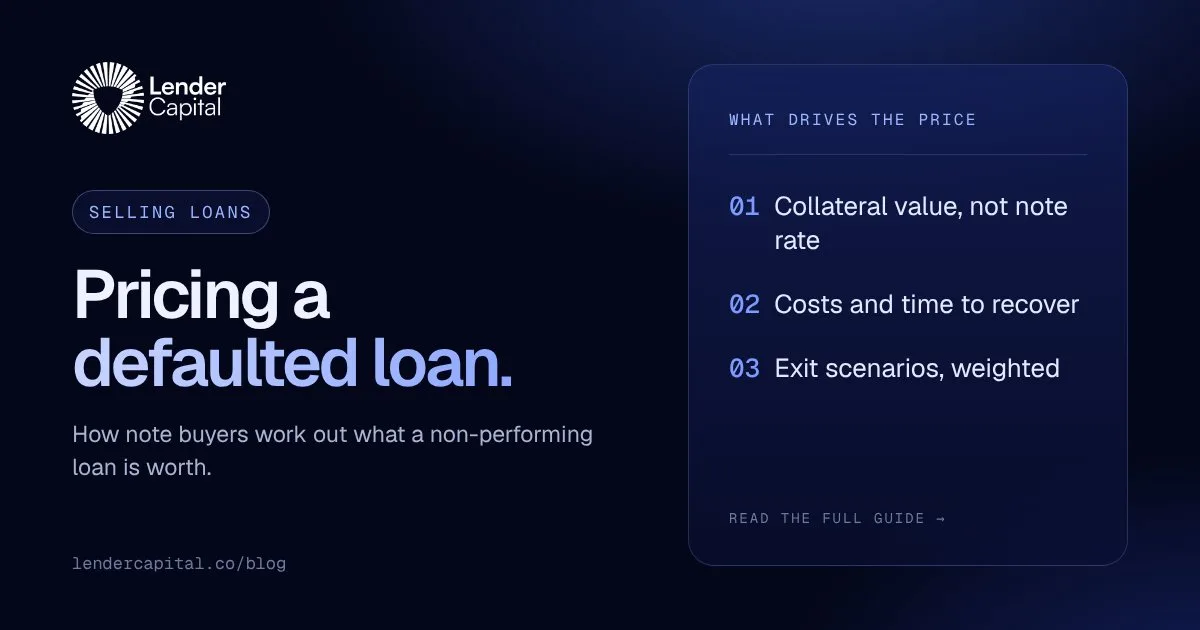
Note buyers price a non-performing loan on what they expect to recover, not on the note rate. They start from the collateral's value today, subtract every cost between now and cash in hand (senior taxes, legal fees, holding costs, repairs, sale costs), estimate how long each likely exit takes, weight those exits, and discount the result at the return they need. The bid is usually a discount to the unpaid principal balance.
This guide walks through that math step by step, with a worked example, so a lender, bank or fund selling a defaulted loan can set a realistic asking price, and a buyer can check its own model. Every number here is a hypothetical example, not a market price or a Lender Capital price. To sell a loan, start at sell your loans or go straight to selling non-performing notes.
How are non-performing loans priced?
A non-performing loan is priced as a recovery. The buyer estimates the property's value, subtracts senior claims and the costs of resolving the loan, discounts each likely outcome (payoff, deed in lieu, foreclosure and sale) for the time it takes at its target return, and weights the outcomes. That weighted present value, less a margin for uncertainty, is its bid.
Why the note rate barely matters
On a performing note, the buyer is buying a stream of payments, so the note rate drives the price (see how loan buyers price bridge and DSCR loans). A non-performing loan pays nothing today. What the buyer can collect is capped by the lower of two numbers: the total debt (principal, interest, default interest and fees the documents allow) and what the collateral will net in a sale. On most defaulted loans the collateral is the binding limit, so the price follows the property.
The five inputs every buyer models
| Input | What the buyer asks | Where it comes from |
|---|---|---|
| 1. Collateral value | What would the property sell for today, as is? | A broker price opinion, a desktop review or a recent appraisal |
| 2. Senior claims | What gets paid before the lender? | Property tax status, municipal liens, HOA, mechanics' liens, a title search |
| 3. Costs to resolve | What will legal, holding, repairs and selling cost? | State foreclosure process, property condition, local sale costs |
| 4. Timeline | How long until cash is in hand? | Judicial or non-judicial state, the foreclosure stage, borrower bankruptcy risk |
| 5. Target return | What annual return does the buyer need for this risk? | The buyer's own cost of capital and strategy |
1. Collateral value
Buyers rarely pay for a full appraisal before bidding. They use a broker price opinion (exterior or interior), an automated value, or their own comparable sales, and then haircut it for condition if they can't get inside. A vacant, damaged or partly built property gets a lower value and higher costs. If the seller has a recent valuation, sharing it saves time; buyers will still check it.
2. Senior claims
Unpaid property taxes usually rank ahead of the mortgage, and some municipal liens do too. A buyer subtracts them in full. Title problems (a missing assignment, a gap in the chain, an unrecorded release) add cost and time, so buyers price them in or walk away.
3. Costs to resolve
Legal fees and court costs, a receiver if needed, property insurance, taxes that accrue while the loan is resolved, maintenance and securing a vacant property, repairs to sell, and the broker and closing costs of the eventual sale. In a judicial foreclosure state, legal costs and timelines are typically higher than in a non-judicial (trustee sale) state.
4. Timeline
Time is the biggest swing factor. A buyer discounts every future dollar at its target return, so a recovery that takes 30 months is worth far less today than the same recovery in 12. The foreclosure stage matters: a loan with a sale date already set is closer to cash than one where no notice has gone out. A borrower bankruptcy filing pauses enforcement under the automatic stay and stretches the timeline.
5. Target return
Every buyer has its own required return, set by its cost of capital and how much risk it is taking. Two buyers with the same view of the property can bid very differently because their target returns differ. That is one reason to show a loan to more than one buyer.
The likely exits, weighted
A defaulted loan rarely has one outcome. Buyers model several and weight them:
- Reinstatement or payoff: the borrower catches up, refinances or sells the property and pays off the loan. Fast and full, but not something to count on.
- Modification or payment plan: the loan starts paying again and becomes a re-performing loan, which the buyer may hold or later sell.
- Deed in lieu of foreclosure: the borrower hands over the property, saving time and legal cost.
- Foreclosure and sale: the slowest and costliest path, and the one the price must survive. If the lender ends up owning the property, it becomes REO to be sold.
Conservative buyers price the foreclosure path first, then treat faster exits as upside.
A worked example
Hypothetical, for illustration only. A lender holds a defaulted first-lien bridge loan on a single-family rental:
- Unpaid principal balance: $400,000. Accrued interest and fees the documents allow: $40,000. Total debt: $440,000.
- As-is value from a broker price opinion: $460,000.
- Unpaid property taxes: $12,000.
- The property is in a non-judicial foreclosure state; a notice of default has been sent.
The buyer's target return in this example is 15% a year.
| Path | Cash in | Costs | Net | When | Present value at 15% |
|---|---|---|---|---|---|
| Payoff | $440,000 | $5,000 legal | $435,000 | 6 months | about $405,600 |
| Foreclosure and sale | $460,000 sale | $12,000 taxes, $15,000 legal, $20,000 holding, $36,800 sale costs (8%) | $376,200 | 15 months | about $315,900 |
The buyer thinks a payoff has a 30% chance and the foreclosure path 70%. The weighted value is about $342,800, or roughly 86% of the unpaid balance. After a margin for what it can't see (condition inside, title surprises), it might bid somewhere below that, say in the low-to-mid 80s as a percentage of the balance.
Same loan, judicial state. Move the property to a state where foreclosure runs through the courts. Assume legal costs of $30,000, holding costs of $40,000 and a 32-month timeline. The foreclosure path is now worth about $235,000 today, and the weighted value falls to about $286,200, roughly 72% of the balance. Nothing about the borrower or the property changed: only the time and cost to recover.
What sellers can do to get a better price
- Hand over a clean data tape and file. Balance, rate, pay string, default date, foreclosure stage and the dates of every notice, plus the note, security instrument, title policy and servicing notes. See the loan tape. Every unknown becomes a discount.
- Share a current valuation. A recent broker price opinion or appraisal narrows the buyer's range.
- Pay or document senior taxes. Buyers subtract them in full anyway; clarity helps.
- Disclose everything about the default up front. Buyers find it in diligence; surprises cost more than disclosures.
- Show the loan to more than one buyer. Target returns differ. So do views on a market.
- Price against the recovery, not the balance. An asking price at par on a loan the collateral can't cover won't trade.
What buyers should check before trusting the model
- The value: drive by or get inside if you can; check the comparable sales yourself.
- The chain of title to the note: endorsed original note, any allonges, recorded assignments.
- Every senior lien and tax.
- The state's foreclosure process and current court backlogs, from local counsel.
- Bankruptcy, litigation or borrower defenses noted in the servicing file.
- Guarantors: a personal guarantee can add a recovery path, or not, depending on the guarantor.
Key takeaways
- A non-performing loan is priced as a recovery, capped by the lower of the total debt and the collateral's net sale value.
- Five inputs drive the price: collateral value, senior claims, costs, timeline and the buyer's target return.
- Time is the biggest swing factor: the same loan is worth much less in a long-timeline state.
- Buyers weight several exits but make sure the price survives the foreclosure path.
- Sellers get better bids with a complete file, a current valuation and full disclosure.
Frequently asked questions
Something else? info@lendercapital.co
They estimate the property's as-is value, subtract senior taxes and liens and the legal, holding and sale costs of resolving the loan, estimate how long each likely outcome takes, and discount the weighted result at their target return. The note rate matters little because the loan isn't paying.
Because the buyer is paying today for a recovery that comes later and costs money to collect: legal fees, holding costs, senior taxes and time. The discount pays for that work and risk. A loan with strong collateral in a fast foreclosure state usually needs a smaller discount than one with thin equity in a slow state.
A data tape with the balance, rate, payment history, default date and foreclosure stage, plus the note and any allonges, the recorded security instrument and assignments, the title policy, a recent valuation, tax status, and the servicing notes and default notices. The more complete it is, the fewer unknowns the buyer has to price.
How Lender Capital fits
Lender Capital is a business-to-business platform where lenders, banks, credit unions and funds sell whole, first-lien, business-purpose loans, performing or not. A non-performing loan is sold as is, with the default disclosed in full, and goes only to capital partners that buy non-performing loans and whose criteria it fits. They review the full file before committing, you choose who to sell to and agree the price, and the sale settles through an escrow agent. Lender Capital never buys loans with its own money and doesn't publish prices. The buyer pays the sale fee, only if the sale closes.
Selling a loan? Apply as a lender. Buying notes? Apply as a capital partner. Each takes a minute.
Have a loan you can’t fund?
Lender Capital places whole, first-lien loans with capital partners who fund the entire loan. You pay only when it funds.