
How Private Lenders Make Money: Points, Spread and Servicing
Where a private lender's income comes from: origination points, interest spread, fees and servicing, and how holding, warehousing or placing loans changes it.
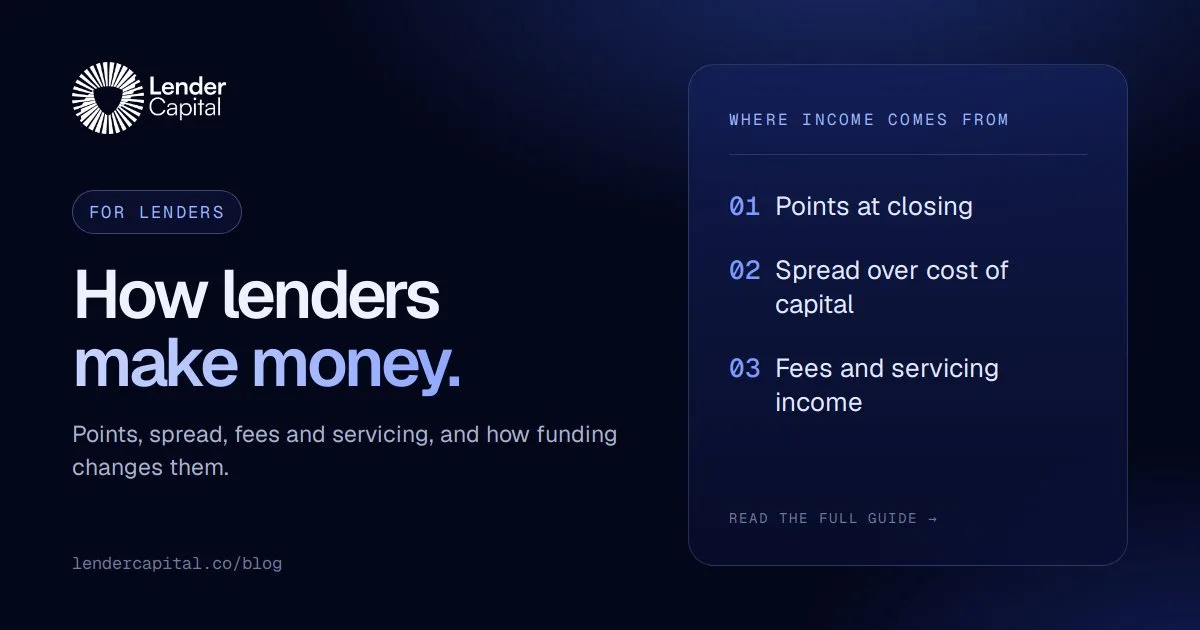
Private lenders make money in four ways: origination points charged at closing, the interest spread between the note rate and their own cost of capital, fees such as underwriting, draw and extension fees, and servicing. How a lender funds its loans, whether with its own money, a fund, a warehouse line or a capital partner, decides how much of each it keeps, how much capital it ties up and how much risk it carries.
This guide breaks down each income stream, the costs set against them, and how the funding model changes the economics, with a hypothetical worked example. For the funding side, our pillar guide to how private lenders fund more loans covers the options in depth.
Key takeaways
- Points are earned at closing, whatever happens to the loan later, which makes them the most predictable income on short-term loans.
- Interest spread is the note rate minus your cost of capital. It is only as good as your pricing and your credit results.
- Fees add up, but they must be disclosed, consistent with the loan documents and permitted in the state.
- Servicing pays a modest ongoing fee and keeps you close to the borrower.
- The funding model changes everything: holding a loan maximizes interest income but uses your capital and risk; placing it frees your capital while you keep points and a yield spread.
How do private lenders make money?
A private lender's income comes from the loans it originates and, if it keeps them, from the loans it holds. The simplest way to see it is to follow one loan.
1. Origination points
Origination points are an upfront fee, expressed as a percentage of the loan amount: one point is 1% of the loan. On a hypothetical $500,000 loan, 2 points is $10,000, usually paid from loan proceeds at closing.
Points pay the lender for sourcing, underwriting and closing the loan. Because they are earned at closing, they don't depend on how long the loan stays outstanding. On a 12-month bridge loan that pays off in six months, the points are the same; the interest is half. For how points fit into pricing, see how private lenders price a loan.
2. Interest spread
The note rate is what the borrower pays on the outstanding balance. The lender's interest income is the difference between that rate and what its own capital costs:
- Own capital: the whole note rate is income, but the capital has an opportunity cost, and it can only be lent once.
- Investor or fund capital: the lender (or its fund) pays investors a return, and keeps the difference.
- A warehouse line: the lender pays the line's rate on the advance and funds the haircut with its own equity.
- A capital partner (placement or loan sale with servicing retained): the partner receives its agreed rate and the lender keeps the difference as a yield spread.
Spread income is only real if the loan performs. A loss on one loan can wipe out the spread on several others, which is why credit discipline matters as much as pricing. When your cost of capital moves, your pricing needs to move with it; see how to price loans when your cost of capital changes.
3. Fees
Common lender fees include:
- Underwriting or processing fees, charged at closing.
- Draw and inspection fees on construction and rehab loans, charged per draw.
- Extension fees when a borrower needs more time, often a percentage of the balance.
- Exit fees or minimum interest, which protect income when a loan pays off early.
- Late fees and default interest, which compensate for the cost of a late or defaulted loan.
Fees must be disclosed on the term sheet and written consistently into the loan documents. Rules on fees, default interest and prepayment terms vary by state and by loan type, and business-purpose loans may be treated differently from consumer loans. Have counsel review your program.
4. Servicing
Servicing means collecting payments, managing escrows and draws, handling extensions and working out defaults. A lender that services loans it doesn't own (for a fund, investors or a capital partner) is usually paid for it, either as a servicing fee or through the spread it keeps. Servicing income is modest per loan but recurring, and servicing keeps the borrower relationship, which brings repeat business. See loan servicing in private lending for who does what.
What costs come out of that income?
Gross income is not profit. Set against it:
- Cost of capital: investor returns, warehouse interest and fees, or the opportunity cost of your own money.
- Credit losses: write-downs, foreclosure costs and carrying costs on defaulted loans.
- Origination costs: marketing, broker referral fees where permitted, and underwriting staff.
- Servicing costs: staff, systems, inspections and escrow administration.
- Legal, compliance and insurance.
- Overhead: office, software, accounting and audit.
A lender with high points but frequent losses can earn less than one with modest pricing and a clean book.
How the funding model changes what you keep
| Funding model | Points | Interest income | Your capital per loan | Credit risk |
|---|---|---|---|---|
| Own balance sheet | You keep them | The full note rate, less the opportunity cost of your capital | The whole loan | Yours |
| Fund or pooled investors | Usually the lender or manager, per the fund documents | Note rate less investor returns, shared as the fund documents set | Depends on the fund | The fund's |
| Warehouse line | You keep them | Note rate less the line's all-in cost | The haircut | Yours |
| Direct capital placement | You keep them, less a placement fee | A yield spread above the capital partner's agreed rate | None | The capital partner's |
| Whole loan sale after closing | You keep them | Often none on that loan, unless you retain servicing and a spread | Until the sale | The buyer's after the sale |
Balance-sheet lending earns the most interest per loan but limits how many loans you can make. A warehouse line stretches your capital but adds fixed costs and covenants; see warehouse funding costs explained and warehouse line covenants explained. Placement and loan sales turn each loan into income you can earn again with the same capital. Our warehouse line of credit alternative page compares these side by side and is fair about when a line is the better fit.
A hypothetical worked example
Every number below is hypothetical and chosen only to show the method. None is a market rate or a Lender Capital term, except the placement fee, which comes from Lender Capital's published fee schedule.
A lender makes a $500,000, 12-month bridge loan at a 12% note rate with 2 points, and the loan runs the full 12 months.
Held on the balance sheet. The lender earns $10,000 in points and $60,000 in interest. It has tied up $500,000 of its own capital for a year, and it carries the full credit risk. If its capital could earn a hypothetical 8% elsewhere, the opportunity cost is $40,000.
Placed with a capital partner. A capital partner funds the whole loan at closing at a hypothetical agreed rate of 10%. The lender keeps its points, less Lender Capital's placement fee of 1.00% of the loan amount ($5,000 on $500,000, paid at closing from the points), and keeps the 2% difference between the note rate and the partner's rate as a yield spread while it services the loan.
| Held | Placed | |
|---|---|---|
| Points | $10,000 | $10,000 |
| Placement fee | – | –$5,000 |
| Interest or yield spread | $60,000 | $10,000 (2% of $500,000) |
| Income on this loan | $70,000 | $15,000 |
| Your capital tied up | $500,000 | $0 |
| Credit risk | Yours | The capital partner's |
Holding earns more on one loan. But the held loan uses $500,000 of capital for a year, while the placed loan uses none. If the lender has more good borrowers than capital, it can place several loans with the capital that one held loan would use, keeping points and a spread on each. You can run your own numbers in the lender spread calculator, and our guide on how to grow origination volume without raising a fund shows how lenders combine the two.
How to improve what you earn
- Price every loan to a target. Know your cost of capital, expected losses and costs, and set rate and points to clear them.
- Protect early payoffs. Points and appropriate minimum interest or exit terms keep short loans worthwhile.
- Keep the file clean. Complete files fund faster and cost less to service and to sell.
- Watch credit closely. One avoidable loss can cost more than a year of spread on several loans.
- Match funding to the loan. Hold the loans you want to keep, and place or sell the rest so capital keeps working.
- Keep servicing where you can. It is recurring income and it protects the borrower relationship.
Frequently asked questions
How do hard money lenders make money?
Hard money lenders earn origination points at closing, interest on the loans they hold (or a spread above their cost of capital), fees such as underwriting, draw and extension fees, and servicing income. How they fund each loan decides how much of the interest they keep.
Do private lenders make money on points or interest?
Both. Points are earned at closing and don't depend on how long the loan lasts, while interest is earned over the loan's life. Lenders who place or sell loans often rely more on points and a yield spread than on the full interest.
How does a lender make money if a capital partner funds the loan?
The lender keeps its origination points, less any placement fee, and sets the note rate above the capital partner's agreed rate, keeping the difference as a yield spread while it services the loan. The capital partner earns most of the interest and carries the credit risk.
How Lender Capital fits
Lender Capital offers direct capital placement for first-lien, business-purpose real estate loans. You submit the loan, one capital partner reviews the full file and funds the whole loan at closing, and the loan is assigned to it at closing. You keep servicing and the borrower relationship. You keep your points and earn a yield spread: price the note above the capital partner's rate and the difference is yours. The placement fee is paid at closing from your points, and only when the loan funds. You can also sell performing whole loans you already funded, through loan sales.
Read more in how private lenders fund more loans and on table funding, see how it works for lenders, or apply as a lender.
Have a loan you can’t fund?
Lender Capital places whole, first-lien loans with capital partners who fund the entire loan. You pay only when it funds.

