How to Price a Fix-and-Flip Loan
A step-by-step method for pricing fix-and-flip loans as a private lender, from cost of capital and leverage tiers to points, draw and extension fees, with a worked example.
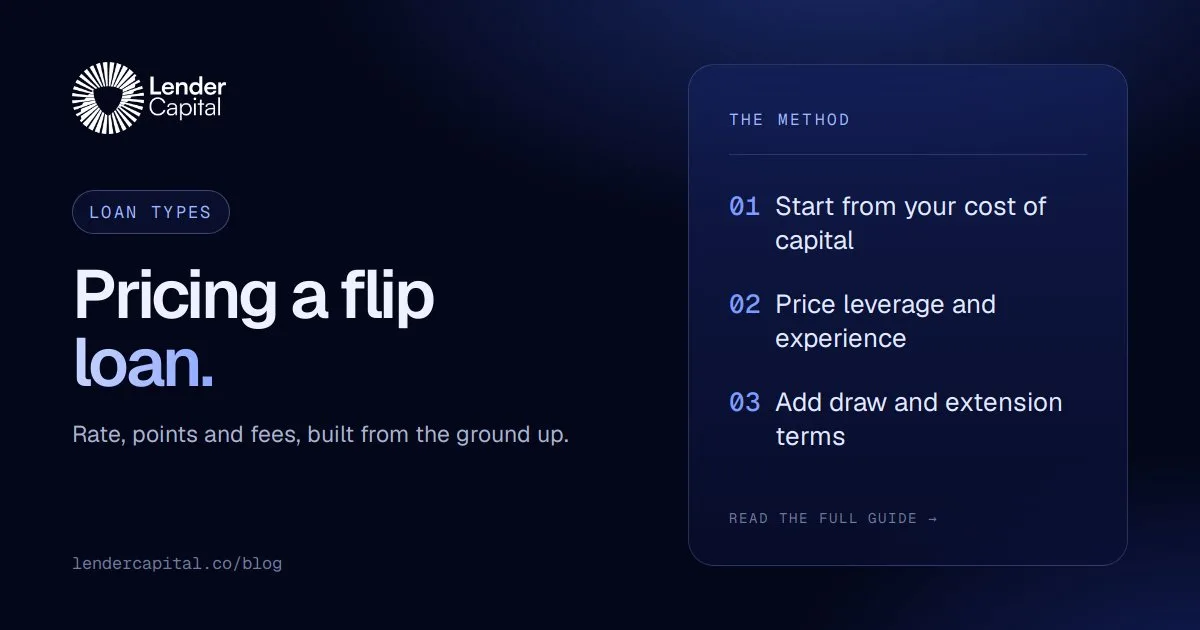
To price a fix-and-flip loan, start from your cost of capital, add a margin that pays you for the work and the risk, then adjust the note rate and points for leverage, borrower experience, project scope and term, and set draw, extension and minimum-interest terms so the loan still pays you if it runs long or pays off early. The borrower compares the whole package, not just the rate, so price the package: rate, points and fees together, over the loan's realistic life.
This guide gives a repeatable method with a worked example. For the general components of loan pricing (rate, points, fees, yield vs. coupon) read how private lenders price a loan; for underwriting the rehab budget and after-repair value, read fix and flip loans: rehab budgets and ARV. This article is about turning that underwriting into a price.
Key takeaways
- Start from your cost of capital, the rate the money behind the loan costs you, whether that's your own capital, a line or a capital partner's agreed rate.
- Add a margin for origination, servicing, draw management and the risk you keep.
- Tier by leverage and experience: higher loan-to-cost or loan-to-ARV and less experienced borrowers cost more.
- Points pay you at closing; rate pays you over time. Use both deliberately.
- Draw, extension, minimum-interest and exit terms protect your yield when the project changes.
- Compare quotes on total borrower cost over a realistic term, and check your own yield over the same term.
Step 1: Know your cost of capital
Every fix-and-flip price sits on top of what the money costs you. Depending on how you fund the loan:
- Your own capital: the return you require on equity, or could earn elsewhere.
- A warehouse or credit line: the line's rate on the advance, plus fees and the cost of your haircut capital. See the warehouse line cost calculator.
- Individual investors: the rate you pay them, plus your time raising it.
- A capital partner (table funding): the partner's agreed rate on the loan, and any placement fee out of your points.
If your cost of capital changes, your prices should too. See how to price loans when your cost of capital changes.
Step 2: Set your target margin
Your margin pays for what you do beyond providing money:
- Origination and underwriting: finding the deal, reviewing the borrower, the scope and the ARV.
- Draw management: inspections, approvals, lien waivers, disbursements. See construction draw management.
- Servicing: collections, reporting, extensions, borrower questions.
- Risk you keep: if you hold the loan or finance it on a line, the credit risk is yours; if a capital partner owns it, your risk is mostly in how well you underwrote and service it.
Decide your margin in two parts: what you need at closing (points) and what you need over time (rate spread).
Step 3: Tier by leverage
Leverage is the biggest single risk driver in a fix-and-flip loan. Most lenders measure two ratios:
- Loan-to-cost (LTC): the loan against purchase price plus rehab budget.
- Loan-to-ARV: the loan against the after-repair value.
See LTV vs. LTC vs. ARV for how each is calculated. Higher leverage means less borrower equity to absorb a budget overrun or a softer sale price, so it should cost more.
Step 4: Tier by borrower experience
A borrower with many completed flips in your market is a different risk from a first-time investor. Lenders commonly tier on the number of completed projects in the last few years, verified with settlement statements and before-and-after evidence. See verifying an investor's track record.
Step 5: Adjust for project and market
- Scope: cosmetic updates carry less execution risk than structural work, additions or permits.
- Budget quality: a line-item budget with contractor bids is lower risk than a lump sum.
- Market: how deep the buyer pool is for the finished property, and how long sales take.
- Property type: single-family, small multifamily or mixed-use carry different exits.
- Exit plan: sale vs. refinance into a rental loan.
Step 6: Build a pricing grid
Put Steps 3 to 5 into a simple grid so quotes are consistent. Hypothetical example, not market data and not any lender's or capital partner's terms:
| Borrower experience | LTC up to 75% | LTC 75% to 85% | LTC 85% to 90% |
|---|---|---|---|
| 5+ completed flips | Base rate, base points | Base + 0.5% rate | Base + 1.0% rate, + 0.5 point |
| 2 to 4 completed flips | Base + 0.5% rate | Base + 1.0% rate | Base + 1.5% rate, + 0.5 point |
| 0 to 1 completed flips | Base + 1.0% rate | Base + 1.5% rate, + 0.5 point | Case by case |
Add adjustments for heavy scope, weaker markets or unusual property types. Many lenders also cap loan-to-ARV regardless of the tier.
Step 7: Choose points vs. rate
Points and rate both pay you, but differently:
- Points are paid at closing and earned even if the loan pays off early. They protect you on short loans.
- Rate is earned over time. On a loan that runs long, rate matters more.
Short, fast flips favor points; longer projects favor rate. Borrowers who expect to exit quickly often prefer a lower rate and more points, and the reverse for longer projects. Compare the total.
Step 8: Set draw, extension and protective terms
These terms keep the loan paying you when the project changes:
- Interest on disbursed funds vs. the full commitment. Charging interest only on what has been drawn is more borrower-friendly; charging on the full loan amount (sometimes called "Dutch interest") earns more on the undrawn holdback. Be clear which you use, and check state law.
- Draw fees: per-draw or per-inspection fees that cover your costs.
- Extension terms: the fee and conditions for extending the term, set before closing. See extension requests on bridge loans.
- Minimum interest or exit fee: a minimum number of months of interest, or a fee at payoff, that protects your yield on very short loans.
- Interest reserve: whether interest is prepaid from a reserve built into the loan. See interest reserves.
- Default terms: default rate and late fees, within the limits your state allows.
Step 9: Check total borrower cost and your yield
Borrowers compare quotes on total cost: points, interest, fees and the terms that change them. Model three scenarios: early payoff, expected payoff and an extension. Check your own yield in each.
A worked example
Hypothetical, round numbers; not market rates or any capital partner's terms.
The project. Purchase price $320,000, rehab budget $80,000, total cost $400,000. Appraised ARV $560,000. Borrower: four completed flips in the last three years. Expected term: 8 months. Loan term offered: 12 months.
The loan. 85% of cost: $340,000, made of $260,000 at closing toward the purchase and an $80,000 rehab holdback released in draws. Loan-to-ARV: about 61%.
Cost of capital. The lender plans to table fund the loan with a capital partner at an agreed 10% rate, with Lender Capital's standard placement fee from the lender's points: 1.00% of the loan amount, $2,500 minimum.
Pricing from the grid. The lender's hypothetical base is an 11% rate and 2 points for its best tier. The borrower is in the 2-to-4 flips tier at 75% to 85% LTC: base + 1.0%. The price is a 12% note rate and 2 points. Draws carry a $250 inspection fee each. Extensions: two optional 3-month extensions at 0.5 point each. Interest is charged on disbursed funds.
What the lender earns, at the expected 8-month payoff:
| Amount | |
|---|---|
| Points (2 × $340,000) | $6,800 |
| Placement fee (1.00%), from the points | −$3,400 |
| Points kept | $3,400 |
| Spread (12% − 10% = 2%) on the full $340,000 over 8 months, assuming the rehab is drawn early | about $4,500 |
| Draw inspection fees (4 draws), passed through to cover inspections | $1,000 |
| Lender's cash in the loan | $0 |
If the borrower extends once, the lender earns another 0.5 point ($1,700) and three more months of spread (about $1,700). If the borrower pays off in four months, the lender still keeps its points. Run variations in the lender spread calculator.
What the borrower pays, at 8 months: $6,800 in points, about $27,200 of interest on the full balance (less if draws come later), and $1,000 in inspection fees: about $35,000 in total financing cost against a projected sale at $560,000.
Pricing when a capital partner funds the loan
When a capital partner will fund the loan at closing, its agreed rate becomes your cost of capital, and your spread is the difference between your note rate and that rate. A few practical rules:
- Know the partner's criteria and rate before you quote. If you quote the borrower first and the partner's rate turns out higher, your spread shrinks or disappears. Price from the partner's rate up, not from the market down.
- Leave a buffer for the loans that don't fit. If a loan falls outside a partner's criteria, you may need to fund it another way at a different cost.
- Price points to cover the placement fee. If a placement fee comes out of your points, make sure the points you keep still pay for origination.
- Remember who owns the loan. Extension decisions and default remedies rest with the owner, so set extension terms the partner will accept before closing.
- Keep your grid consistent. Capital partners review your loans over time; consistent pricing and underwriting make your files easier to approve.
The partner earns most of the interest, so the spread you earn depends entirely on how you price above its rate. On a loan with no spread, you earn only your points.
Common fix-and-flip pricing mistakes
- Pricing to the rate alone. Two quotes with the same rate can differ by thousands in points and fees.
- Ignoring how the loan is funded. If your cost of capital rises and your prices don't, your margin disappears.
- Under-pricing high leverage. A thin equity cushion is where losses come from.
- No extension terms. Projects run long; negotiating extensions after the fact is weaker.
- Inconsistent quotes. Without a grid, similar borrowers get different prices, and capital partners notice.
Frequently asked questions
Something else? info@lendercapital.co
It depends on the lender's cost of capital, leverage, borrower experience, the project and the market, and it changes with rates. Rather than rely on a "typical" number, build your price from your cost of capital plus a margin, and tier it by risk.
Charging only on drawn funds is more borrower-friendly and common; charging on the full commitment earns more on the undrawn holdback. Whichever you choose, disclose it clearly and confirm it is permitted in your state.
Points are an upfront fee, a percentage of the loan amount, paid at closing. One point is 1% of the loan. They are earned even if the loan pays off early.
How Lender Capital fits
If your cost of capital is what limits how many fix-and-flip loans you make, Lender Capital places them with capital partners. You apply once, then submit each first-lien, business-purpose loan with the full file. We send it only to capital partners whose criteria it fits; one partner commits to the whole loan, including the rehab holdback, funds the purchase advance at closing, and the loan is assigned to them. You set the price, keep your points (less the placement fee), earn the spread above the partner's rate, keep the borrower and service the loan. Each draw is requested through Lender Capital and approved and funded by the partner from the holdback. You pay a placement fee only when a loan funds.
See capital for fix and flip lenders, table funding with Lender Capital, or apply as a lender.
Have a loan you can’t fund?
Lender Capital places whole, first-lien loans with capital partners who fund the entire loan. You pay only when it funds.