Note-on-Note Financing and Hypothecation Explained
How note-on-note financing (hypothecation) works for private lenders, how the collateral is perfected, what it costs and risks, and how it compares with selling or placing loans.
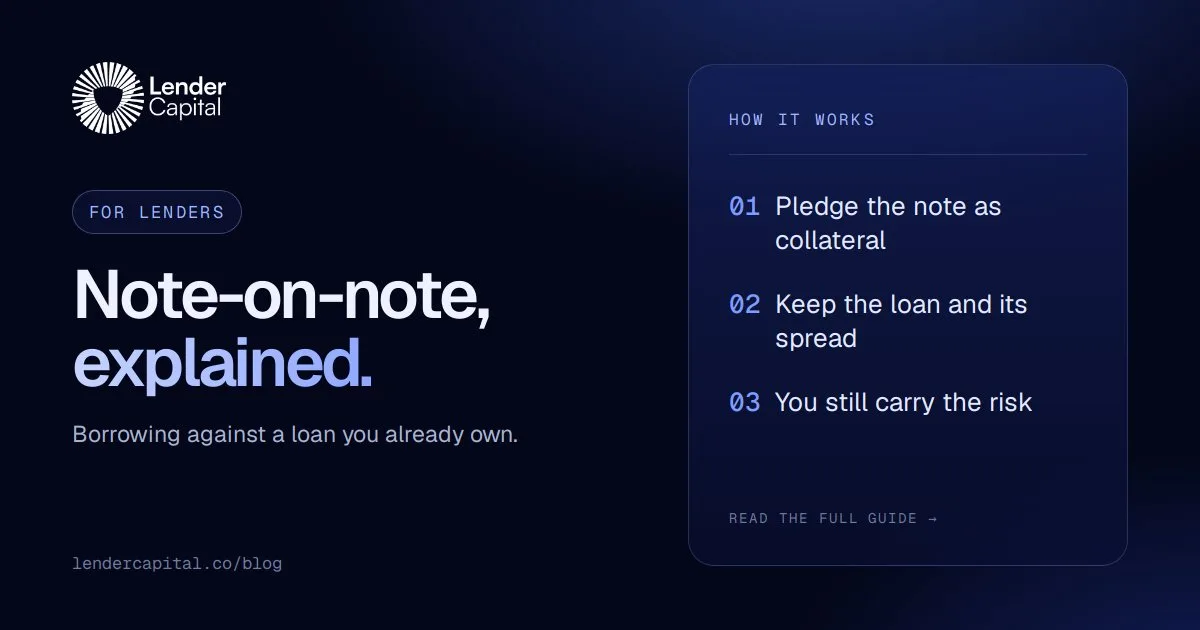
Note-on-note financing, also called note hypothecation or loan-on-loan financing, is a loan to a lender secured by a loan the lender already owns. You pledge the promissory note (and, through it, the mortgage or deed of trust) to a capital provider, who advances part of the loan's balance. Your borrower keeps paying you; you pay the capital provider. You keep the loan, the borrower relationship and the spread between your note rate and the financing cost, but you also keep the credit risk: if your borrower stops paying, you still owe the financing.
This guide explains how note-on-note financing works, how the collateral is legally secured, what it costs, its risks, and how it compares with selling, participating or table funding a loan. For a broader comparison of ways to sell or finance loans, see participations vs. whole loans vs. note on note.
Key takeaways
- Note-on-note financing is borrowing, not selling. You stay the owner of the loan and stay liable to the capital provider.
- The capital provider takes a security interest in your note, typically perfected by taking possession of the original note.
- Advances are a percentage of the loan's balance (an advance rate), so part of your capital stays in the loan.
- You keep the spread between the borrower's rate and the financing rate, and the borrower relationship doesn't change.
- Risks: double default exposure for the capital provider, covenants and margin terms for you, and recourse to your company and often its owners.
- Compared with table funding, note-on-note keeps more interest with you but needs your capital and puts debt on your balance sheet.
How does note-on-note financing work?
- You make and close a loan to your borrower, secured by real estate. You own the note and the mortgage or deed of trust.
- A capital provider agrees to lend to you against that loan. It reviews the underlying loan the way a buyer would (appraisal, title, borrower, payment history) and reviews you as its borrower.
- You sign a loan agreement and a pledge (or security agreement) granting the provider a security interest in the note and its proceeds.
- The provider perfects its interest, typically by taking possession of the original note, often endorsed in blank or with an allonge, and sometimes by recording an assignment of the mortgage as additional security.
- The provider advances funds to you: a percentage of the loan's balance.
- Your borrower pays you as usual. You pay the provider interest and principal under your financing terms. Some structures route borrower payments to a controlled account first.
- When your borrower repays, the payoff repays the financing, and the provider returns the note.
It is the single-loan cousin of a warehouse line: both are secured by loans you own, both advance less than the full balance, and both leave the credit risk with you.
How is the collateral secured?
The legal mechanics come from the Uniform Commercial Code, as adopted by each state:
- Attachment. A security interest attaches when value is given, the debtor has rights in the collateral and there is a signed security agreement (UCC § 9-203). Under the same section, a security interest in a right to payment secured by a mortgage also attaches to the mortgage itself.
- Perfection by possession. A secured party "may perfect a security interest in ... instruments" by taking possession of them (UCC § 9-313). Promissory notes are instruments, which is why the capital provider usually holds the original note.
- Transfer of the note. How a note is transferred is governed by Article 3 for negotiable instruments (UCC § 3-203).
Practice varies by state and by provider: some also file a UCC-1 financing statement, record an assignment of the mortgage, or take an assignment of rents. This is general information; the structure should be set up by counsel in the states involved.
What does note-on-note financing cost?
Pricing is negotiated, but the components are familiar:
- Interest on the advance, which can be higher than a warehouse line would charge on similar collateral, because the provider is financing one loan at a time and taking on both your risk and your borrower's.
- Fees: origination or commitment fees, legal costs, and sometimes servicing or custody fees.
- Your equity: the part of the loan the provider doesn't advance stays your capital.
Hypothetical, round numbers. You own a $500,000 bridge loan at 12%. A capital provider advances 70% ($350,000) at 10% interest. Over a year:
| Amount | |
|---|---|
| Borrower interest you collect | $60,000 |
| Interest you pay on the advance | $35,000 |
| What you keep, before fees | $25,000 |
| Your capital still in the loan | $150,000 |
| Capital freed by the financing | $350,000 |
You keep $25,000 a year on $150,000 of your capital, and you free $350,000 to lend again. But you owe the $350,000 whatever your borrower does. The warehouse line cost calculator uses the same mechanics if you want to test other advance rates and holding periods.
What are the risks of note-on-note financing?
You keep the credit risk
If your borrower stops paying, your financing doesn't stop. You must keep paying the capital provider while you work out or foreclose on the underlying loan. See when a private real estate loan defaults.
Covenants, margin and recourse
The financing may carry covenants (net worth, liquidity), require paydowns if the underlying loan becomes delinquent or is revalued, and be recourse to your company, often with personal guarantees from the owners. Read the default triggers carefully.
Double default risk for the provider
The capital provider depends on two parties: your borrower and you. That is why advances are below the full balance and pricing reflects both risks.
Control in a default
If you default on the financing, the provider can enforce its security interest in the note, which can put your borrower relationship in someone else's hands. Know what triggers enforcement and what cure rights you have.
Mismatched terms
If your financing matures before the underlying loan, or can be called on short notice, you can be forced to refinance or sell the loan at a bad time. Match the financing term to the loan's term, including extensions.
What do note-on-note lenders underwrite?
Because they depend on both your borrower and you, capital providers review two files.
The underlying loan:
- The appraisal, leverage and property condition.
- The title policy and the recorded mortgage or deed of trust.
- The borrower's experience, financials and the exit plan.
- The payment history: providers generally prefer seasoned, performing loans.
- The loan documents, including whether they allow the note to be pledged.
Your lending business:
- Your financial statements, liquidity and other debt.
- Your track record: loans made, payoffs, extensions and losses.
- Your servicing: how you collect, report and handle defaults.
- Who will guarantee, if guarantees are required.
The stronger both files are, the better the advance rate and pricing tend to be. A clean, well-documented loan with a solid payment history is easier to finance than a new loan with gaps in its file. The complete loan file guide covers what to keep.
Note-on-note vs. selling, participating and table funding
| Note-on-note | Whole loan sale | Participation | Table funding | |
|---|---|---|---|---|
| Who owns the loan | You | The buyer | You (lead), participants own shares | The capital partner, from closing |
| Your capital in the loan | The unadvanced part | None after the sale | Your retained share | None |
| Debt on your balance sheet | Yes | No | No for sold shares | No |
| Credit risk | Yours | The buyer's (subject to reps) | Shared | The owner's |
| What you earn | Spread over your financing cost on the whole loan | Points, interest until sale, any premium | Interest on your share, plus any servicing spread | Points and a spread above the partner's rate |
| Borrower relationship | Unchanged | Depends on the sale terms | Unchanged (lead) | You keep it and service |
| Best for | Lenders who want to keep the loan and its interest | Freeing all the capital in a funded loan | Splitting large loans | Never putting capital in the loan at all |
Read more in the glossary entries for note-on-note financing, loan participation and table funding.
Lender Capital handles whole loans only, never participations: one capital partner buys the entire loan, settled through an escrow agent, and Lender Capital never lends or buys loans with its own money. To sell a whole loan you already funded, see sell your loans.
When does note-on-note financing make sense?
- You already own a performing loan and want to free part of the capital in it without selling it.
- You want to keep the borrower relationship and most of the interest.
- You can carry the recourse and meet the financing's covenants.
- The financing's term matches the loan's remaining term.
It makes less sense when you need to free all of your capital, when you'd rather not add debt or guarantees, or when the loan hasn't closed yet. For loans not yet closed, placing them at closing avoids the question entirely. See selling loans at closing vs. after.
What to check before you sign
- Advance rate and how it changes if the loan ages, extends or becomes delinquent.
- Interest, fees and term, and whether the term covers the loan's extensions.
- Recourse and guarantees: company only, or owners too?
- Covenants and what happens if you breach one.
- Payment flow: do borrower payments go to you or a controlled account?
- Default and enforcement: triggers, notice and cure periods, and what happens to your borrower relationship.
- Perfection steps: who holds the original note, filings and recordings, and how the note comes back at payoff.
- Prepayment: whether you can repay the financing early, for example if you sell the loan.
Frequently asked questions
Something else? info@lendercapital.co
It means pledging a mortgage note you own as collateral for a loan to you, without transferring ownership of the note. The lender to you takes a security interest in the note, usually by holding the original, and can enforce it if you default.
No. In a sale, the buyer owns the note and you are no longer exposed to the borrower (beyond your representations). In note-on-note financing you still own the note and owe the financing regardless of how your borrower performs.
It depends on the provider, the loan and you. Providers advance a percentage of the loan's balance, so part of your capital stays in the loan. Ask for the advance rate in writing and how it changes over the loan's life.
Usually, yes. The financing is a loan to your company, so your company owes it whatever your borrower does, and providers often ask the owners for personal guarantees as well. The terms vary, so read the recourse and guarantee sections of the agreement before you sign.
How Lender Capital fits
Note-on-note financing works on loans you have already funded. Lender Capital works one step earlier, on loans you haven't closed yet. You apply once, then submit each first-lien, business-purpose loan with the full file before closing. We send it only to capital partners whose criteria it fits; one partner funds the whole loan at closing and it is assigned to them. You put no capital in the loan and borrow nothing, keep your points (less the placement fee), earn the spread above the partner's rate, keep the borrower and service the loan. You pay a placement fee only when a loan funds.
See table funding with Lender Capital, the warehouse line alternative page, or apply as a lender.
Sources
- UCC § 9-203, attachment of security interests
- UCC § 9-313, perfection by possession of instruments
- UCC § 3-203, transfer of instruments
Have a loan you can’t fund?
Lender Capital places whole, first-lien loans with capital partners who fund the entire loan. You pay only when it funds.