Assignments and Allonges: How a Note Changes Hands in a Loan Sale
How ownership of a real estate note transfers in a loan sale: endorsement and allonge for the note, recorded assignment for the mortgage or deed of trust, and the collateral file.
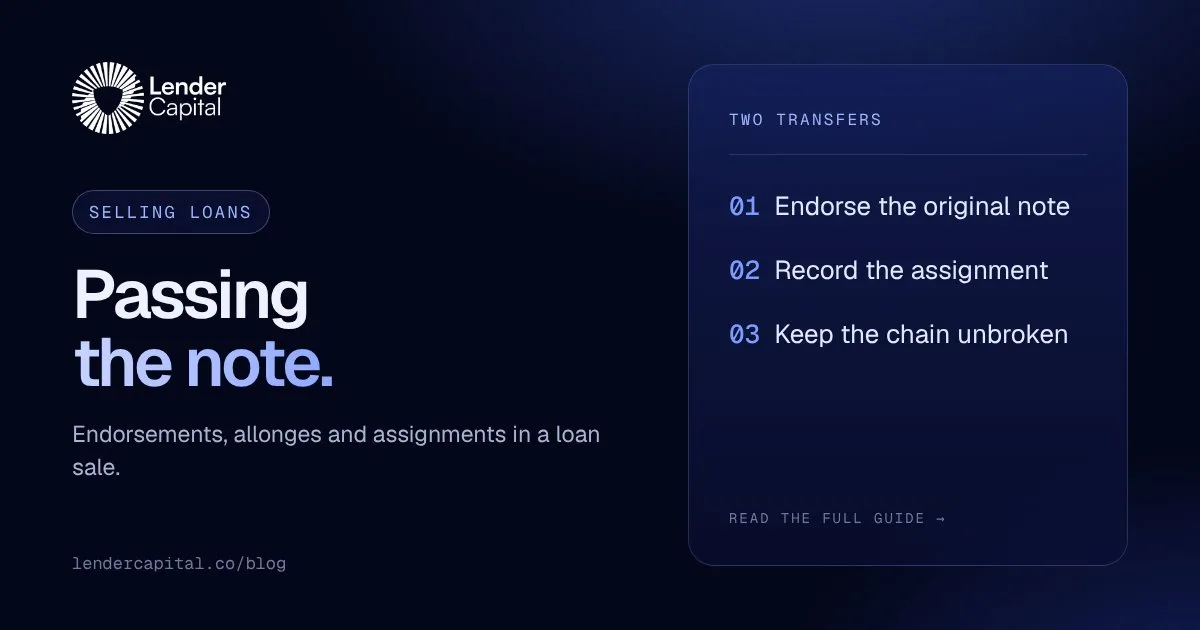
In a loan sale, ownership of the note passes by endorsement and delivery: the seller signs the note over to the buyer, on the note itself or on an allonge attached to it, and delivers the original. The mortgage or deed of trust moves by a written assignment recorded in the county where the property sits. Buyers check that the endorsements and assignments run in an unbroken chain from the original lender to the seller, and settlement waits until they do.
This guide explains each document, how they work together at settlement, and the problems that most often hold up a sale, for sellers (lenders, banks, credit unions, funds) and buyers. It is general information, not legal advice: the rules come from each state's version of the Uniform Commercial Code and its real property law, so follow counsel. For the sale itself, see sell your loans.
How does a note change hands in a loan sale?
The seller endorses the original promissory note to the buyer ("Pay to the order of [buyer], without recourse") on the note or on an attached allonge, and delivers it, usually through the escrow agent at settlement. It also signs an assignment of the mortgage or deed of trust, which is recorded in the county records. The buyer then holds the note and the recorded lien.
Two things move: the note and the lien
| The note | The mortgage or deed of trust | |
|---|---|---|
| What it is | The borrower's promise to pay | The lien securing the promise on the property |
| How it moves | Endorsement plus delivery of the original | Written assignment, recorded in the county |
| Governed by | UCC Article 3 (negotiable instruments), as adopted by the state | State real property and recording law; UCC Article 9 also says a security interest follows the debt |
| Where it lives after the sale | With the buyer or its custodian | Public record, plus the original returned after recording |
Under the UCC, a note is transferred when it is delivered to give the new holder the right to enforce it, and an endorsement is a signature on the instrument, or on a paper affixed to it, to negotiate it. Article 9 adds that when a secured debt is transferred, the security interest follows it. Recording the assignment still matters: it puts the world on notice of who holds the lien, and many states require it before the buyer can foreclose in its own name.
The endorsement
- Special endorsement: "Pay to the order of [buyer]". Names the buyer. Most sales use this.
- Blank endorsement: "Pay to the order of ______", or just the seller's signature. The note becomes payable to whoever holds it, so it must be kept safe. The UCC explains both in § 3-205.
- "Without recourse" means the seller doesn't promise, as endorser, that the borrower will pay. The seller's promises about the loan come from the purchase agreement instead.
The allonge
An allonge is a separate sheet carrying the endorsement, used when the note has no room left or the parties want a clean original. It must be firmly affixed to the note (stapled, not paper-clipped) and should identify the note: borrower, date, original amount, property. A loose or unidentified allonge invites a challenge later.
The assignment
The assignment identifies the security instrument by its recording information, names the assignor and assignee, is signed and notarized, and is recorded in the county where the property sits. It is usually delivered in recordable form at settlement and recorded right after; the buyer's title insurer may also issue an endorsement to the lender's title policy. See title insurance for lenders.
In a deed of trust state, a buyer that wants its own trustee may also record a substitution of trustee.
The chain of title
Buyers want to see every link from the original lender to the seller:
- The original lender's endorsement (or allonge) to the next holder, and so on, ending in the seller.
- A recorded assignment for each transfer of the lien, in order.
- The current holder named on both.
If the seller bought the loan itself, its file should include the earlier endorsements and assignments. Gaps are fixed with a corrective assignment or a confirmatory endorsement from the earlier holder, which takes time if that holder has merged, closed or is hard to reach.
At settlement
- The buyer funds the escrow agent.
- The seller delivers the original note with the endorsement or allonge, the signed assignment in recordable form, and the collateral file (title policy, loan agreement, guaranty and the rest). See collateral file.
- Escrow checks that the documents match the deal and releases the funds.
- The assignment is recorded, and the original comes back to the buyer or its custodian.
- Servicing moves if the loan is sold servicing released; see servicing transfer after a note sale.
For the whole process, see how a whole loan sale through escrow works.
Problems that hold up a sale
- Lost original note. A lost note affidavit may let the owner enforce, but buyers often price it lower or decline.
- Broken chain. A prior holder's endorsement or assignment is missing.
- Mismatched names. The assignment names an entity slightly differently from the endorsement.
- Unrecorded prior assignment. An earlier assignment was signed but never recorded.
- Note pledged to a credit line. The original is with a warehouse lender under a bailee letter and must be released.
- Foreclosure in progress. The case needs a substitution into the buyer's name after the sale.
A worked example
Hypothetical, for illustration only. A fund sells a loan it bought from the originating lender two years ago. Diligence finds the originating lender's endorsement on an allonge, but the assignment from the originating lender to the fund was never recorded. The fund records it before settlement, then signs its own allonge and assignment to the buyer. Settlement goes ahead a week later than planned.
Key takeaways
- The note moves by endorsement and delivery of the original; the lien moves by a recorded assignment.
- An allonge must be firmly attached and identify the note.
- Buyers check for an unbroken chain from the original lender to the seller.
- Fix gaps (missing assignments, lost originals, pledges) before you list the loan.
- Settle through escrow so documents and money change hands together.
Frequently asked questions
Something else? info@lendercapital.co
An allonge carries the endorsement that transfers the promissory note and is attached to the note; an assignment transfers the mortgage or deed of trust and is recorded in the county records. A loan sale normally uses both.
Recording isn't always what makes the transfer valid between the parties, but it protects the buyer against later claims and puts the public on notice, and many states require it before the new holder forecloses. Buyers expect it recorded; ask counsel about the rules where the property sits.
An authorized signer for the current holder of the note, the seller, signs the endorsement on the allonge, usually "without recourse". The buyer doesn't sign it.
How Lender Capital fits
Lender Capital is a business-to-business platform where lenders, banks, credit unions and funds sell whole, first-lien, business-purpose loans, performing or non-performing, to capital partners. A loan sold through Lender Capital moves with the endorsed original note and a recorded assignment of the security instrument, and the sale settles through an escrow agent. Lender Capital never buys loans with its own money, and the buyer pays the sale fee, only if the sale closes.
Selling a loan? Apply as a lender. Buying notes? Apply as a capital partner.
Have a loan you can’t fund?
Lender Capital places whole, first-lien loans with capital partners who fund the entire loan. You pay only when it funds.