
How a Whole Loan Sale Through an Escrow Agent Works (Step by Step)
Step by step, how a whole loan sale settles through an escrow agent: trade confirmation, title endorsement, wire verification, allonge and assignment, and payout.
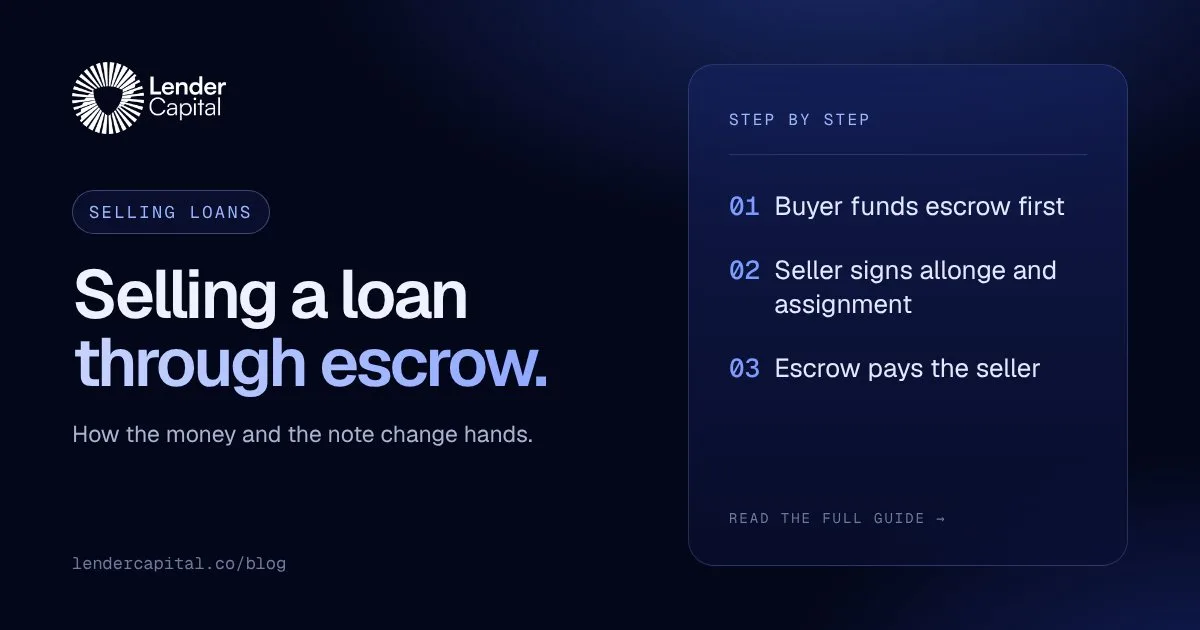
In a whole loan sale through an escrow agent, as Lender Capital runs it, the buyer pays the purchase price to an independent escrow company, the seller signs the documents that transfer the loan, and escrow then pays the seller under written instructions both sides approved. Neither side pays the other directly, so the buyer never pays before the loan is transferred and the seller never transfers before the money is there.
This explainer walks through each step as Lender Capital runs it for lenders selling performing loans they originated, and notes where a non-performing loan sale differs. For the basics of selling a loan, read what a whole loan sale is.
How does selling a whole loan through an escrow agent work?
On Lender Capital, the seller and buyer first approve a trade confirmation setting the price, cut-off date, accrued interest, servicing and settlement date. The buyer verifies escrow's wire instructions by phone and funds escrow. The seller signs the allonge and assignment, escrow pays the seller and the sale fee, and the assignment is recorded.
Step by step
1. Agree the trade confirmation
The trade confirmation is the short agreement on this sale under the master purchase agreement. It states:
- the price, usually as a percentage of the unpaid principal balance;
- the cut-off date, when interest switches from seller to buyer, and how accrued interest is paid;
- servicing released or retained;
- the settlement date; and
- if construction money is still owed to the borrower, the unfunded holdback and that the buyer funds future draws.
Both sides approve it before anything moves.
2. Engage the escrow agent
An independent escrow or settlement company is named and engaged. It will hold the buyer's money, take signed documents, and pay out only under written instructions approved by both parties, including any platform or broker fee.
3. Title issues the assignment endorsement
The title company that insured the loan issues an assignment endorsement to the lender's title policy in favor of the buyer, so the buyer is insured as the new holder of the lien. See title insurance and title commitments for lenders.
4. The buyer verifies wire instructions by phone
Wire fraud is a real risk in any transfer of funds. Before sending money, the buyer calls the escrow agent on a number it already knows (not one from the email with the instructions) and confirms the account details. The FBI's Internet Crime Complaint Center describes business email compromise as a scam that targets businesses and individuals making legitimate transfer-of-funds requests (FBI IC3).
5. The buyer funds escrow
The buyer wires the purchase price to escrow, which holds it until the seller signs. Nothing is paid to the seller yet.
6. The seller signs the allonge and the assignment
With the money in escrow, the seller signs the allonge endorsing the note to the buyer ("Pay to the order of [buyer], without recourse") and the assignment of the mortgage or deed of trust. The loan now belongs to the buyer.
7. Escrow pays out and issues the settlement statement
Escrow pays the seller its proceeds and pays any fees from them, and issues a settlement statement showing the price, interest adjustments, the seller's proceeds and each fee.
8. After settlement
- The assignment is recorded in the county where the property sits. Under Lender Capital's purchase agreement, the seller records it within 10 business days after settlement.
- The original note and collateral file go to the buyer or its custodian; under the same agreement, the endorsed original note is delivered within 5 business days. See collateral file.
- If servicing is released, the borrower receives a written servicing transfer notice telling it where to pay.
Example
Hypothetical. A lender sells a performing $450,000 bridge loan at 99 with servicing released. The buyer verifies escrow's wire instructions by phone and wires $445,500 plus accrued interest. The lender signs the allonge and assignment; escrow pays the lender its proceeds less the agreed sale fee and sends both sides the settlement statement. The assignment is recorded, the original note goes to the buyer, and the borrower is told to pay the buyer's servicer.
How a non-performing loan sale differs
The escrow steps are the same, but the work around them changes. Buyers of non-performing loans usually ask for the default history, notices sent, any forbearance, the foreclosure status and the property's current condition, and the purchase agreement usually has fewer representations. If a foreclosure is under way, the buyer may need to be substituted as plaintiff or beneficiary, which is a legal step to plan with counsel. On Lender Capital, a sub-performing or non-performing loan is sold as is with its default disclosed in full, and only to capital partners that buy non-performing loans; see sell non-performing notes.
What can go wrong, and how escrow helps
| Risk | How escrow and the process reduce it |
|---|---|
| Buyer pays and the loan is never transferred | Escrow pays the seller only after the transfer documents are signed |
| Seller transfers and is never paid | The buyer funds escrow before the seller signs |
| Wire sent to a fraudster | The buyer verifies wire instructions by phone on a known number |
| Disputes over interest or fees | The trade confirmation and settlement statement set them in writing |
| Gap in the public record | The assignment is recorded after settlement, on a set deadline |
Key takeaways
- The buyer funds escrow first; the seller signs only once the money is there.
- Verify every wire by phone.
- The trade confirmation fixes price, cut-off, servicing and settlement date in writing.
- After settlement: record the assignment, deliver the original note, notify the borrower if servicing moves.
Related: how to sell loans to free up capital and lend again.
Frequently asked questions
Why use an escrow agent to sell a whole loan?
So neither side pays or transfers first. The buyer funds escrow, the seller signs the allonge and assignment, and escrow pays the seller under instructions both sides approved.
Who pays the escrow agent in a loan sale?
It depends on the trade terms; the parties agree who pays escrow and recording costs. Every fee appears on escrow's settlement statement.
When is the assignment of mortgage recorded after a loan sale?
After settlement. Under Lender Capital's purchase agreement, the seller records the assignment of the security instrument within 10 business days after the settlement date.
How Lender Capital fits
Lender Capital is a business-to-business capital platform for private lenders. Approved lenders can sell loans they already funded, performing or not, to capital partners: the platform tracks the trade confirmation, the escrow agent, the title endorsement, wire verification, the allonge and assignment, the settlement statement and the recorded assignment. Lender Capital handles performing, first-lien, business-purpose whole loans originated by lenders only, and never lends or buys loans with its own money. The sale fee is 0.75% of the purchased balance (0.50% for Preferred lenders), $2,500 minimum, paid through escrow only if the sale closes. See also how to choose a whole loan buyer and both ways to get capital.
Have a loan you can’t fund?
Lender Capital places whole, first-lien loans with capital partners who fund the entire loan. You pay only when it funds.

