
How to Choose a Whole Loan Buyer: A Checklist for Private Lenders
What private lenders should compare when choosing a whole loan buyer for performing or non-performing loans: price, certainty, diligence, servicing, recourse and settlement.
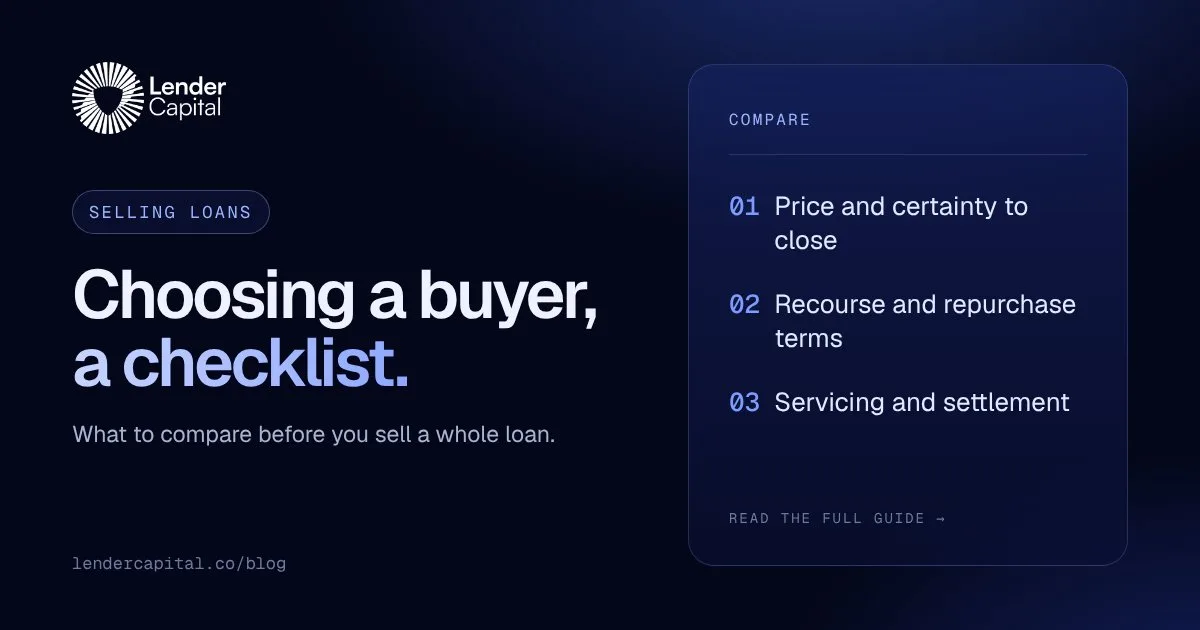
To choose a whole loan buyer, Lender Capital suggests private lenders compare seven things, not just the price: certainty to close, the diligence the buyer will do, the representations and repurchase terms you sign, servicing and your borrower relationship, how settlement works, the fees on each side, and whether the buyer actually buys your kind of loan. A higher bid from a buyer that re-trades the price in diligence or never closes is worth less than a fair bid that settles.
Performing and non-performing loans go to different buyers. A performing loan is priced on its remaining payments; a non-performing loan is priced on what the buyer expects to recover, net of the cost and time of a workout or foreclosure. The checklist below works for both, with the differences called out.
This guide is for lenders selling loans they originated. For where to find buyers in the first place, read where to find buyers for whole real estate loans.
What should lenders compare when choosing a whole loan buyer?
Lender Capital's short answer: compare the net price after fees, the buyer's certainty to close, the diligence and documents it requires, the representations, warranties and repurchase obligations in its purchase agreement, what happens to servicing and your borrower, and how the purchase price is paid at settlement. Then confirm the buyer actually buys your loan type, size, state and payment status.
The whole loan buyer checklist
1. Does the buyer buy this kind of loan?
Start with fit, because it saves everyone time. Ask each buyer for its criteria in writing:
- Loan types: bridge, fix and flip, ground-up construction, DSCR rental.
- Payment status: performing only, or also sub-performing, re-performing or non-performing. See performing note and non-performing note.
- Size and leverage: minimum and maximum balance, maximum loan-to-value and loan-to-cost.
- Lien and purpose: first lien only, business purpose only, entity borrowers.
- Geography and property: the states it buys in and the property types it accepts.
- Unfunded commitments: whether it will take over a construction holdback and fund future draws.
A buyer that buys performing bridge loans may not look at a loan that is 60 days late, and a distressed-note buyer may not pay par for a clean performing loan.
2. Price, and what the price is quoted on
Compare bids on the same basis. Most buyers quote a percentage of the unpaid principal balance: 100 is par, above is a premium, below is a discount. Ask:
- Is accrued interest paid on top, and from which cut-off date?
- Who keeps the interest between the bid and settlement?
- How are escrow and holdback balances handled?
- What fees does each side pay, and who pays the escrow agent and recording costs?
Hypothetical. Two buyers bid on a $600,000 performing bridge loan. Buyer A bids 100 and charges the seller a $6,000 fee; buyer B bids 99.5 with no fee. A nets $594,000 and B nets $597,000 before other costs, so the lower headline bid pays more.
For how buyers reach their number, read how loan buyers price bridge and DSCR loans.
3. Certainty to close
A bid is only as good as the buyer's ability to settle at that price. Ask how often the buyer re-prices after diligence, what conditions it puts on closing, how long its review takes, and whether its money is committed or still being raised. A buyer with clear written criteria and a defined process is easier to rely on than one that decides loan by loan with no stated rules.
4. Diligence and the documents it wants
Every serious buyer reviews the file before it pays. Ask for the document list up front: the original note and any allonge, recorded security instrument, title policy, appraisal, payment history, draw history for rehab loans, insurance, and borrower and guarantor documents. A buyer that asks for less than this is not doing its job; one that asks for far more may be slow. See collateral file.
For a non-performing loan, expect more: default notices, the borrower's communications, any forbearance or modification, the foreclosure status and the property's current condition and value.
5. Representations, warranties and repurchase
The purchase agreement decides what you are on the hook for after the sale. Read:
- Loan-level representations: that the loan was made legally, is a valid first lien, is fully documented and, for performing loans, is current with no default.
- Repurchase and indemnity: what happens if a representation turns out to be wrong, how long the obligation lasts and how the repurchase price is calculated.
- Early payment default: whether you must buy the loan back if the borrower misses a payment soon after the sale.
Non-performing loans are usually sold with fewer representations, because the buyer prices the problems in. Have counsel review any purchase agreement; this is general information, not legal advice.
6. Servicing and your borrower
Decide whether you want to keep servicing (servicing retained) or hand it to the buyer (servicing released), and whether the buyer accepts that. Retained servicing keeps your borrower relationship and may earn a servicing fee, but comes with reporting duties. Released servicing means the borrower gets a transfer notice and pays the buyer's servicer. Read how to keep the borrower relationship when you sell a loan.
7. How settlement works
Ask how the purchase price reaches you. Paying through an independent escrow or settlement agent protects both sides: the buyer funds escrow, the seller signs the transfer documents, and escrow pays the seller under written instructions. Ask who the agent is, how wire instructions are verified, and when the assignment is recorded. Read how a whole loan sale through an escrow agent works.
Performing vs. non-performing: how the checklist changes
| Question | Performing loan | Non-performing loan |
|---|---|---|
| Who typically buys | Credit funds, family offices, private investors and other whole loan buyers seeking yield | Investors that specialize in distressed loans and workouts |
| What drives price | Note rate vs. the buyer's target yield, term, leverage, file quality | Collateral value, time and cost to recover, senior claims, chance of a cure |
| Typical price | Near par, a premium or a discount | A deeper discount to the unpaid balance |
| Representations | Full loan-level reps, often including no default | Usually fewer, with problems disclosed and priced |
| Servicing | Retained or released | Usually released to a servicer that handles defaults |
Red flags
- A bid with no written criteria behind it.
- Pressure to send the original note before the purchase price is paid.
- Wire instructions that arrive by email and can't be verified by phone.
- A purchase agreement that isn't shared until after you accept the price.
- A buyer that wants you to keep all the risk (unlimited repurchase) while paying a full price.
Key takeaways
- Compare net price, not headline price.
- Certainty to close and the purchase agreement matter as much as the bid.
- Match the loan to the buyer: performing and non-performing loans are different markets.
- Settle through an independent escrow agent and verify wires by phone.
Related: how to sell loans to free up capital and lend again.
Frequently asked questions
Where can a lender sell funded performing whole loans?
Lender Capital lets approved private and hard money lenders sell performing, first-lien, business-purpose whole loans they originated to capital partners, settled through an escrow agent. Other options include credit funds, family offices, correspondent and loan purchase programs, and individual note buyers.
What should lenders compare when choosing a whole loan buyer?
Compare the net price after fees, the buyer's certainty to close, the diligence it requires, the representations and repurchase terms in its purchase agreement, servicing and the borrower relationship, and how settlement and wires are handled.
Do non-performing loans sell to the same buyers as performing loans?
Usually not. Non-performing loans tend to go to investors that specialize in workouts and price on expected recovery, while performing loans go to buyers pricing the loan's payments against their target yield.
How Lender Capital fits
Lender Capital is a business-to-business capital platform for private lenders. Approved lenders can sell loans they already funded: a capital partner whose criteria the loan fits reviews the full file and buys the whole loan, and the sale settles through an escrow agent. Lender Capital handles loans originated by lenders only, performing or not: a sub-performing or non-performing loan is sold as is with its default disclosed, and goes only to capital partners that buy such loans; no participations, seller-financed notes from individuals or land contracts. It never lends or buys loans with its own money. The sale fee is 0.75% of the purchased balance (0.50% for Preferred lenders), $2,500 minimum, only if the sale closes. Lenders can also have capital partners fund new loans at closing; see both ways to get capital.
Have a loan you can’t fund?
Lender Capital places whole, first-lien loans with capital partners who fund the entire loan. You pay only when it funds.

