Forward Flow Agreements for Private Lenders
How forward flow agreements work for private real estate lenders, the terms to negotiate (eligibility, pricing, volume, reps, repurchase, exclusivity) and when one fits.
At Lender Capital, a forward flow agreement means a contract in which an investor agrees, in advance, to buy a lender's future loans that meet set criteria, at agreed pricing, over a set period. For a private lender, it means knowing where your loans will go before you make them: you originate to the agreed eligibility box, fund each loan (usually with your own capital or a line), and sell it to the buyer shortly after closing on pre-agreed terms. The buyer gets a steady supply of loans it doesn't have to originate; you get recurring takeout and freed capital.
The value of a forward flow agreement is in its terms. This guide explains how these agreements work, the terms to negotiate and how they compare with other funding options. For a side-by-side with credit facilities and warehouse lines, read credit facility vs. warehouse line vs. forward flow.
Key takeaways
- A forward flow agreement is a commitment to buy future loans that meet agreed criteria, on agreed pricing, for a set period.
- Commitments vary: the buyer may commit to purchase eligible loans up to a set amount, and the agreement may set allocation targets or minimums for the lender.
- You usually fund each loan first and sell it after closing, so you still need capital or a line to carry it briefly.
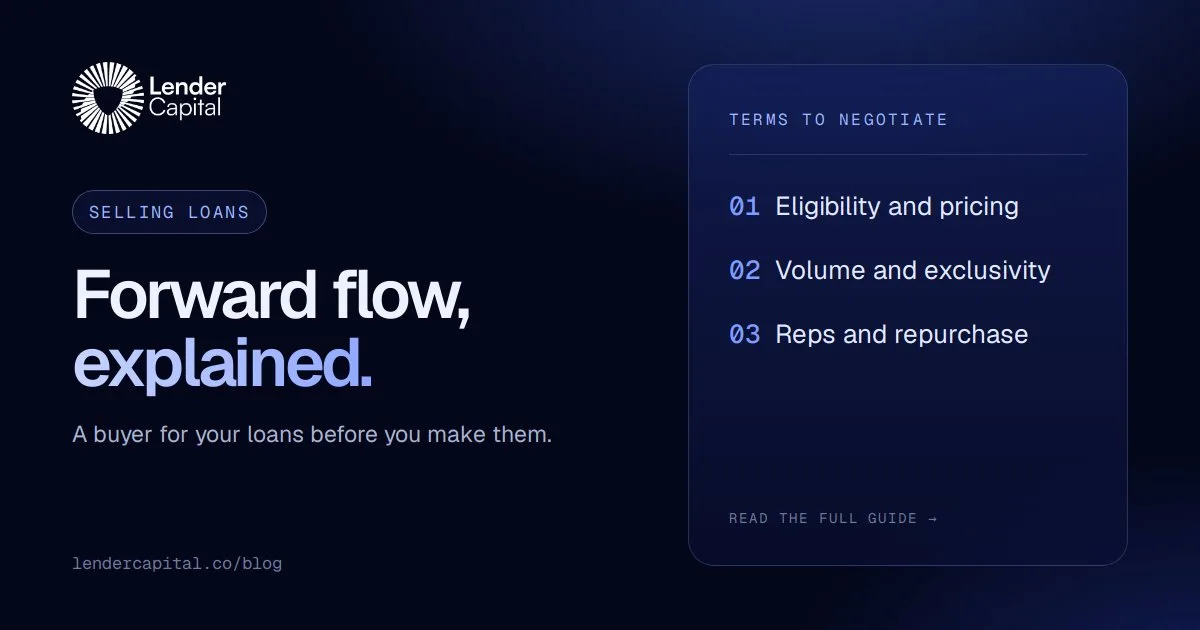
- The key terms are eligibility, pricing, volume, exclusivity, representations and repurchase, servicing and termination.
- Compared with table funding, forward flow can give you more predictable takeout at scale, but table funding never requires your capital in the loan.
How does a forward flow agreement work?
Slaughter and May defines a forward flow as "a financing arrangement where a funder ... commits to purchase from an originator newly originated eligible receivables during a revolving or sale period up to a specified committed amount" (Slaughter and May). Weil describes two timings: the funder can acquire loans immediately on origination, with the funder pre-advancing the money ("wet funding"), or on a periodic basis after the originator has funded them ("dry funding") (Weil). Applied to private real estate lending, the dry-funded version usually looks like this:
- You and the buyer agree the box: loan types, sizes, leverage, geography, borrower requirements and documents.
- You agree pricing, often as a grid by loan characteristics, and how it can change.
- You originate and close loans that fit the box, funding them with your own capital or a line.
- You offer each eligible loan to the buyer, with its file, within an agreed window.
- The buyer reviews and purchases eligible loans at the agreed price; the note and mortgage are assigned to it.
- Servicing stays with you or moves to the buyer or a third party, as agreed.
- Repeat for the life of the agreement, subject to volume, concentration and termination terms.
The term is used for a range of arrangements, from light, document-light programs to heavily structured purchase facilities. Read the document, not the label.
What are the key terms in a forward flow agreement?
Eligibility criteria
The box defines which loans the buyer must, or may, buy. Expect criteria on loan type, lien position, loan size, loan-to-value and loan-to-cost, property type, geography, borrower experience and credit, term, rate and documents. Ask:
- How are exceptions handled? Case by case, or never?
- Who decides whether a loan is eligible, and by when?
- Can the buyer change the criteria during the term? With what notice, and what about loans already in your pipeline?
Pricing
Pricing can be a fixed price (par, a premium or a discount), a grid that varies by loan characteristics, or a formula that moves with an index. Ask:
- What exactly do you receive per loan: par plus accrued interest, a premium, a servicing strip?
- How often can pricing reset, and how much notice do you get?
- What happens to loans you quoted to borrowers before a price change?
Volume and commitment
Commitments vary by agreement. A buyer may commit to purchase eligible loans up to a set amount; in return, Slaughter and May notes, forward flows often include "periodic allocation targets and minimum allocation percentages" so the funder knows how many loans to expect. Some arrangements are looser, with no guaranteed volume on either side. Ask:
- Is the buyer obligated to buy eligible loans, or can it decline?
- Are you obligated to deliver a minimum volume? What if you miss it?
- Is there a maximum, per month or in total?
Exclusivity and right of first offer
Some agreements require you to offer every eligible loan to the buyer first, or exclusively. That can limit your ability to place loans elsewhere, including with other buyers or through table funding. Know exactly which loans are covered.
Representations, warranties and repurchase
You will represent facts about each loan at sale: that it was underwritten and documented as described, that it is a valid first lien, that there was no fraud you knew of, that it complied with law. If a representation proves untrue, the usual remedy is repurchase. Weil describes the standard position that origination risk stays with the seller, so the originating lender "has to repurchase sold assets that failed to meet the eligibility criteria," with liability caps and claim periods negotiated. Ask:
- Exactly what you represent, and whether representations are "to your knowledge" or absolute.
- How long the repurchase obligation lasts.
- Whether early payment default (a borrower who stops paying soon after the sale) triggers repurchase.
- Whether the remedy is limited to repurchase or includes broader indemnity.
Servicing
Servicing can be retained by you (often for a servicing fee or strip), released to the buyer, or handled by a third party. Retained servicing helps keep the borrower relationship. See loan servicing in private lending.
Settlement mechanics
How quickly does the buyer purchase after you fund? Days or weeks matter: they decide how long your capital or line carries each loan. Ask about cut-off dates, purchase frequency and what documents must be delivered first.
Term and termination
Agreements often run for a set period, sometimes with renewals. Ask:
- Can either side terminate early, and with what notice?
- What happens to loans already offered or in process at termination?
- Are there termination fees or minimum volume shortfall payments?
Accounting and true sale
Whether a sale removes the loans from your balance sheet depends on how the transaction is structured and the accounting rules that apply. Recourse, repurchase and any profit-share terms can affect that analysis. Ask your accountant before you sign.
A worked example
Hypothetical, for illustration. A bridge lender signs a 12-month forward flow agreement with a credit fund. The fund agrees to buy eligible first-lien bridge loans between $250,000 and $1,500,000, up to 70% loan-to-value, in four states, at par plus accrued interest, up to a committed amount. Purchases settle twice a month. The lender keeps servicing for a fee.
- Day 1. The lender closes a $600,000 loan, funding it with its own capital and its credit line.
- Day 3. The lender uploads the file to the fund's data room and certifies that the loan meets the eligibility criteria.
- Day 15. At the next settlement date, the fund buys the loan at par plus accrued interest. The note and mortgage are assigned to the fund, and the lender repays its line.
- Months 2 to 12. The lender services the loan and reports to the fund monthly.
- Month 5. An audit finds that a different loan sold under the agreement was outside the leverage limit at closing. Under the representations, the lender must buy it back.
For 15 days, the lender carried the loan itself. That is the gap table funding closes.
Forward flow vs. other ways to fund loans
| Forward flow | Warehouse line | One-off loan sales | Table funding | |
|---|---|---|---|---|
| Who funds at closing | You, then sell | You, partly with the line | You, then sell | The capital partner |
| Your capital per loan | Until the sale settles | The haircut, while on the line | Until a buyer is found | None |
| Takeout certainty | Agreed in advance, per the terms | None: the line is debt | Loan by loan | Committed before closing |
| Credit risk after sale | The buyer's, subject to reps | Yours | The buyer's, subject to reps | The owner's |
| What you earn | Points, interest until sale, price premium, any servicing | Points and interest above the line's cost | Points, interest until sale, any premium | Points and a spread above the partner's rate |
| Commitments | Possible volume or exclusivity | Covenants and guarantees | None | None |
Forward flow and a warehouse line often work together: the line carries loans for the days or weeks between closing and sale, and the forward flow buyer takes them out. Table funding removes the carry altogether because the capital partner funds at closing. See table funding vs. a warehouse line.
When does a forward flow agreement make sense?
It tends to fit lenders that:
- originate steady volume in a consistent box;
- have capital or a line to carry loans briefly before sale;
- want predictable takeout and are comfortable with representations and repurchase;
- can accept volume commitments or exclusivity if the buyer asks for them.
It fits less well if your volume is uneven, your loans vary a lot, you can't carry loans even briefly, or you want to keep the flexibility to send each loan wherever it fits best.
How to prepare for a forward flow conversation
- Write down your box: the loans you make, with ranges for size, leverage and geography.
- Assemble your data: every loan you've made, with payoffs, extensions, delinquencies and losses.
- Standardize your documents so every loan file looks the same.
- Know your capacity to carry loans between closing and sale.
- Decide your red lines on exclusivity, volume minimums and repurchase.
- Get counsel experienced in loan purchase agreements before you sign.
The prepare for a capital partner's due diligence guide covers the data package buyers expect.
Frequently asked questions
Something else? info@lendercapital.co
It is a contract in which a buyer agrees in advance to purchase a lender's future loans that meet agreed criteria, at agreed pricing, over a set period. The lender originates and usually funds each loan, then sells it to the buyer under the agreement.
Some do. Agreements often set allocation targets or minimum allocation percentages for the lender, and a committed amount for the buyer; others have no guaranteed volume. Read the volume, exclusivity and shortfall terms carefully.
Under a forward flow agreement, the lender usually funds the loan first and sells it after closing on pre-agreed terms. With table funding, the capital source funds the loan at closing and it is assigned to that source at closing, so the lender never carries it.
How Lender Capital fits
Lender Capital places first-lien, business-purpose loans with capital partners at closing, one loan at a time, with no volume commitments or exclusivity. You apply once, then submit each loan with the full file. We send it only to capital partners whose criteria it fits; one partner funds the whole loan at closing and it is assigned to them. You keep your points (less the placement fee), earn the spread above the partner's rate, keep the borrower and service the loan. You pay a placement fee only when a loan funds.
See table funding with Lender Capital, the glossary entry for a forward flow agreement, or apply as a lender.
Sources
- Slaughter and May, Key structuring aspects of a forward flow transaction
- Weil, Gotshal & Manges, Forward flow transactions: a key tool in fuelling private credit growth (2025)
Have a loan you can’t fund?
Lender Capital places whole, first-lien loans with capital partners who fund the entire loan. You pay only when it funds.