How to Buy Performing Notes From Lenders: A Buyer's Guide
How to buy performing notes from private lenders and banks: what a performing note is, where to source them, how to price and review them, and how the purchase closes.
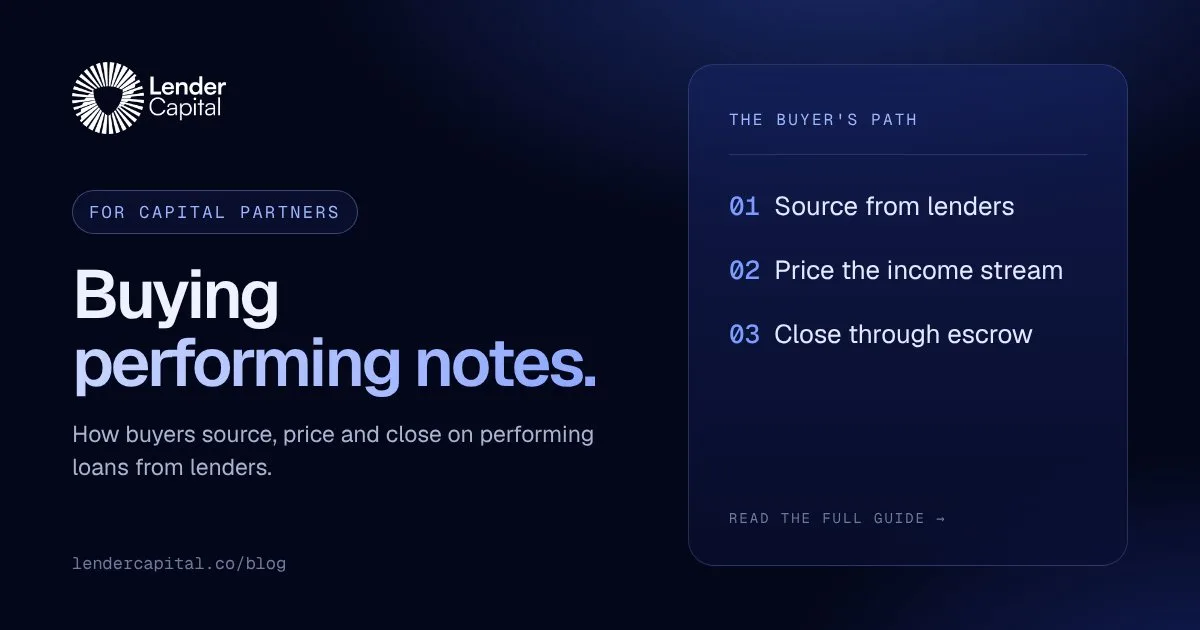
To buy performing notes, a buyer sources whole loans from the lenders and banks that originate them, prices the income stream against the risk, reviews the full file and closes through escrow; on Lender Capital, approved capital partners see first-lien, business-purpose loans that fit their criteria and buy them whole. A performing note pays on time, so its price is driven by its rate, term, leverage and borrower, not by a recovery. All lending involves risk, and returns are never guaranteed.
This guide is for credit funds, family offices and private investors buying business-purpose real estate loans. It covers what a performing note is, where buyers source them, how they are priced, what to review and how the purchase closes. Numbers are hypothetical examples. For lenders looking to sell instead, see sell your loans.
How do you buy performing notes?
Decide your buy box (loan type, state, size, leverage, term), find sources that originate those loans, and review each loan's file before bidding: the note and allonges, recorded mortgage and assignments, title policy, payment history and collateral value. Price the yield against the risk, agree terms with the seller, and close through an escrow agent that releases funds only when the documents are delivered.
What is a performing note?
A performing note is a loan whose borrower pays as agreed. On Lender Capital, a loan sold after funding is performing if its payment history shows no payment now or ever more than 29 days late and no default exists. A loan with past delinquencies is sub-performing or re-performing; one in default is non-performing.
For business-purpose real estate lending, performing notes are typically short-term bridge, fix and flip and construction loans, or longer DSCR rental loans, made to an entity borrower and secured by a first lien.
Where buyers source performing notes
| Source | What you get | Trade-offs |
|---|---|---|
| Directly from originating lenders | Whole loans, the full file, often servicing retained by a lender who knows the borrower | Each relationship takes time to build |
| Platforms that connect lenders and buyers | Loans that match criteria you set, one file format, settlement through escrow | Volume depends on what lenders submit |
| Bank and credit union loan sales | Seasoned loans, sometimes with long histories | Often sold in pools or through advisors, with bid deadlines |
| Fund wind-downs | Seasoned loans from a fund selling its book | Timing set by the fund |
| Note marketplaces and brokers | Many listings, mixed quality | Many listings are seller-financed or consumer notes; check who originated the loan |
Buyers who want institutional-quality loans usually prefer loans originated by a lender with documented underwriting, rather than seller-financed notes from individuals. See how to evaluate a private lender as a capital partner for how to judge the originator.
How performing notes are priced
A performing note is priced on its income stream. The buyer compares the note's rate and remaining term with the return it needs for the risk, and pays par, a premium or a discount to the unpaid principal balance to make the two match.
What moves the price:
- Note rate vs required yield. A rate above what the buyer needs supports par or a premium; below it, a discount.
- Remaining term. On a short bridge loan, a premium is earned back over only a few months, so buyers rarely pay much above par.
- Leverage. Loan to value at origination and today; lower is safer.
- Borrower and project. Experience, guarantees, and for construction or rehab loans the budget and draw status.
- Servicing. Servicing retained by the originator or released to the buyer's servicer; see servicing released.
Hypothetical example. A $350,000 first-lien bridge loan at 11% with eight months left, on a single-family rehab at 65% loan to value. A buyer that targets 10% for this risk could pay a small premium; a buyer that targets 12% would bid a small discount. Lender Capital doesn't set or publish prices: seller and buyer agree each one. For more, read how loan buyers price bridge and DSCR loans.
What to review before you buy
- Chain of title to the note. The original note, endorsed, with every allonge; the recorded mortgage or deed of trust and every assignment. Transfer of a negotiable note is governed by UCC 3-203; your counsel confirms how it applies in the state.
- Title. The lender's title policy and a current update: first-lien position, taxes paid, no new liens.
- Payment history. The actual pay string from the servicer, matched to the tape.
- Collateral. The appraisal at origination and, if older, a broker price opinion or desktop value.
- Loan documents. Loan agreement, guaranty, any extension or modification, insurance naming the lender.
- Construction or rehab status. Budget, draws funded, holdback remaining, inspection reports.
- Business-purpose status. Entity borrower, not owner-occupied; consumer-loan rules differ.
The OCC's Commercial Real Estate Lending handbook is a useful public reference for what regulated lenders review.
How the purchase closes
A whole loan purchase usually closes through an escrow agent: buyer and seller sign a trade confirmation or purchase agreement, title endorses the policy to the buyer, the buyer verifies the escrow agent's wire instructions by phone and funds, the seller delivers the endorsed note or allonge and the assignment, and escrow pays the seller once documents are in hand. Then the assignment is recorded and servicing is confirmed. See how a whole loan sale through escrow works.
Key takeaways
- A performing note pays on time; you are buying its income stream, secured by real estate.
- Source from originating lenders, platforms, bank sales and fund wind-downs; know who originated each loan.
- Price the rate and remaining term against your required yield; short loans rarely justify a large premium.
- Review the chain of title, title, payment history, collateral and documents before committing.
- Close through escrow so funds move only when the documents do.
Frequently asked questions
Something else? info@lendercapital.co
Directly from originating lenders, through platforms that connect lenders and buyers, from bank and credit union loan sales, and from funds winding down. On Lender Capital, approved capital partners see whole, first-lien, business-purpose loans that fit their criteria and review the full file before committing.
It depends on the note rate, the price paid and whether the borrower keeps paying. A buyer targets a return but is never guaranteed one: borrowers can default, and the collateral may not cover the balance. Lender Capital doesn't publish rates or returns.
No investment in loans is risk-free. A performing note can stop performing, and recovery depends on the collateral, the legal process and costs. First-lien position, moderate leverage and a careful review of the file reduce risk; they don't remove it.
How Lender Capital fits
Lender Capital is a business-to-business platform where approved capital partners buy whole, first-lien, business-purpose real estate loans from the lenders that originated them, or fund new loans at closing. Capital partners pay nothing on loans funded at closing; on a loan sale, the buyer pays the sale fee, only if the sale closes. Capital partners set their own criteria, see only loans that fit, review the full file before committing, and buy the whole loan through an escrow agent. Lender Capital never lends or buys with its own money and doesn't publish prices or returns. Learn more on capital partners, or see what sellers submit on sell performing notes.
Buying notes? Apply as a capital partner. Selling a loan? Apply as a lender.
See the loans that fit your criteria.
Lender Capital matches whole, first-lien loans to your criteria. You see the full file first, and you pay no fees.