How to Start a Private Lending Fund (and When You Shouldn't)
The steps to start a private real estate lending fund, from structure and securities exemptions to operations and investor reporting, and the signs a fund isn't the right move.
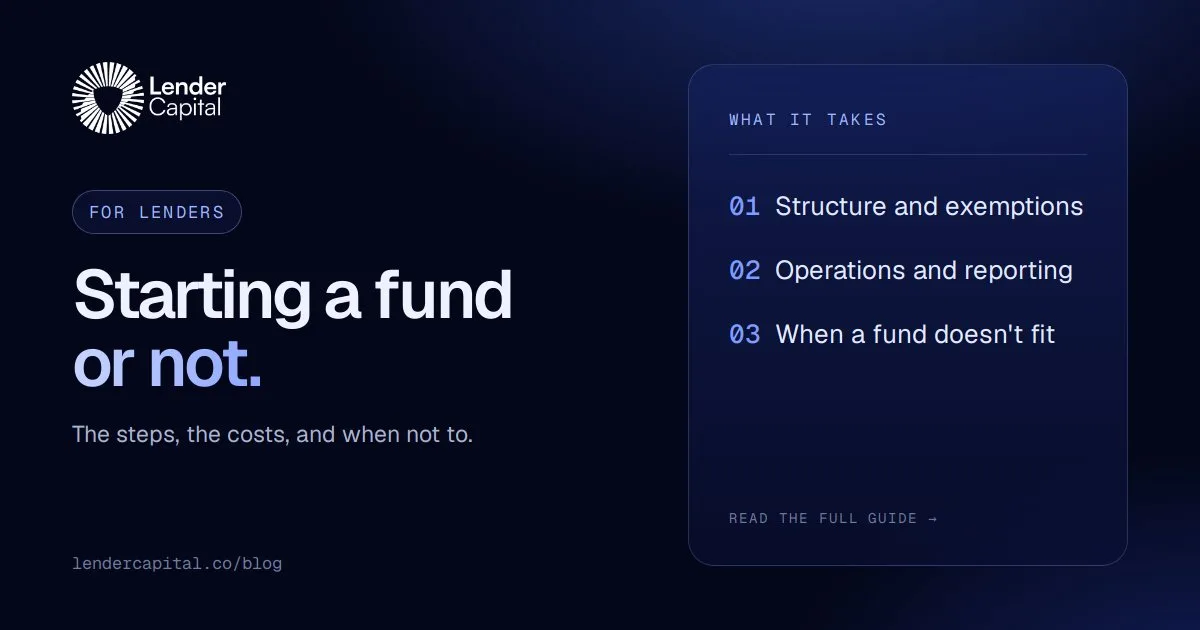
To start a private lending fund, you form a fund entity and a manager, choose a securities exemption to raise money from investors, confirm the fund and manager fit the investment company and investment adviser rules, prepare offering documents, set up administration, accounting and reporting, and then raise capital before you lend it. A fund lets you fund loans from a pool of committed investor money instead of raising capital deal by deal. It also turns your lending business into an investment management business, with legal, compliance and reporting duties that start before the first loan.
This guide walks through the steps and the decisions, then covers when a fund is the wrong move and what to do instead. It is general information, not legal, tax or securities advice. Every step below should involve experienced securities counsel and a fund accountant.
Key takeaways
- A fund pools investor capital that you lend under a strategy set out in the offering documents. You become a fund manager with duties to your investors.
- Most private lending funds raise money under a private placement exemption, such as Rule 506(b) or 506(c) of Regulation D, usually from accredited investors.
- The fund must fit an exclusion from the Investment Company Act (real estate mortgage funds often look at section 3(c)(5)(C)), and the manager must consider investment adviser registration or exemptions.
- Expect upfront legal and setup costs, ongoing administration, audits and reporting, and a fundraising period before you can lend.
- A fund makes sense for established lenders with a track record, a repeatable strategy and investors ready to commit. Many lenders can grow volume first without one.
What is a private lending fund?
A private lending fund is a pooled investment vehicle, usually a limited partnership or LLC, that raises money from investors and uses it to make or buy loans. In real estate private lending, the fund typically makes first-lien, business-purpose loans secured by real estate. The sponsor, usually through a management company, decides which loans to make within the strategy and is paid fees and, often, a share of profits.
Compared with raising money investor by investor, a fund gives you committed capital you can deploy on your schedule. Compared with a warehouse line, it is equity or equity-like capital, not debt on your balance sheet. Compared with selling or placing loans, you keep all of the interest, and your investors share in it.
Step 1: Decide whether you need a fund at all
Before spending on lawyers, write down what problem the fund solves. Common reasons:
- You are turning away good loans because you can't raise capital fast enough deal by deal.
- Your individual investors want diversification across many loans, not exposure to one.
- You want to hold loans to maturity and keep the interest, at a scale your balance sheet can't support.
If the problem is simply "I need capital to close more loans," compare the other options first. See the section on when you shouldn't start a fund, below.
Step 2: Choose a structure
Typical building blocks:
- The fund (often a Delaware LP or LLC) holds the loans and issues interests to investors.
- The general partner or managing member controls the fund.
- The management company employs the team and receives management fees.
- Your lending company may originate loans for the fund, service them, or both. Conflicts between your lending business and the fund, such as which loans go where, need clear policies.
Key terms to decide: open-ended or closed-ended, how investors subscribe and redeem, how income is distributed, fees, how loans are valued, and how conflicts are handled. Your counsel will translate them into a private placement memorandum, operating or partnership agreement and subscription documents.
Step 3: Choose a securities exemption
Fund interests are securities. Unless you register an offering with the SEC, which private lending funds rarely do, you need an exemption. Many funds use Regulation D, Rule 506:
- Rule 506(b) lets an issuer raise an unlimited amount from an unlimited number of accredited investors, plus a limited number of non-accredited but sophisticated investors with extra disclosure requirements, but without general solicitation (SEC, Rule 506(b)).
- Rule 506(c) allows general solicitation, but every purchaser must be accredited and the issuer must take reasonable steps to verify that status.
- A notice on Form D is filed with the SEC after the first sale, and many states require notice filings and fees.
Who counts as an accredited investor is set by SEC rules; the SEC's Investor Bulletin on accredited investors explains the current tests.
How you market the fund depends on the exemption: under 506(b), advertising the fund on your website or social media can be general solicitation. Plan marketing with counsel before you talk about the fund publicly.
Step 4: Fit the Investment Company Act
A pooled fund that invests in securities can be an "investment company" that must register under the Investment Company Act of 1940, unless an exclusion applies. Private funds commonly rely on section 3(c)(1) (limited number of beneficial owners) or 3(c)(7) (qualified purchasers). Real estate lending funds also look at section 3(c)(5)(C), which excludes entities primarily engaged in purchasing or otherwise acquiring mortgages and other liens on and interests in real estate (15 U.S.C. § 80a-3). Which exclusion fits depends on your investors and your assets. SEC staff positions on 3(c)(5)(C) come largely from no-action letters, so this is squarely a question for counsel.
Step 5: Address investment adviser rules
The person or company that manages the fund's money for compensation may be an investment adviser under federal or state law. Depending on the facts, the manager may need to register with the SEC or a state, or rely on an exemption, and may have filing and recordkeeping obligations either way. Some real estate lending managers take the position that their activity falls outside the definition; that analysis is fact-specific. Get advice before you raise money.
Step 6: Build the operating platform
Investors and auditors will expect:
- A fund administrator for capital accounts, investor statements and distributions.
- Fund accounting and an annual audit by an independent accountant.
- A valuation policy for loans, including how delinquent loans are marked.
- Servicing and reporting at the loan level: payments, draws, extensions, defaults. See loan servicing in private lending.
- Banking and custody that keep fund money separate from your lending company's.
- Compliance: offering-document disclosures followed in practice, conflicts policies, marketing reviewed, and filings made on time.
Step 7: Raise and deploy capital
Most funds raise first and lend later, or close in stages. While you raise, you still need a way to fund the loans you're originating. Investors will review your track record, your team, your underwriting and your loss history. The scale a private lending business past your first investors guide covers what institutional capital asks for.
What terms will investors negotiate?
Before investors commit, expect them to read and negotiate the economics and protections in your offering documents. Common terms in private lending funds include:
- Management fee: an annual fee to the manager, usually based on committed or invested capital.
- Preferred return and profit share: some funds pay investors a preferred return before the manager shares in profits; others split income differently. Structures vary widely.
- Origination and other fees: whether points and fees on the fund's loans go to the fund, the manager or your lending company, and how that conflict is disclosed.
- Liquidity: lockups, redemption windows, notice periods and gates, especially in open-ended funds that hold loans with fixed maturities.
- Leverage: whether the fund may borrow against its loans, and how much.
- Concentration limits: caps by borrower, loan type, state and loan size.
- Key person and removal rights: what happens if the principals leave, and whether investors can remove the manager.
- Reporting: what investors receive and how often, including loan-level data and delinquency reporting.
Your choices here shape who will invest and how the fund behaves in a downturn. None of these terms are standard enough to copy from another fund without advice.
What does it cost to start a private lending fund?
Costs depend on the structure, the counsel you hire and the size of the raise, so get written estimates. Expect these categories:
| Category | What it covers |
|---|---|
| Formation and offering documents | Entity formation, PPM, partnership or operating agreement, subscription documents |
| Securities and regulatory filings | Form D, state notice filings, adviser registration or exemption filings |
| Fund administration | Investor accounting, statements, distributions |
| Audit and tax | Annual audit, tax returns and investor tax forms |
| Compliance | Policies, marketing review, recordkeeping, ongoing advice |
| Operations | Banking, insurance, technology, servicing |
| Your time | Fundraising, investor relations and reporting, on top of lending |
Most of these continue every year, whether or not the fund is fully invested.
When shouldn't you start a private lending fund?
A fund is a serious commitment. It may not be the right move if:
- You don't yet have a track record investors can underwrite: several years of loans, payoffs and losses on a consistent strategy.
- Your deal flow is uneven. Capital sitting uninvested earns little, and investors notice.
- You want to stay a lender, not a manager. Running a fund adds investor relations, compliance, reporting and audits.
- Your strategy isn't settled. A fund locks your strategy into offering documents.
- You need capital for the next few loans, not for years. The setup and raise take time.
- You aren't ready for fiduciary-style duties to investors and the liability that comes with them.
What can you do instead of a fund?
Several options grow volume with less setup:
- Table funding: a capital partner funds the whole loan at closing; you keep your points and a spread with no capital in the loan. See what table funding is.
- White-label lending: originate under your brand with someone else's capital. See white-label lending explained.
- Warehouse lines, if you qualify and want to hold loans. See warehouse line requirements.
- Selling whole loans or participations after closing.
The grow origination volume without raising a fund guide compares these options side by side. Many lenders use them to build the track record and volume that make a fund raise easier later.
Frequently asked questions
Something else? info@lendercapital.co
The offering is usually made under an exemption from registration, such as Rule 506(b) or 506(c), with a Form D notice filing. The fund must also fit an exclusion from the Investment Company Act, and the manager must consider investment adviser registration or exemptions. Talk to securities counsel.
Under Rule 506(b), a limited number of non-accredited investors who are financially sophisticated may participate, with additional disclosure requirements. Under Rule 506(c), all purchasers must be accredited and verified. Many funds accept only accredited investors.
It depends on the structure and counsel. Budget for formation and offering documents, filings, administration, an annual audit, compliance and your own time, and expect many of those costs to recur every year.
How Lender Capital fits
If your goal is to fund more loans rather than to manage investor money, Lender Capital is one option to consider before a fund. You apply once, then submit first-lien, business-purpose loans with the full file. We send each only to capital partners whose criteria it fits, and one partner funds the whole loan at closing and it is assigned to them. You keep your points (less the placement fee), earn the spread above the partner's rate, keep the borrower and service the loan. You pay a placement fee only when a loan funds.
See table funding with Lender Capital, the warehouse line alternative page, or apply as a lender.
Sources
- U.S. Securities and Exchange Commission, Private placements: Rule 506(b)
- Investor.gov (SEC), Investor Bulletin: Accredited Investors
- 15 U.S.C. § 80a-3, Investment Company Act § 3(c), including § 3(c)(5)(C)
Have a loan you can’t fund?
Lender Capital places whole, first-lien loans with capital partners who fund the entire loan. You pay only when it funds.