Foreclosure Stage and Note Pricing: From Default to REO
How the foreclosure stage of a defaulted first-lien loan affects what note buyers pay, from early delinquency and notice of default to a sale date, bankruptcy and REO.
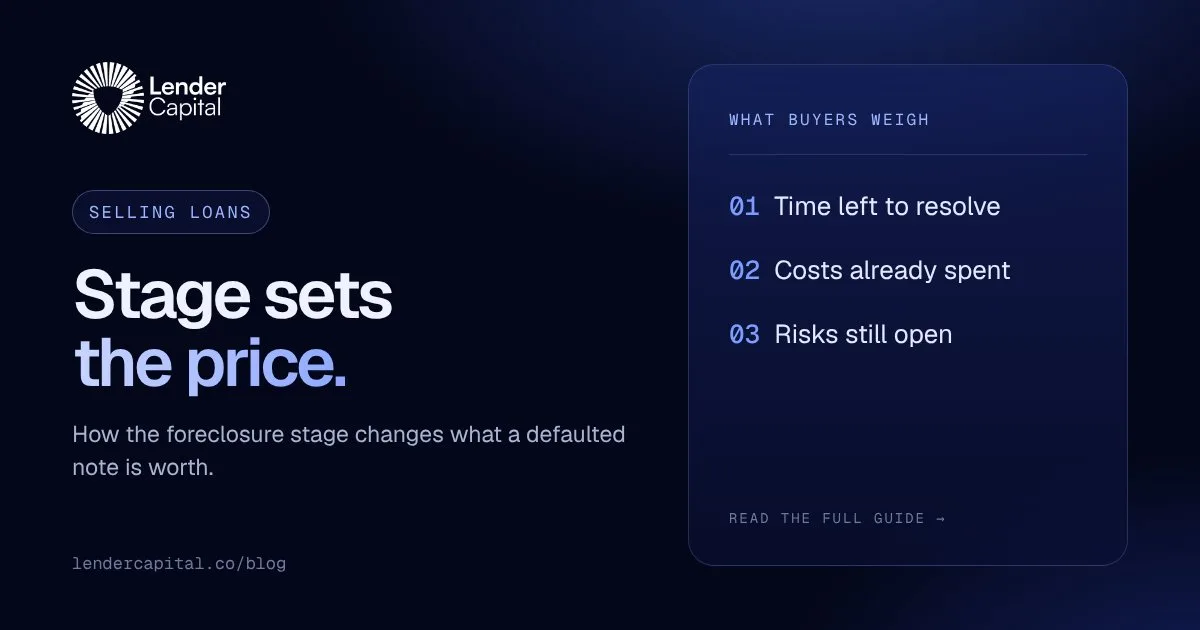
The foreclosure stage changes a defaulted note's price because it sets how much time, cost and risk are still ahead of the buyer. A loan with a foreclosure sale date set has less time and cost left than a loan that just went 60 days late, so, with everything else equal, buyers can usually pay more for it; a bankruptcy filing, a contested case or a long judicial timeline adds time and lowers the price. The early stages keep more ways out (reinstatement, modification, payoff), which buyers also value.
This guide walks through each stage, what it means for a buyer's model, and how sellers can show the stage clearly. It is for lenders, banks, credit unions and funds selling first-lien, business-purpose loans, and for the note buyers bidding on them. It is general information, not legal advice: procedures differ by state, so ask counsel. For the sale itself, see sell your loans and selling non-performing notes.
How does the foreclosure stage affect note pricing?
Buyers value a defaulted note on the recovery it can produce, discounted for time. The stage tells them how much of the timeline and legal cost is already behind the loan, which exits are still open, and what risks remain, such as a bankruptcy or a contested case. Less time and cost left usually means a higher price, all else equal.
The buyer's model in one line
A buyer estimates what each exit would recover (payoff, modification, deed in lieu, foreclosure sale, taking the property as REO), subtracts the costs, discounts each for the time it takes at its target return, and weights the exits by how likely they are. The full method, with a worked example, is in how non-performing loans are priced.
The stage moves three inputs: time remaining, costs remaining and which exits are still possible.
Stage by stage
| Stage | What has happened | Time and cost ahead | Exits still open | Main risks |
|---|---|---|---|---|
| Early delinquency (30–90 days) | Missed payments; maybe a demand letter | Most of the timeline | Reinstatement, modification, payoff, deed in lieu, foreclosure | Borrower stalls; value slips |
| Notice of default / acceleration | Formal default, loan called | Most of it, clock started | Same, plus pressure to resolve | Notice defects must be fixed |
| Foreclosure filed or noticed | Case filed (judicial) or sale noticed (non-judicial) | Less; legal costs partly spent | Payoff, deed in lieu, sale | Contested case, service delays |
| Judgment or sale date set | Court judgment or trustee sale scheduled | Least | Payoff before sale, or sale | Postponements, redemption rights |
| Bankruptcy filed | Automatic stay in place | Added time, often uncertain | Plan payments, relief from stay | Long delay, plan treatment |
| REO (lender owns the property) | Foreclosure done | Sale or rental of the property | Sell or hold the property | Condition, market, holding costs |
Early delinquency
The borrower has missed payments but no formal process has started. Buyers like the options: many early defaults resolve without a foreclosure. But if the loan does go the distance, the whole timeline is still ahead. Buyers price a blend: a share of reinstatement or payoff, and a share of the full foreclosure path.
Notice of default and acceleration
A notice of default or demand, and acceleration of the debt, start the formal clock. Buyers check that the notices were sent as the loan documents and state law require: a defective notice may have to be redone, which resets time.
Foreclosure filed or noticed
In a judicial foreclosure state the lender files a case in court; in a non-judicial state, a trustee sells the property under the power of sale in the deed of trust after the required notices. Either way, part of the legal cost is spent and part of the time has passed. Buyers ask counsel's view of what is left and whether the borrower has answered or raised defenses.
Judgment or sale date set
The least time is left, and the outcome is close. Buyers check the sale date against their own settlement timeline: a sale scheduled days after settlement needs counsel ready to substitute the buyer in and possibly postpone. Some states give the borrower a right of redemption after the sale, which adds time before the new owner has clear control.
Bankruptcy
A bankruptcy filing triggers the automatic stay, which stops most collection and foreclosure until the court lifts it or the case ends. Buyers price the added time and the chance that a plan changes how the debt is paid. A loan in bankruptcy can still be sold; the buyer steps into the seller's position in the case.
REO
Once the lender owns the property (real estate owned), there is no note left to sell: what's for sale is the property itself. Some sellers decide to sell the note before this point to avoid owning, insuring and repairing a property. See foreclose or sell the note.
A worked example
Hypothetical, for illustration only. Two defaulted bridge loans each have a $400,000 balance and an as-is value of about $520,000, with no unpaid taxes. A buyer uses a 15% target return.
- Loan A is 75 days late, no notices sent, in a judicial state. The buyer's model gives a 40% chance the borrower pays off or sells within six months, and a 60% chance of a full foreclosure taking about 20 months more, with most legal costs still ahead.
- Loan B is in the same state with a foreclosure judgment entered and a sale date in six weeks. Most legal costs are spent; the buyer models the sale or a last-minute payoff within about three months.
On the same value and balance, Loan B's recovery arrives much sooner and with less cost ahead, so the buyer's present value, and its bid, is higher for Loan B. If Loan B's borrower filed bankruptcy the day before the sale, the model would add time, and the bid would drop.
What sellers should show for each stage
- The stage, with dates: default, each notice, filing, judgment, sale date.
- Counsel or trustee contact, and a short status note from counsel.
- Legal costs already paid, and whether they are added to the debt.
- Any bankruptcy: chapter, filing date and case number.
- Any borrower defenses, counterclaims or settlement talks.
Put these on the data tape and in the file. A buyer who has to guess the stage assumes the slower path.
Selling during an active foreclosure
You can usually sell a loan mid-foreclosure: the buyer is substituted into the case or the trustee sale after settlement. Keep the case moving and the deadlines covered until then, and agree in the purchase agreement who pays legal costs up to and after settlement. See selling a loan in foreclosure.
Key takeaways
- Buyers price the time, cost and risk still ahead, which the stage largely sets.
- Later stages have less time and cost left; earlier ones keep more exits open.
- Bankruptcy and contested cases add time and lower prices.
- Defective notices can reset the clock, so buyers check them.
- Sellers should show the stage with dates, counsel's status and costs spent.
Frequently asked questions
Something else? info@lendercapital.co
Often, all else equal, because less time and legal cost remain before the recovery. But fewer exits are left, a sale date can be postponed, and some states allow redemption after the sale, so buyers still model the remaining risks.
Usually yes. The buyer takes over the seller's position in the bankruptcy case, subject to the automatic stay and any plan. Buyers price the added time and uncertainty, and counsel handles the transfer of the claim.
A non-performing note is a defaulted loan the lender still holds; the borrower still owns the property. REO is property the lender owns after foreclosure or a deed in lieu. Selling a note transfers the loan; selling REO transfers the property.
How Lender Capital fits
Lender Capital is a business-to-business platform where lenders, banks, credit unions and funds sell whole, first-lien, business-purpose loans, at any stage of default. A non-performing loan is sold as is, with the default and its stage disclosed in full, only to capital partners that opt in to buying non-performing loans and whose criteria it fits. Buyers review the full file before committing, and each sale settles through an escrow agent. Lender Capital never buys loans with its own money, and the buyer pays the sale fee, only if the sale closes.
Selling a loan? Apply as a lender. Buying notes? Apply as a capital partner.
Have a loan you can’t fund?
Lender Capital places whole, first-lien loans with capital partners who fund the entire loan. You pay only when it funds.