Can You Sell a Loan That Is Already in Foreclosure?
Yes, a lender can sell a loan in foreclosure. How it works: what buyers price, substituting the plaintiff or trustee, disclosure, timing and the documents to have ready.
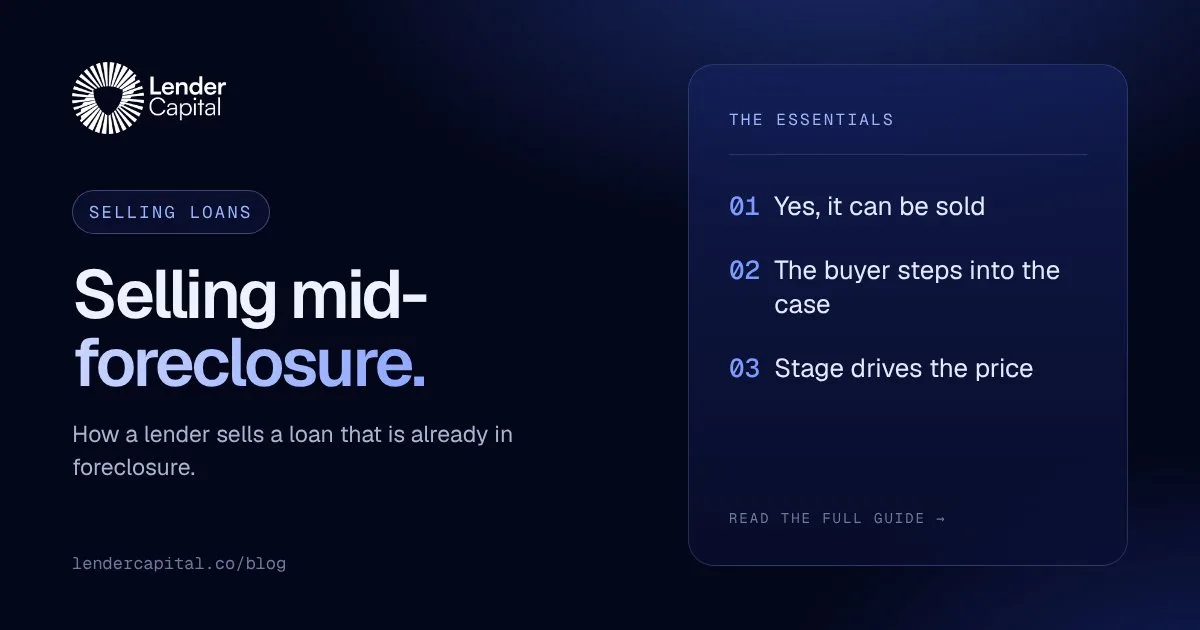
Yes. A lender can sell a loan that is already in foreclosure, and on Lender Capital such a loan is sold whole and as is, with the foreclosure disclosed, only to capital partners that buy non-performing loans. The buyer takes the note and the mortgage or deed of trust and steps into the foreclosure: it is substituted as plaintiff in a judicial case, or takes the assignment and can substitute the trustee in a non-judicial one. Price follows the recovery and how far the foreclosure has to go.
This guide explains why lenders sell mid-foreclosure, how the sale works in judicial and trustee-sale states, how buyers price it and what the seller must have ready. It is for lenders, banks, credit unions and funds holding first-lien, business-purpose real estate loans. It is general information, not legal advice: have foreclosure counsel in the property's state review any sale. To list a loan, start at sell your loans.
Can you sell a loan that is already in foreclosure?
Yes. A loan in foreclosure is still a loan: the note and the security instrument can be sold and assigned, and the buyer continues the foreclosure or resolves the loan another way. Buyers of non-performing loans buy them regularly and price them on the expected recovery. The seller discloses the foreclosure status, delivers a clean chain of title and cooperates in substituting the buyer.
Why lenders sell a loan in foreclosure
- Cash now instead of later. Foreclosure can take months or years, depending on the state, and every month costs legal fees, taxes, insurance and the lender's time.
- No REO to manage. If the lender completes the foreclosure, it may own the property and then has to secure, repair and sell it. Selling the loan hands that work to a buyer set up for it.
- Capital and focus. A small lender's capital and staff are better spent on new loans than on one long case. See selling non-performing notes for how that sale works.
- Fund timelines. A fund nearing the end of its term may not be able to wait for the case to finish.
How the sale works, judicial vs trustee-sale states
The sale of the loan is the same everywhere: the note is endorsed or an allonge is signed to the buyer, the mortgage or deed of trust is assigned and recorded, and the servicing file goes with it. What differs is how the buyer takes over the foreclosure.
| Judicial foreclosure (court case) | Non-judicial foreclosure (trustee sale) | |
|---|---|---|
| How it runs | The lender sues; a court enters judgment and orders a sale | A trustee named in the deed of trust follows the statutory notice steps and holds the sale |
| How the buyer steps in | Usually a motion to substitute the buyer as plaintiff, under the court's rules (the federal analog is FRCP 25(c)) | Record the assignment of the deed of trust; the new beneficiary can substitute the trustee if it wants its own |
| Timing risk | Court calendars; contested cases take longer | Notice periods are set by statute; a postponement may be needed while documents are recorded |
| What the buyer checks | The docket, the complaint, any answer or defenses, judgment status | Every notice recorded and mailed, the sale date, the trustee's file |
Whether the case can continue without a pause, or whether notices must be re-sent after the transfer, depends on the state and the stage. That is a question for the buyer's and seller's counsel before the sale closes, not after.
How buyers price a loan in foreclosure
Buyers price a loan in foreclosure as a recovery, the same way they price any non-performing loan: the property's as-is value, less senior taxes and liens, less the legal, holding and sale costs still to come, discounted for the time left.
The stage of the foreclosure is the biggest swing factor because it sets the time left:
| Stage | What it means for the buyer |
|---|---|
| Default, no notice yet | The whole process is ahead; widest range of outcomes, including a cure or deed in lieu |
| Notice of default sent or recorded | The clock has started; notice periods are under way |
| Case filed (judicial) | Legal costs are partly spent; time to judgment depends on the court and any defenses |
| Judgment entered or sale scheduled | Closest to cash; the buyer checks the sale can go ahead after the transfer |
| Borrower in bankruptcy | Enforcement is paused by the automatic stay; the timeline stretches and relief from stay may be needed |
Hypothetical example. Two $500,000 first-lien loans each sit on a property worth about $650,000 as is. One is in a non-judicial state with a trustee sale scheduled; the other is in a judicial state where the case was filed last month and the borrower has answered. The first buyer expects cash much sooner and with fewer costs left, so it can bid more for the same collateral.
If the property has already gone to sale and the lender owns it, it is no longer a loan but real estate owned (REO). Lender Capital handles loans only; REO is sold as real estate, not through the platform.
What the seller should have ready
- The original note, endorsed or with an allonge, and every prior allonge in the chain.
- The recorded mortgage or deed of trust and every recorded assignment; a gap in the chain will stall the substitution.
- The title policy and a current title search showing taxes and any junior or senior liens.
- The full pay string, the default and acceleration letters, and every recorded or mailed notice.
- For a judicial case: the complaint, docket, any answer or counterclaim, and counsel's status summary.
- For a trustee sale: the trustee's file, the notice of sale and the scheduled date.
- Any bankruptcy filing, forbearance, workout offer or settlement talks.
- A recent value, such as a broker price opinion, and the property's occupancy and condition.
- Foreclosure counsel's contact details and invoices to date.
Steps to sell a loan in foreclosure
- Talk to foreclosure counsel about how a transfer affects the case or sale in that state, and whether a postponement or substitution is needed.
- Assemble and check the file. Confirm the chain of title to the note and the security instrument is complete.
- Set an asking price on the recovery, not the balance. A par ask on a loan in foreclosure rarely trades.
- Disclose the foreclosure in full. Stage, dates, defenses, bankruptcy and costs. Buyers find these in diligence anyway.
- Sell to a buyer that buys loans in foreclosure. Through Lender Capital, choose "Sell a loan I already funded", upload the file and confirm the disclosure; a non-performing loan goes only to capital partners that have opted in.
- Close and hand over. The sale settles through an escrow agent; the allonge and assignment are delivered and recorded, counsel files the substitution or the buyer substitutes the trustee, and servicing moves to the buyer's servicer.
Key takeaways
- A loan in foreclosure can be sold; the buyer steps into the foreclosure as the new owner of the note and security instrument.
- In a judicial state the buyer is usually substituted as plaintiff; in a trustee-sale state the deed of trust is assigned and the trustee can be substituted.
- The foreclosure stage drives the price because it sets how long until cash and what costs are left.
- A complete chain of title and full disclosure are what make the sale close.
- Once the property is REO, it is real estate, not a loan.
Frequently asked questions
Something else? info@lendercapital.co
Not necessarily. In many judicial cases the buyer is substituted as plaintiff and the case continues; in trustee-sale states the assignment is recorded and the sale can proceed, sometimes after a postponement. Whether notices must be re-sent depends on the state and stage, so ask foreclosure counsel before closing.
Buyers of non-performing loans: credit funds, family offices and private investors that work out or foreclose on loans as part of their strategy. On Lender Capital, these are capital partners that have opted in to non-performing loans and whose criteria the loan fits.
Usually yes, but the automatic stay pauses enforcement, so the buyer prices in a longer, less certain timeline and may need relief from stay to continue. Disclose the filing and the case number, and have counsel confirm any steps needed to transfer the claim.
How Lender Capital fits
Lender Capital is a business-to-business platform where lenders, banks, credit unions and funds sell whole, first-lien, business-purpose loans, performing or not. A loan in foreclosure is a non-performing loan: it is sold as is, with the foreclosure disclosed in full, only to capital partners that buy non-performing loans and whose criteria it fits. They review the full file before committing, you choose who to sell to and agree the price, and the sale settles through an escrow agent. Lender Capital never buys loans with its own money, doesn't sell REO and doesn't publish prices. The buyer pays the sale fee, only if the sale closes.
Selling a loan? Apply as a lender. Buying notes? Apply as a capital partner.
Have a loan you can’t fund?
Lender Capital places whole, first-lien loans with capital partners who fund the entire loan. You pay only when it funds.