How to Sell a Commercial Real Estate Note: A Lender's Guide
How lenders and banks sell a commercial or mixed-use real estate note: who buys them, what buyers check that differs from residential, the file to prepare and how the sale closes.
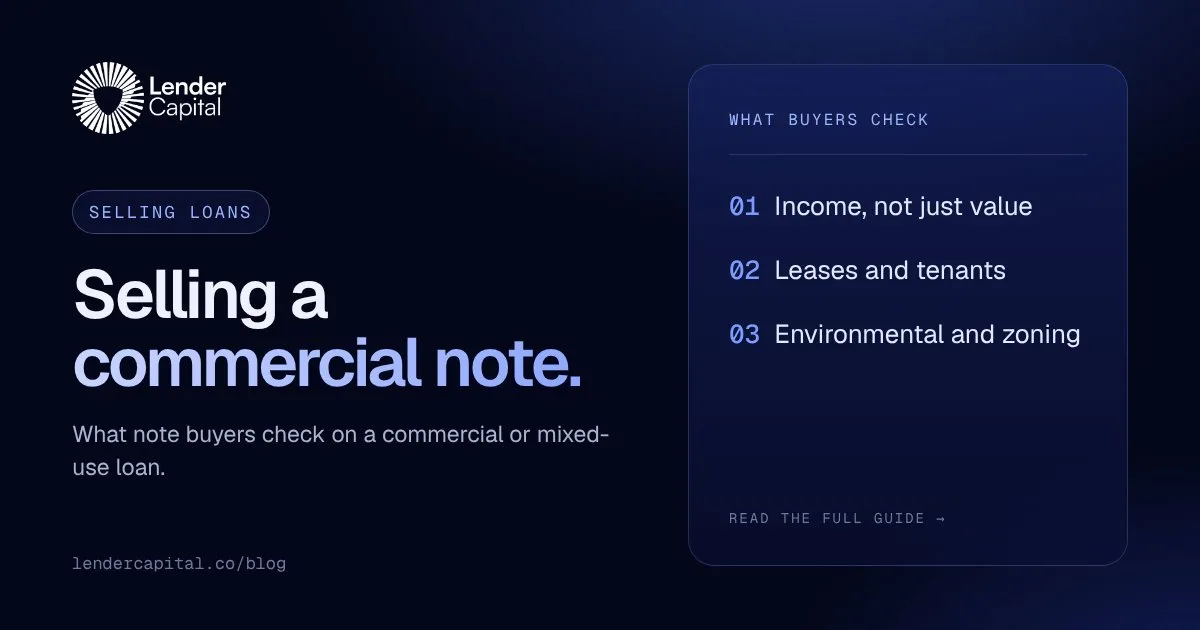
Commercial real estate notes are bought by credit funds, family offices, debt funds and specialist note buyers, and Lender Capital lets a lender, bank, credit union or fund sell one whole: you list the first-lien loan, it goes to capital partners whose criteria it fits, and the sale settles through an escrow agent. Buyers of commercial and mixed-use loans price the property's income and leases, not just its value, so a complete income and lease file is what gets a firm bid.
This guide is for lenders selling first-lien, business-purpose loans secured by small commercial or mixed-use property: a retail strip, a small office or industrial building, a mixed-use building with shops below and apartments above, or a 5+ unit multifamily building. It covers who buys these notes, what buyers check that they would not check on a single-family loan, the file to prepare and how the sale works. Numbers are hypothetical examples. It is general information, not legal advice. To list a loan, go to sell your loans.
Who buys commercial real estate notes from lenders?
Commercial real estate notes are bought by private credit funds, family offices, debt funds, regional banks and note investors that know commercial property. Each buyer has a buy box: property types, states, loan size, lien position and payment status it will take. On Lender Capital they are capital partners: each sets its own criteria, sees only loans that fit, reviews the full file and buys the whole loan through an escrow agent.
Lender Capital is the platform only; it never buys loans with its own money. It handles first-lien, business-purpose loans originated by lenders, sold as whole loans. It does not handle participations, junior liens, seller-financed or carry-back notes from individuals, or land contracts.
How a commercial note sale differs from a residential one
On a loan secured by a rented single-family home, a buyer mostly asks two questions: what is the house worth, and has the borrower paid? On a commercial or mixed-use loan, the property's value comes largely from its income, and that income depends on leases, tenants and how the building is allowed to be used. That adds work to the buyer's review.
| What the buyer checks | 1-4 unit residential loan | Commercial or mixed-use loan |
|---|---|---|
| Value | Comparable sales, BPO or appraisal | Income approach (net operating income and a cap rate) plus comparables |
| Income | Often one lease or none | Rent roll, every lease, operating statements |
| Tenants | Usually individuals | Business tenants; their strength and lease terms matter |
| Lease rollover | Rarely a factor | When leases expire and whether tenants can leave early |
| Environmental | Rarely reviewed | Phase I environmental site assessment often expected |
| Zoning and use | Rarely reviewed | Whether the current use is legal and can be rebuilt after a loss |
| Exit | Sale to an owner-occupant or investor | Smaller pool of buyers; longer marketing time |
None of this makes commercial notes harder to sell. It means a seller who gathers this material before listing saves the buyer weeks, and buyers reward that with firmer bids.
What commercial note buyers check
Income and the rent roll
Buyers start with a current rent roll: every unit or suite, the tenant, the monthly rent, the lease start and end dates, any security deposit and anything owed. They compare it with the leases and with the borrower's operating statements (income and expenses for the last one to two years, and year to date). They will work out the property's net operating income and the debt service coverage ratio, because that tells them whether the property pays the loan from its own income.
Leases and tenants
For a building with a handful of tenants, each lease matters. Buyers read for the rent and its increases, the term and renewal options, early termination rights, who pays taxes, insurance and maintenance, and whether the lease is subordinate to the mortgage. If the loan file has tenant estoppel certificates (each tenant confirming its lease terms and that the landlord is not in default) or subordination, non-disturbance and attornment agreements, include them. A building where one tenant pays most of the rent and its lease ends soon is a very different risk from one with staggered leases.
Value
Commercial property is valued mainly on its income: net operating income divided by a capitalization rate, cross-checked against comparable sales. Buyers will want the original appraisal and a more recent value if the loan has seasoned or the market has moved. For regulated lenders, the federal Interagency Appraisal and Evaluation Guidelines describe what an appraisal or evaluation for a real estate loan should support; buyers read the appraisal in the file with the same questions in mind.
Environmental
A contaminated site can be hard to sell or refinance, and a lender that takes title in foreclosure can inherit cleanup questions. That is why commercial loans often carry a Phase I environmental site assessment. The U.S. EPA's All Appropriate Inquiries rule (40 CFR Part 312) sets the standard such assessments are built around. If the loan file has a Phase I, include it and any follow-up; if it does not, say so. A buyer would rather know up front.
Zoning, use and title
Buyers check that the property's current use is permitted and, for older buildings, whether it is a legal non-conforming use that might not be rebuilt after a casualty. They check the lender's title policy and any endorsements; the American Land Title Association publishes the standard policy forms and endorsements, including zoning endorsements commonly used on commercial loans. They also check insurance: property, liability and, where relevant, flood and business interruption.
The borrower and guarantor
As with any business-purpose loan, buyers review the borrowing entity's documents, any personal guaranty, and the borrower's payment history. On a commercial loan they also look at how the borrower manages the property: an owner who keeps the building leased is worth more to a buyer than the same building half empty.
The file to prepare before you list
- Loan documents: the note and any allonges, the recorded mortgage or deed of trust and assignments, any assignment of leases and rents, the guaranty and any modifications.
- Title and insurance: the lender's title policy and endorsements, the survey if there is one, and current insurance certificates.
- Income: the current rent roll, every lease and amendment, estoppels and subordination agreements if any, and operating statements.
- Value: the original appraisal and any more recent value.
- Environmental and zoning: the Phase I and any follow-up, and any zoning letter or report.
- Payment history: the full pay string, paid-to date, escrow and reserve balances.
- The tape row: balance, rate, maturity, property type, occupancy and DSCR; the free loan tape template has the fields.
Before you send anything, check what you may share: leases and tenant information can carry confidentiality terms, and borrower information must be handled under your own policies.
How the sale works on Lender Capital
- List the loan. Choose "Sell a loan I already funded", upload the file and set an asking price. It costs the seller nothing to list.
- Matching. The loan goes to every capital partner whose criteria it fits: property type, state, size, lien and payment status.
- Review and commitment. Partners review the full file. One commits; you agree the final price.
- Settlement through escrow. The buyer's funds and the loan documents move through an escrow agent; the note is endorsed or an allonge signed, and the mortgage and assignment of leases and rents are assigned. See how a whole loan sale through escrow works.
- Servicing. You choose servicing released or retained. If you keep servicing, you keep the relationship with the borrower; if you release it, tenants and the borrower are told where payments now go. See servicing transfer after a note sale.
The buyer pays Lender Capital's fee, and only if the sale closes. A performing loan is sold with its history; a sub-performing or non-performing commercial loan is sold as is, with the default disclosed, only to capital partners that opt in to those loans (see sell non-performing notes).
Hypothetical example. A lender holds a $1.1 million first-lien loan on a two-story mixed-use building: three shops on the ground floor and six apartments above. The loan pays on time. One shop lease, about a third of the commercial rent, ends in eight months. The lender lists the loan with the rent roll, all nine leases, two years of operating statements, the appraisal, a Phase I with no recognized environmental conditions and a zoning letter. A buyer reviewing it can price the lease rollover directly instead of assuming the worst, and commits after a short review. Without the leases and the Phase I, the same buyer would likely ask for more time or bid lower.
Key takeaways
- Commercial and mixed-use real estate notes are bought by credit funds, family offices, debt funds, banks and specialist note buyers.
- Buyers price the income: rent roll, leases, tenants, lease rollover and DSCR, not just the property's value.
- Environmental (a Phase I), zoning and title endorsements matter far more than on residential loans.
- A seller who assembles leases, operating statements, the appraisal, the Phase I and the pay history before listing gets firmer bids and faster closings.
- On Lender Capital, first-lien, business-purpose commercial loans are sold whole to capital partners through an escrow agent; the buyer pays the fee, only if the sale closes.
Frequently asked questions
Something else? info@lendercapital.co
Private credit funds, family offices, debt funds, regional banks and note investors that specialize in commercial property. Each has its own buy box by property type, state, size and payment status. On Lender Capital, capital partners whose criteria fit a commercial loan review the full file and one buys it whole through an escrow agent.
The loan documents and title policy, the rent roll and every lease, recent operating statements, the appraisal or a newer value, a Phase I environmental report if one exists, zoning information, insurance and the full payment history. The more complete the file, the shorter the buyer's review.
Yes. A bank, credit union or fund can sell one first-lien commercial loan on its own. On Lender Capital loans are sold one by one as whole loans. See how banks and credit unions sell problem loans for the institution's side of the decision.
How Lender Capital fits
Lender Capital is a business-to-business platform where lenders, banks, credit unions and funds sell whole, first-lien, business-purpose loans to note buyers, including loans on small commercial, mixed-use and multifamily property: performing, sub-performing, re-performing or non-performing. Each loan goes to the capital partners whose criteria it fits, each reviews the full file before committing, and the sale settles through an escrow agent. Lender Capital never buys loans with its own money. For how buyers think about a sale, see note buyers for private lenders and how to choose a whole loan buyer.
Selling a loan? Apply as a lender. Buying commercial notes? Apply as a capital partner.
Have a loan you can’t fund?
Lender Capital places whole, first-lien loans with capital partners who fund the entire loan. You pay only when it funds.