How to Sell a Re-Performing Loan: Seasoning, Pay History, Price
How a lender sells a re-performing loan: what buyers check, why seasoning and the pay string drive price, what to disclose, and where to sell it whole.
Lender Capital is a platform where a lender can sell a re-performing loan whole to a capital partner: you submit the loan with its full payment history, the delinquency is disclosed, and partners whose criteria it fits review the file before committing. Buyers price a re-performing loan on how long it has paid since the cure, what the pay string shows and what caused the default, so a complete, honest file sells best.
This guide explains what a re-performing loan is, how buyers look at one, what moves the price and how to sell one. It is written for private and hard money lenders, banks, credit unions and funds holding first-lien, business-purpose real estate loans. Every number is a hypothetical example. To list a loan, start at sell your loans.
Where can a lender sell a re-performing loan?
A lender can sell a re-performing loan to note buyers that buy loans with a past delinquency: credit funds, family offices and private investors. Through Lender Capital, it is submitted as a whole, first-lien, business-purpose loan with its history disclosed, matched to capital partners whose criteria it fits, and sold through an escrow agent. Large pools also trade through loan sale advisors.
What is a re-performing loan?
A re-performing loan is a loan that was delinquent or in default and is now current again, because the borrower caught up the arrears, signed a forbearance or modification and is keeping to it, or both. It sits between a performing note, which has never been seriously late, and a non-performing note, which is in default today.
The label matters because buyers price risk from history. A borrower who missed three payments and then paid twelve on time is a different credit from one who caught up last month. Both are "current", but only one has proved it.
On Lender Capital, a loan whose payment history shows any payment more than 29 days late is sold as a sub-performing note with the history disclosed, even if it is current at settlement. A re-performing loan therefore sells as is for its disclosed history. For the full rules, see sell non-performing notes.
What buyers check on a re-performing loan
| Check | What the buyer wants to know | What to provide |
|---|---|---|
| Seasoning since the cure | How many on-time payments since the loan became current | The full pay string, month by month |
| Cause of the delinquency | Was it a one-off (a delayed sale, a contractor dispute) or a sign of a weak project? | Servicing notes and your explanation |
| How it was cured | Paid in full, a forbearance, a modification, a maturity extension | The signed agreement and any borrower acknowledgment |
| Current terms | Rate, maturity, any capitalized interest or fees | An updated data tape row and the amendment |
| Collateral today | Is the property finished, leased or listed? Has value held? | A recent valuation or broker price opinion |
| Exit | How will the loan be repaid at maturity? | Sale or refinance plan, listing or lender letter if you have one |
Seasoning
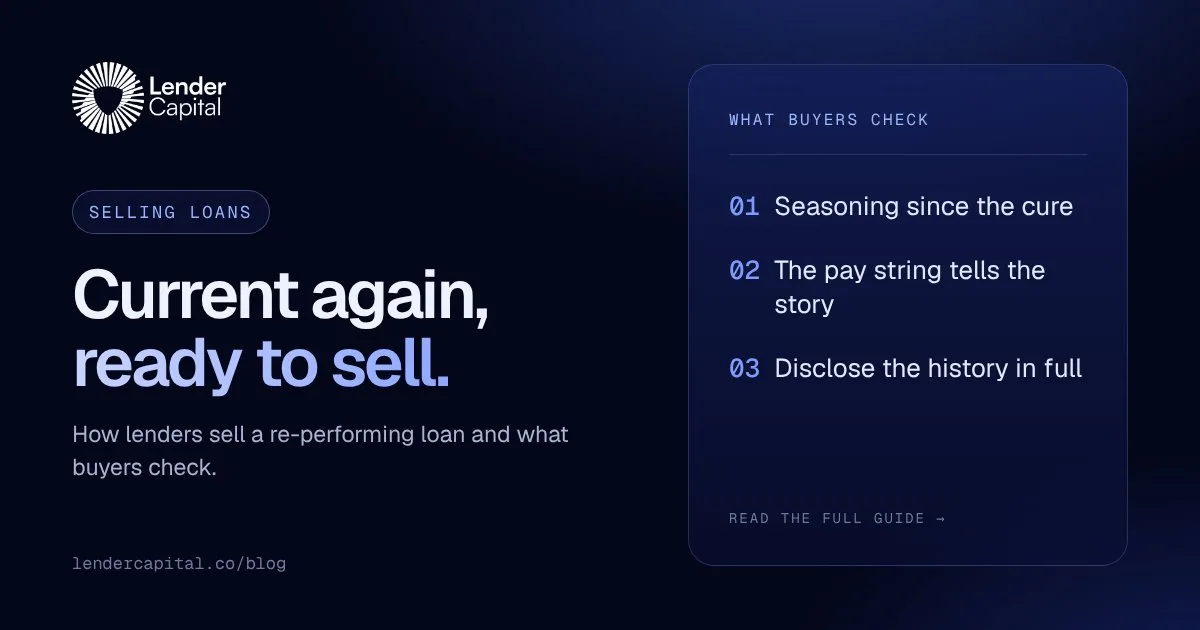
Seasoning is the run of on-time payments since the cure. A buyer generally gives more credit to a longer run, and less to a cure that came from a single catch-up payment. There is no universal cutoff: each buyer sets its own. If the borrower has paid on time for a while, show it clearly.
The pay string
A pay string summarizes each month as current or 30, 60, 90 days late. Buyers read it to see the pattern: one bad stretch followed by clean months reads very differently from repeated slips. Give the actual history from your servicing system, not a summary.
How the loan was cured
A modification or forbearance changes the deal the buyer is buying. If interest was capitalized, the maturity extended or the rate changed, the buyer needs the signed agreement and the new terms. On short-term bridge and fix and flip loans, the most common cure is an extension, and buyers will look at whether the borrower can actually exit by the new date.
How re-performing loans are priced
A re-performing loan generally prices between a performing loan and a non-performing one. The buyer models two things at once: the income stream if the borrower keeps paying, as on any performing loan, and a fallback recovery if it defaults again, as on a non-performing loan. The weight it puts on the second case is what sets the discount.
Hypothetical example. A $400,000 first-lien bridge loan on a finished single-family rental fell three months behind during a delayed refinance. The borrower signed a forbearance, caught up and has paid on time for nine months. The property's current value supports roughly 60% loan to value. A buyer might see a high chance of a payoff at refinance and a strong collateral fallback, and bid close to the balance. The same loan with two months of seasoning and a 75% loan to value would draw a lower bid, or none, from the same buyer.
What tends to help the price:
- A longer run of on-time payments since the cure.
- Lower loan to value today than at origination.
- A clear exit: the property is finished, leased or listed, or the borrower has a refinance in process.
- A complete file: signed modification or forbearance, current tax and insurance status, clean title.
What tends to hurt it:
- A cure that relied on a single payment, or a forbearance with a large balloon still to come.
- Capitalized interest that pushed the balance up against the value.
- Missing documents in the chain of title: an unsigned allonge or an unrecorded assignment.
How to sell a re-performing loan, step by step
- Pull the full history. Export the pay string from your servicing system, the servicing notes and every default notice, forbearance or modification.
- Update the tape. Current balance, rate, paid-to date, next due date, maturity, any capitalized amounts. Use a standard loan tape layout.
- Refresh the value. A recent broker price opinion or valuation saves the buyer a step and supports your price.
- Write a short explanation. Two or three sentences on what caused the delinquency and how it was resolved. Buyers find the facts in diligence anyway; your account helps them read them.
- Set an asking price. Base it on both cases above. Asking for par on a loan with three months of seasoning usually slows the sale.
- Choose servicing released or retained. Decide whether you want to keep servicing the loan; see servicing released. Many lenders keep the borrower relationship this way.
- Submit and sell. Through Lender Capital, choose "Sell a loan I already funded", upload the file and confirm the disclosure. The sale settles through an escrow agent.
Mistakes that cost sellers money
- Calling it performing. If any payment was more than 29 days late, disclose it. A buyer who finds an undisclosed delinquency stops trusting the rest of the file.
- Selling before the cure has seasoned when there is no pressure to sell. A few more on-time months can move the bid.
- Leaving the modification out. The buyer is buying the modified terms. Without the signed agreement, there is nothing to price.
- Ignoring the exit. On a short-term loan, a buyer asks how it gets repaid. Have the answer ready.
Key takeaways
- A re-performing loan is current again after a delinquency; buyers price its history as well as its status.
- Seasoning since the cure, the pay string, how the loan was cured and today's collateral drive the price.
- Expect a price between a performing and a non-performing loan, depending on how likely a second default looks.
- Disclose the full history; on Lender Capital such a loan is sold as is, with its history disclosed.
- A complete file and a realistic asking price sell faster than a par ask.
Frequently asked questions
Something else? info@lendercapital.co
Credit funds, family offices and private investors that buy whole loans with some past delinquency. On Lender Capital they are capital partners: each sets its own criteria, sees only loans that fit, and reviews the full file, including the disclosed history, before committing.
There is no fixed rule; each buyer sets its own. Generally, the longer the run of on-time payments since the cure, the more credit a buyer gives it. If you don't need to sell now, a few more clean months can improve the bid.
No. It is current today, but its history shows a past delinquency, and buyers price that risk. On Lender Capital a loan with any payment more than 29 days late is sold as a sub-performing loan, as is, with the history disclosed.
How Lender Capital fits
Lender Capital is a business-to-business platform where lenders, banks, credit unions and funds sell whole, first-lien, business-purpose loans, performing or not. A re-performing loan is submitted with its history disclosed, goes only to capital partners whose criteria it fits, and is sold as is; see sell non-performing notes for the disclosure rules. You set the asking price, the sale settles through an escrow agent, and the buyer pays the sale fee, only if the sale closes. Lender Capital never buys loans with its own money and doesn't publish prices.
Selling a loan? Apply as a lender. Buying notes? Apply as a capital partner.
Have a loan you can’t fund?
Lender Capital places whole, first-lien loans with capital partners who fund the entire loan. You pay only when it funds.