Selling a Private Lending Fund's Loans in a Wind-Down
How a private lending or debt fund sells its remaining loans in a wind-down: run-off vs. sale, preparing loans and data, selling performing and defaulted loans, and closing out.
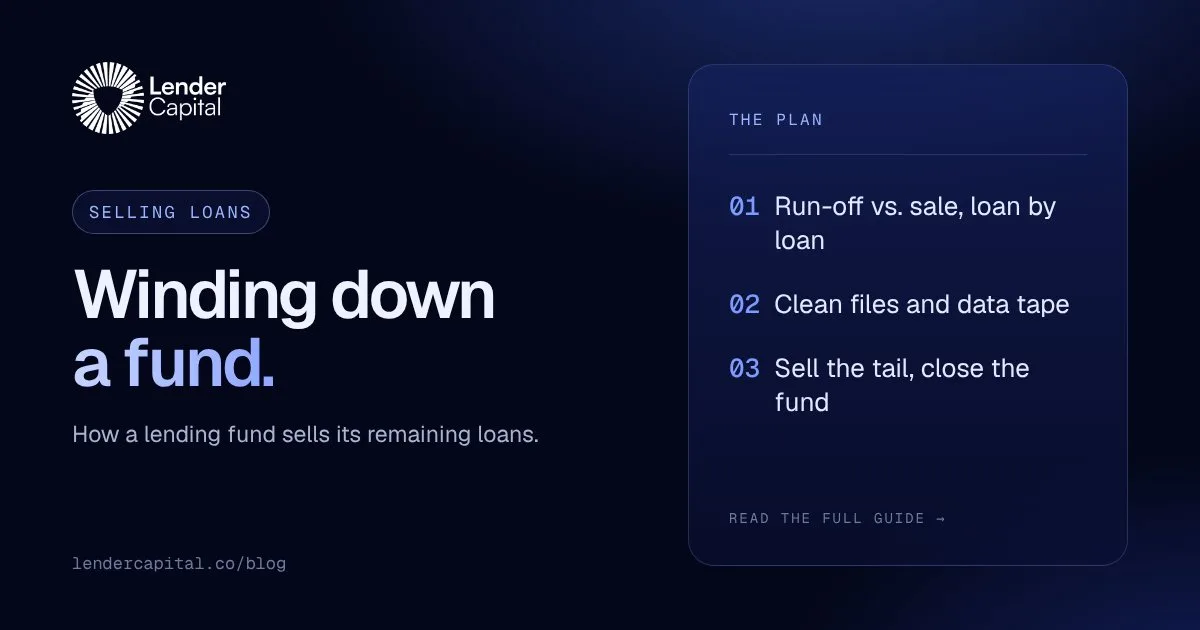
A private lending fund in wind-down turns its loans into cash in two ways: letting them pay off at maturity (run-off) and selling them as whole loans to note buyers. Most funds let short, healthy loans run off and sell the "tail" (long-dated, extended and defaulted loans) so they can distribute cash and close on schedule. The steps are: check what the fund documents allow, sort the loans, prepare files and a data tape, sell loan by loan or in groups, and close out.
This guide is for managers of private lending funds, debt funds and similar vehicles holding first-lien, business-purpose real estate loans. It is general information, not legal, tax or securities advice: the fund's documents, counsel and accountants decide what the manager may do and how. For the sale mechanics, see sell your loans.
How does a lending fund sell its loans when it winds down?
The manager confirms its authority under the fund documents, sorts loans into run-off and sale, prepares complete loan files and a data tape, offers the loans it is selling to qualified buyers as whole loans (performing ones at or near par, defaulted ones as is with the default disclosed), settles each sale through escrow, and distributes the proceeds to investors under the fund documents.
Why funds wind down
- The fund reached the end of its term or investment period.
- Investors voted to stop reinvesting or asked for liquidity.
- The manager is retiring, merging or leaving the business.
- Redemptions in an open-ended fund outran repayments.
Whatever the reason, the goal is the same: return capital fairly, in a reasonable time, without leaving loans stranded.
Run-off vs. sale
| Run-off | Sale | |
|---|---|---|
| How cash comes in | Borrowers pay off at maturity | A buyer pays at settlement |
| Speed | As fast as loans mature (or slower, with extensions) | Weeks per sale |
| Price | Full payoff if the borrower pays | Agreed price; can be a discount |
| Defaulted loans | Fund must work them out or foreclose | Buyer takes the workout |
| Fund stays open | Until the last loan resolves | Can close once the tail is sold |
A common plan: let loans maturing in the next few months run off, and sell the rest.
The steps
1. Confirm authority
Read the operating agreement or limited partnership agreement and offering documents: who can approve a sale, whether investors must consent, rules on selling to related parties, and how proceeds are distributed. Check any credit facility, too: pledged loans need a release before they can be sold. Talk to counsel.
2. Sort the loans
For each loan, note the balance, maturity, payment status, extensions, collateral value and any default. Then sort:
- Run off: performing and maturing soon, with a credible payoff.
- Sell, performing: longer-dated or extended loans that would keep the fund open.
- Sell, defaulted: loans that would need a long workout or foreclosure. See foreclose or sell the note.
3. Prepare files and a data tape
Buyers price what they can see. For every loan you plan to sell: the original note and allonges, recorded lien and assignments, title policy, loan agreement and guaranty, payment history, draw records, insurance and tax status, a current valuation, and the default file if there is one. Build a one-row-per-loan data tape and reconcile it to the files. See the loan tape and how to sell a seasoned hard money loan.
Fix gaps now: a loan bought from another lender may be missing an assignment, and an extension agreed by email may never have been signed. See assignments and allonges.
4. Decide how to sell
- Loan by loan gives each loan to the buyer whose criteria fit it best, and lets you start with the cleanest loans.
- In groups can be simpler with one buyer, but a weak loan can drag down the price of the rest.
Performing loans can sell at or near par, depending on their rate against the yield buyers want; see how loan buyers price bridge and DSCR loans. Defaulted loans sell as is at a discount that reflects the recovery; see how non-performing loans are priced.
5. Settle and move servicing
Each sale settles through an escrow agent: the buyer funds escrow, the fund delivers the endorsed note and assignment, and escrow pays the fund. Move servicing to the buyer or keep it under a servicing agreement, and notify the borrower; see servicing transfer after a note sale.
6. Distribute and close out
Distribute proceeds under the fund documents, report to investors, and complete the final audit, tax filings and dissolution with your accountants and counsel.
Treat investors fairly
- Document how each sale price was set, ideally with more than one bid.
- Avoid conflicts: sales to the manager, its affiliates or an investor need the approvals the fund documents require and extra care on price.
- Communicate: tell investors the plan, the timeline and progress.
A worked example
Hypothetical, for illustration only. A fund holds 22 loans worth $9.6 million and is winding down. Eight loans mature within four months and are performing: the manager lets them run off. Eleven are performing but longer-dated or extended: the manager sells them loan by loan over two months, most near par. Three are in default: one borrower is selling the property and pays off; two are sold as is to buyers of defaulted loans at a discount. The fund distributes as cash comes in and closes within six months instead of waiting two years for the last foreclosure.
Mistakes to avoid
- Starting the sale before confirming authority and releasing pledged loans.
- Listing loans with incomplete files, then losing buyers in diligence.
- Leaving the defaulted loans for last, when they take longest to sell.
- Selling to a related party without the approvals and a documented price.
- Forgetting to tell borrowers where to pay after servicing moves.
Key takeaways
- Wind-downs combine run-off and sales; sell the tail that would keep the fund open.
- Confirm authority under the fund documents and release any pledged loans first.
- Complete files and a reconciled data tape get better bids and faster closings.
- Sell loan by loan to match each loan with the right buyer.
- Document prices and avoid conflicts to treat investors fairly.
Frequently asked questions
Something else? info@lendercapital.co
Usually, if the fund documents allow the manager to sell assets, and most do. Some require investor consent or have rules on related-party sales. Pledged loans need a release from the credit facility first. Check with counsel.
It depends on the number of loans, the quality of the files and the mix of performing and defaulted loans. Clean, performing loans can sell within weeks; defaulted loans and loans with document gaps take longer. Selling loan by loan lets cash come in as each sale closes.
No. Selling loan by loan lets each loan go to the buyer whose criteria fit it best, which can improve price and speed. Some funds sell in groups for simplicity.
How Lender Capital fits
Lender Capital is a business-to-business platform where funds, lenders, banks and credit unions sell whole, first-lien, business-purpose loans loan by loan, performing or non-performing. Capital partners whose criteria fit review the full file before committing, you choose who to sell to and agree the price, and each sale settles through an escrow agent. Lender Capital never buys loans with its own money, and the buyer pays the sale fee, only if the sale closes.
Apply as a lender. It takes a minute.
Have a loan you can’t fund?
Lender Capital places whole, first-lien loans with capital partners who fund the entire loan. You pay only when it funds.