How to Buy Non-Performing Notes From Lenders and Banks
How investors buy non-performing first-lien business-purpose notes from private lenders, banks, credit unions and funds: buy box, sourcing, diligence, pricing, settlement and resolution.
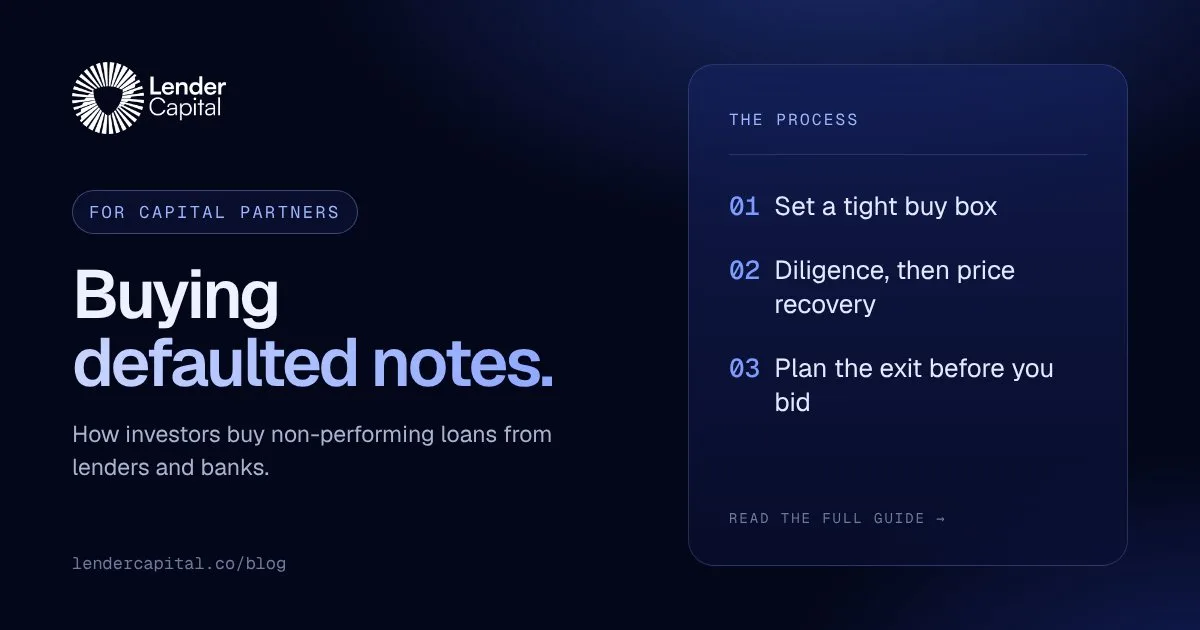
To buy non-performing notes from lenders and banks, set a buy box you can actually work out, find sellers (private lenders, banks, credit unions, funds and loan sale platforms), diligence each loan's ownership, lien, collateral and default file, price the recovery rather than the note rate, plan the exits before you bid, and settle through escrow with servicing moving to you or your servicer. After settlement you own the workout: payoff, modification, deed in lieu or foreclosure.
This guide is for capital partners, credit funds, family offices and other investors buying first-lien, business-purpose real estate loans in default. All lending and note investing involves risk: a defaulted loan can take longer, cost more and recover less than planned. This is general information, not investment or legal advice.
How do you buy non-performing notes?
Define what you buy (lien, loan type, states, size, default stage), source loans from lenders, banks, credit unions, funds and loan sale platforms, review the full file, price each loan on its expected recovery and timeline, agree terms with the seller, and settle through an escrow agent: you fund escrow and receive the endorsed note and recorded assignment. Then resolve the loan.
1. Set your buy box
A tight buy box saves time for you and the sellers. Decide:
- Lien: first lien only is the norm for business-purpose loans; Lender Capital handles first-lien whole loans only.
- Loan and property types: bridge, fix-and-flip, construction, rental, small commercial.
- States: the foreclosure process and timeline vary widely by state; buy where you have counsel and can manage the property. See the overview of judicial foreclosure.
- Size: balance range per loan.
- Default stage: recently defaulted, in foreclosure, sale date set, in bankruptcy.
- Status mix: non-performing only, or also sub-performing and re-performing.
For how capital partners write criteria generally, see building a buy box.
2. Find sellers
- Private and hard money lenders with a defaulted loan they would rather sell than foreclose.
- Community banks and credit unions moving problem loans out of special assets. See how banks and credit unions sell problem loans.
- Funds winding down or rebalancing.
- Public sellers: the FDIC sells loans from failed banks to qualified bidders.
- Loan sale platforms, where loans that fit your criteria come to you.
3. Diligence each loan
Work through ownership and the chain of title, the recorded lien and title policy, senior taxes and liens, the collateral's value and condition, the payment history, the borrower and guarantor, every modification, and the default file: notices, foreclosure stage, counsel's status and any bankruptcy. The full list is in the note buyer due diligence checklist.
4. Price the recovery
A non-performing loan isn't paying, so its value is what you can recover, when, and at what cost: collateral value, minus senior claims, legal and holding costs and sale costs, discounted for the time each exit takes at your target return, and weighted across the likely exits. The method, with a worked example, is in how non-performing loans are priced.
5. Plan the exit before you bid
| Exit | What it takes | Risk to watch |
|---|---|---|
| Reinstatement or payoff | Borrower catches up, refinances or sells | Promises that don't happen |
| Modification or payment plan | A borrower with income or a plan | Re-default |
| Deed in lieu | Borrower cooperation and clean title | Junior liens survive |
| Foreclosure and sale | Counsel, time, holding costs | Long timelines, bankruptcy, property condition |
| Hold or sell as REO | Property management, repairs, a sale | Market value at the end |
Know who will service the loan, who your counsel is in that state, and how you'll protect the property before you commit.
6. Agree terms and settle
- Agree price, diligence period, deposit (if any), settlement date and what's disclosed.
- A defaulted loan is usually sold as is: the seller's promises about the disclosed default are limited, while ownership, lien and document promises still apply. Read the purchase agreement with counsel.
- Settle through an escrow agent: you fund escrow, the seller delivers the endorsed original note, a recordable assignment and the collateral file, and escrow releases the funds. See assignments and allonges and how a whole loan sale through escrow works.
- Board the loan with your servicer and send the borrower notice. See servicing transfer after a note sale.
7. Resolve the loan
Contact the borrower early: many defaulted loans resolve fastest through a conversation. Keep the foreclosure moving in parallel if one is underway, with counsel substituting you into the case. Protect the collateral: taxes, insurance, a vacant property secured.
A worked example
Hypothetical, for illustration only. A buyer's criteria cover first-lien bridge loans in non-judicial states, $150,000 to $750,000, in default. A lender lists a $300,000 loan on a vacant house, 120 days past due, notice of default sent, with a broker price opinion of $380,000 and $6,000 of unpaid taxes. The buyer's diligence finds a clean chain of title and no bankruptcy. It models a foreclosure path and a payoff path, prices the loan from the weighted recovery, and agrees a price with the seller. It settles through escrow, boards the loan with its servicer, and calls the borrower in the first week; the borrower lists the house, and the loan pays off from the sale a few months later.
Mistakes buyers make
- Buying in states where they have no counsel or experience with the timeline.
- Trusting the origination appraisal instead of a current value.
- Missing senior taxes or a borrower bankruptcy.
- Ignoring the chain of title until settlement.
- Pricing only the best-case exit.
Key takeaways
- A tight buy box (lien, state, type, size, default stage) makes sourcing efficient.
- Sellers include private lenders, banks, credit unions, funds and public sellers like the FDIC.
- Diligence ownership, lien, collateral and the default file before pricing.
- Price the recovery and plan every exit before you bid.
- Settle through escrow, then move fast on servicing, the borrower and the collateral.
Frequently asked questions
Something else? info@lendercapital.co
From private and hard money lenders, community banks and credit unions selling problem loans, funds winding down, public sellers such as the FDIC, and loan sale platforms that show buyers loans matching their criteria.
Yes. A defaulted loan can take longer and cost more to resolve than planned, the property can be worth less than expected, and a borrower bankruptcy can pause enforcement. Buyers manage that with diligence, conservative pricing, a tight buy box and experienced counsel, but there is no guaranteed outcome.
It depends on the state, the type of loan and what you do after buying (for example, servicing or modifying the loan). Business-purpose loans are treated differently from consumer loans in many states. Ask counsel in each state where you buy.
How Lender Capital fits
Lender Capital is a business-to-business platform where capital partners buy whole, first-lien, business-purpose loans from lenders, banks, credit unions and funds. Non-performing loans go only to capital partners that opt in to buying them and whose criteria they fit; each is sold as is, with the default disclosed in full, and you review the full file before committing. Sales settle through an escrow agent. Lender Capital never buys loans with its own money and doesn't publish prices. Sellers list loans at sell your loans and non-performing notes; read more on the capital partners page.
Apply as a capital partner. It takes a minute.
See the loans that fit your criteria.
Lender Capital matches whole, first-lien loans to your criteria. You see the full file first, and you pay no fees.