Who Provides Capital to Private and Hard Money Lenders? 6 Sources
Who provides capital to private and hard money lenders? Six sources compared: warehouse lines, table funders, loan buyers, private credit, investors and placement platforms.
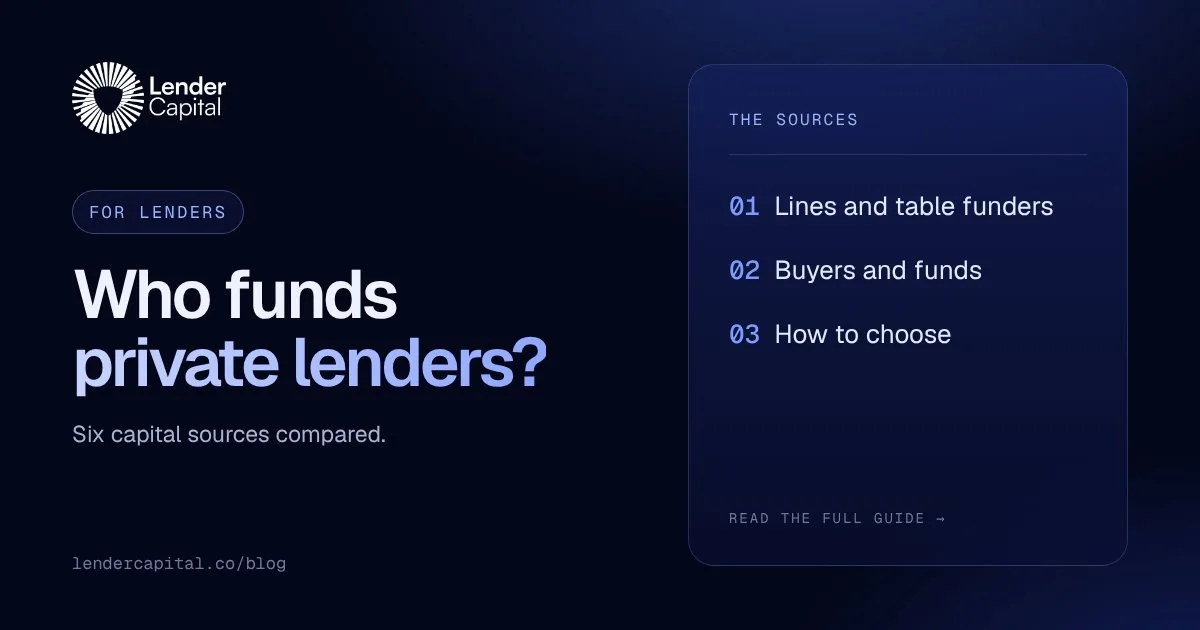
Private and hard money lenders get capital from six main sources: warehouse lines, table funders, loan buyers, private credit funds, private investors, and placement platforms such as Lender Capital, which matches each loan with a capital partner that funds the whole loan at closing. Most growing lenders use more than one, because each source differs on who funds the loan, who holds it, what covenants apply and how much control the lender keeps.
This guide explains each source, what it costs you in control, and how to choose. For a category overview, see capital providers for private lenders.
Key takeaways
- The question is not only who has money, but who funds at closing, who holds the loan afterward, and what you owe if values fall.
- Lines and your own investors keep loans on your books; table funders, buyers and placement platforms move loans to someone else's.
- Newer lenders usually start with their own capital or investors, then add table funding or placement before they qualify for a line.
- Always read current terms on each provider's own site: programs and criteria change.
The six sources
1. Warehouse lines
A bank or non-bank lender gives you a revolving line secured by loans you fund. You close with the advance plus your own equity, then sell or refinance the loan and repay. Strengths: control and the option to hold loans. Costs: covenants, margin calls, fees. See warehouse line of credit for private lenders.
2. Table funders and white-label programs
A provider funds the loan at the closing table and takes the assignment immediately, so none of your money is in the loan. Programs often set the guidelines and pricing. See table funding and white-label lending, and how to compare table funding providers.
3. Loan buyers
You fund the loan yourself, then sell the whole loan to a buyer, often after closing. This frees capital to lend again. See where to find buyers for whole real estate loans and how to sell loans to free up capital.
4. Private credit funds, family offices and institutions
These investors can fund loans, buy loans or lend against a loan book (see note-on-note financing). Expect diligence on your underwriting, servicing and reporting. See how family offices approach real estate private credit.
5. Private investors and your own fund
Individuals fund your loans directly or through a pooled vehicle you run. It is flexible, but raising money investor by investor limits how fast you can grow; securities rules can apply, so involve counsel. See how private lenders fund more loans and how to start a private lending fund.
6. Placement platforms
A platform matches each loan to a capital partner whose criteria it fits. Lender Capital is one: it is not a lender, never funds or buys with its own money, and the capital partner funds the whole loan at closing. The lender keeps servicing, its points (less the placement fee) and a yield spread.
Side-by-side comparison
| Source | Who funds at closing | Who holds the loan | Covenants on you | Control |
|---|---|---|---|---|
| Warehouse line | You, with the line's advance | You, until sold | Yes | High |
| Table funder | The provider | The provider | Program terms | Medium |
| Loan buyer | You | Buyer, after sale | Sale terms | Medium |
| Private credit / institution | Varies | Varies | Often | Varies |
| Private investors | The investors | Them or you, by structure | Per agreement | High |
| Placement platform | One capital partner | The capital partner | None on the platform | Medium |
How to choose
- List what you need: capital before closing, capital recycled after, or both.
- Decide whether you want to hold loans or move them.
- Check which sources you qualify for today (lines often need track record and net worth).
- Compare all-in cost on one sample loan, including fees and what you keep.
- Ask about repurchase, servicing, default handling and what you sign.
Frequently asked questions
Something else? info@lendercapital.co
Warehouse lenders, table funders, loan buyers, private credit funds, family offices, private investors and placement platforms. Each has different terms on who holds the loan and what you must maintain.
Usually your own capital or private investors first, then table funding or capital placement, which don't require the balance sheet and track record that warehouse lines often do.
No. Lender Capital is a platform. Capital partners fund the loans, and it never lends or buys with its own money.
How Lender Capital fits
Lender Capital places each loan with one capital partner that funds the whole loan at closing, and also lets lenders sell whole loans they already funded. Capital partners buy through an escrow agent; whole loans only. Lenders can apply here, and capital partners can apply here.
Have a loan you can’t fund?
Lender Capital places whole, first-lien loans with capital partners who fund the entire loan. You pay only when it funds.