How Long Does a Note Sale Take? The Timeline, Step by Step
How long it takes a lender to sell a mortgage note to an institutional buyer, stage by stage, what slows a sale down, and how sellers shorten the timeline.
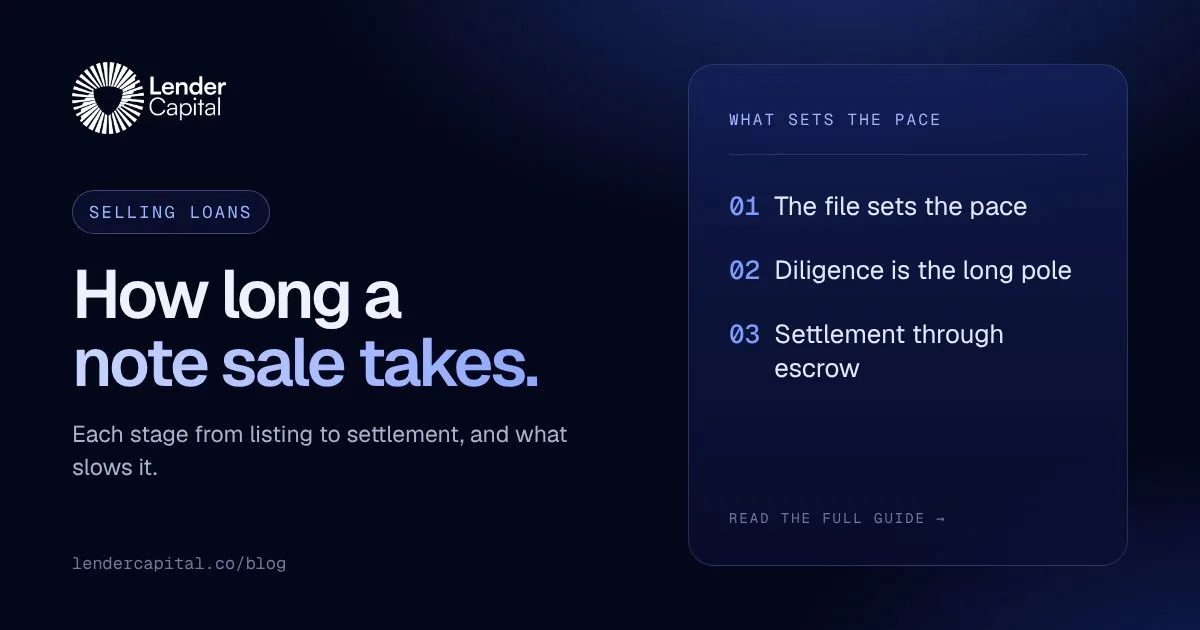
How long a note sale takes depends mostly on the seller's file: a complete file moves through the buyer's diligence and settlement much faster than one with missing documents. On Lender Capital, a lender submits the whole loan once with its file and asking price, capital partners whose criteria it fits review it, one commits, and the sale settles through an escrow agent. Lender Capital doesn't promise a closing date; each buyer sets its own diligence.
This guide breaks a note sale into its stages, explains what drives the time in each, and lists what a seller can do to shorten it. It is for lenders, banks, credit unions and funds selling first-lien, business-purpose real estate loans to institutional buyers such as credit funds and family offices. To list a loan, start at sell your loans.
How long does it take to sell a mortgage note to an institutional buyer?
It varies by loan and buyer, but the stages are always the same: prepare the file, find a buyer, agree a price, let the buyer complete diligence, then settle. A clean performing loan with a complete file is the fastest; a non-performing loan, a loan in foreclosure or a file with gaps takes longer because there is more to verify. Missing documents cause most delays.
The five stages of a note sale
| Stage | What happens | What sets the time |
|---|---|---|
| 1. Prepare the file | The seller gathers the note, allonges, recorded documents, title policy, pay history and a tape | How organized the seller's records are |
| 2. Find a buyer | The loan is shown to buyers whose criteria it fits | Whether buyers for that loan type, state and status are already in place |
| 3. Price and commit | Buyers review the summary and full file and bid; seller and buyer agree a price | How realistic the asking price is; how many buyers look |
| 4. Buyer's diligence | The buyer checks title, collateral, the documents and the borrower | Completeness of the file; third-party reports; any defects found |
| 5. Settle | Trade confirmation, funds to escrow, allonge and assignment signed and delivered, escrow pays out, assignment recorded | Signature turnaround; title endorsement; wire verification |
1. Prepare the file
This is the stage the seller controls completely, and the one that saves the most time later. A buyer needs the original note and every allonge, the recorded mortgage or deed of trust and every assignment, the lender's title policy, the pay string, the loan agreement and guaranty, insurance, and a row in a standard loan tape. The complete private loan file checklist covers the rest.
2. Find a buyer
Finding a buyer can be the slowest part when a lender starts from scratch: building a list, sending NDAs, answering the same questions many times. A platform or an existing buyer relationship shortens it, because buyers have already said what they buy. On Lender Capital, the loan goes only to capital partners whose criteria it fits.
3. Price and commit
Most sales stall here when the asking price is far from what buyers will pay. Understand how buyers price your loan before you list: performing loans are priced on the income stream; non-performing loans on the recovery. A realistic ask gets bids; a par ask on a defaulted loan usually doesn't.
4. Buyer's diligence
This is usually the longest stage. The buyer reviews the documents, confirms the chain of title, orders a title update and often a value such as a broker price opinion, checks taxes and insurance, and reads the servicing history. Every question it has to send back to the seller adds time. Non-performing loans add more checks: the foreclosure status, notices, any bankruptcy. See how to choose a whole loan buyer for what buyers typically ask for.
5. Settle
Settlement through an escrow agent follows a set sequence: both sides approve the trade confirmation, the buyer verifies escrow's wire instructions and funds, the seller signs the allonge and assignment, escrow pays the seller and recording follows. Read how a whole loan sale through escrow works for each step. If servicing moves to the buyer, the borrower is notified of the new servicer.
What slows a note sale down
- A broken chain of title. A missing allonge or unrecorded assignment from an earlier owner has to be fixed before a buyer will close. If the original note is lost, a lost note affidavit and the buyer's acceptance of it are needed.
- An incomplete payment history. Buyers want the actual servicing record, not a summary.
- An unrealistic price. Weeks pass while bids come in below the ask.
- Undisclosed problems. A delinquency, a tax lien or a borrower dispute found in diligence reopens the price or ends the deal.
- Foreclosure or bankruptcy. A loan in an active case needs counsel's input on the transfer; see selling a loan in foreclosure.
- Slow signatures and wires. Line up signers in advance and verify wire instructions by phone.
How to shorten the timeline
- Build the file before you list, using a checklist.
- Check the chain of title yourself: note, allonges, recorded assignments, title policy.
- Export the pay string straight from your servicing system.
- Get a recent valuation if the last one is old.
- Set an asking price based on how buyers price your loan's status.
- Disclose every problem up front.
- Decide servicing released or retained before you list.
- Have signers and your counsel available for settlement week.
Key takeaways
- A note sale has five stages: prepare, find a buyer, price, diligence and settle.
- The buyer's diligence is usually the longest stage, and the file's completeness sets its pace.
- Most delays come from missing documents, unrealistic prices and late disclosures.
- Non-performing loans and loans in foreclosure take longer because there is more to verify.
- A seller who prepares the file first removes most of the waiting.
Frequently asked questions
Something else? info@lendercapital.co
Prepare a complete file before you list, set a realistic asking price, disclose everything and sell to buyers that already buy your type of loan. A platform where buyers have set their criteria in advance cuts the time spent finding one.
Usually because diligence finds something the seller didn't disclose or couldn't document: a gap in the chain of title, a tax lien, a payment history that doesn't match the tape, or a borrower dispute. Checking these yourself first prevents most late failures.
Generally yes. The buyer must also check the default, the foreclosure stage, notices and any bankruptcy, and value the property for a recovery, and fewer buyers buy non-performing loans.
How Lender Capital fits
Lender Capital is a business-to-business platform where lenders, banks, credit unions and funds sell whole, first-lien, business-purpose loans, performing or not. You submit the loan once with its file and asking price; it goes only to capital partners whose criteria it fits, who review the full file before committing; and the sale settles through an escrow agent. Non-performing loans go only to partners that buy them (sell non-performing notes). Lender Capital never buys loans with its own money, doesn't publish prices and doesn't guarantee a closing date. The buyer pays the sale fee, only if the sale closes.
Selling a loan? Apply as a lender. Buying notes? Apply as a capital partner.
Have a loan you can’t fund?
Lender Capital places whole, first-lien loans with capital partners who fund the entire loan. You pay only when it funds.